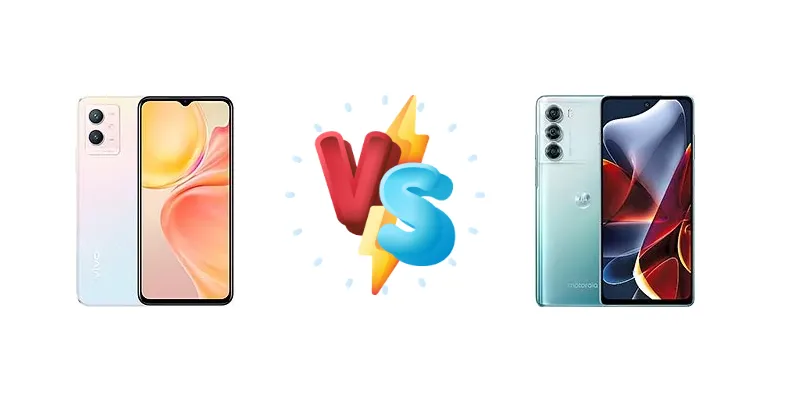
The Motorola Edge S30 and vivo Y52t represent distinct approaches to the mid-range smartphone market. The Edge S30, while an older model, boasts a flagship-tier Snapdragon 888+ chipset, offering raw power. Conversely, the Y52t prioritizes efficiency with a Dimensity 700, aiming for a balance between performance and battery life. This comparison dissects their key differences to help you determine which device best suits your needs.
🏆 Quick Verdict
For users prioritizing raw performance and faster charging, the Motorola Edge S30 is the clear winner. However, the vivo Y52t provides a more efficient daily driver experience and represents better value for those less concerned with demanding tasks, making it ideal for everyday use.
| Network |
|---|
| 2G bands | GSM 850 / 900 / 1800 / 1900 | GSM 850 / 900 / 1800 / 1900 |
| 3G bands | HSDPA 850 / 900 / 2100 | HSDPA 850 / 900 / 1800 / 1900 / 2100 |
| 4G bands | 1, 3, 5, 8, 28, 34, 38, 39, 40, 41 | 1, 2, 3, 4, 5, 7, 8, 12, 17, 34, 38, 39, 40, 41 |
| 5G bands | 1, 5, 8, 28, 41, 77, 78 SA/NSA | 1, 3, 5, 7, 8, 20, 28, 38, 41, 78 SA/NSA/Sub6 |
| Speed | HSPA, LTE, 5G | HSPA 42.2/5.76 Mbps, LTE Cat20 2000/150 Mbps, 5G |
| Technology | GSM / CDMA / HSPA / CDMA2000 / LTE / 5G | GSM / HSPA / LTE / 5G |
| | CDMA2000 1x | - |
| Launch |
|---|
| Announced | 2022, September 18 | 2021, December 12 |
| Status | Available. Released 2022, September 19 | Available. Released 2021, December 21 |
| Body |
|---|
| Build | Glass front, plastic frame, plastic back | Glass front, plastic frame, plastic back |
| Dimensions | 164 x 75.9 x 8.5 mm (6.46 x 2.99 x 0.33 in) | 168.1 x 75.5 x 8.9 mm (6.62 x 2.97 x 0.35 in) |
| SIM | Nano-SIM + Nano-SIM | Nano-SIM + Nano-SIM |
| Weight | 198 g (6.98 oz) | 202 g (7.13 oz) |
| | - | Water-repellent design |
| Display |
|---|
| Resolution | 720 x 1600 pixels, 20:9 ratio (~270 ppi density) | 1080 x 2460 pixels (~395 ppi density) |
| Size | 6.51 inches, 102.3 cm2 (~82.2% screen-to-body ratio) | 6.8 inches, 109.8 cm2 (~86.5% screen-to-body ratio) |
| Type | IPS LCD | LCD, 144Hz, HDR10 |
| Platform |
|---|
| CPU | Octa-core (2x2.2 GHz Cortex-A76 & 6x2.0 GHz Cortex-A55) | Octa-core (1x2.99 GHz Cortex-X1 & 3x2.42 GHz Cortex-A78 & 4x1.80 GHz Cortex-A55) |
| Chipset | Mediatek Dimensity 700 (7 nm) | Qualcomm SM8350 Snapdragon 888+ 5G (5 nm) |
| GPU | Mali-G57 MC2 | Adreno 660 |
| OS | Android 12, OriginOS Ocean | Android 11, MYUI 2.0 |
| Memory |
|---|
| Card slot | microSDXC | No |
| Internal | 128GB 8GB RAM, 256GB 8GB RAM | 128GB 6GB RAM, 128GB 8GB RAM, 256GB 8GB RAM, 256GB 12GB RAM |
| | - | UFS 3.1 |
| Main Camera |
|---|
| Dual | 13 MP, f/2.2, 26mm (wide), PDAF
2 MP (macro) | - |
| Features | LED flash, HDR, panorama | Dual-LED dual-tone flash, HDR, panorama |
| Single | 8 MP, f/2.0, (wide) | - |
| Triple | - | 108 MP, f/1.9, (wide), 1/1.52", 0.7µm, PDAF
13 MP, f/2.2, 120˚ (ultrawide), 1.12µm
Auxiliary lens |
| Video | 1080p@30fps | 4K@30fps, 1080p@30ps, 10-bit HDR10+, gyro-EIS |
| Selfie camera |
|---|
| Features | - | HDR |
| Single | 8 MP, f/2.0, (wide) | 16 MP, f/2.2, (wide), 1.0µm |
| Video | 1080p@30fps | 1080p@30fps |
| Sound |
|---|
| 3.5mm jack | Yes | No |
| 35mm jack | Yes | No |
| Loudspeaker | Yes | Yes |
| Comms |
|---|
| Bluetooth | 5.1, A2DP, LE, aptX HD | 5.2, A2DP, LE, aptX HD, aptX Adaptive |
| NFC | No | No |
| Positioning | GPS, GLONASS, GALILEO, BDS, QZSS | GPS, GLONASS, GALILEO, BDS |
| Radio | No | No |
| USB | USB Type-C, OTG | USB Type-C 3.1 |
| WLAN | Wi-Fi 802.11 a/b/g/n/ac, dual-band, Wi-Fi Direct | Wi-Fi 802.11 a/b/g/n/ac/6e, dual-band, Wi-Fi Direct |
| Features |
|---|
| Sensors | Fingerprint (side-mounted), accelerometer, proximity, compass | Fingerprint (side-mounted), accelerometer, gyro, proximity, compass |
| | - | Ready For support |
| Battery |
|---|
| Charging | 10W wired | 33W wired |
| Type | 5000 mAh | Li-Po 5000 mAh |
| Misc |
|---|
| Colors | Black, Blue, Silver | Glacier Blue, Phantom Black |
| Models | V2166A | XT2175-2 |
| Price | About 200 EUR | About 280 EUR |
vivo Y52t
- Significantly more powerful Snapdragon 888+ chipset
- Faster 33W wired charging
- Likely superior display quality (refresh rate, brightness)
- Potentially better camera system with OIS
- Higher power consumption and potential for throttling
- Likely shorter battery life
- May be more expensive
Motorola Edge S30
- More power-efficient Dimensity 700 chipset
- Potentially longer battery life
- More affordable price point
- Suitable for everyday tasks
- Significantly lower performance compared to Snapdragon 888+
- Slow 10W wired charging
- Likely inferior display and camera quality
Display Comparison
Neither device's display specifications are provided, so we must infer. Given the Edge S30's positioning, it likely features a higher refresh rate (potentially 90Hz or 120Hz) and a brighter panel than the Y52t. The Y52t, being a more budget-focused device, likely utilizes a standard 60Hz LCD. Color accuracy is also likely superior on the Edge S30, benefiting from its higher-end components. Bezels are expected to be slimmer on the Edge S30, contributing to a more immersive viewing experience.
Camera Comparison
Camera details are absent, but we can deduce based on brand tendencies. The Motorola Edge S30, positioned as a more premium device, likely features a larger main sensor with optical image stabilization (OIS) for improved low-light performance. The Y52t likely employs a more basic camera setup, potentially lacking OIS. Lens apertures are also likely wider on the Edge S30, allowing for more light capture. Image processing algorithms will differ, with Motorola potentially favoring a more saturated look, while vivo often aims for a more natural aesthetic. The presence of a 2MP macro camera on the Y52t is likely of limited practical use.
Performance
The core difference lies in the chipsets. The Motorola Edge S30’s Snapdragon 888+ (5nm) is significantly more powerful than the vivo Y52t’s Dimensity 700 (7nm). The Snapdragon 888+ features a Cortex-X1 prime core clocked at 2.99GHz, offering substantial single-core performance gains over the Y52t’s Cortex-A76 cores at 2.2GHz. The 5nm process node of the Snapdragon 888+ also contributes to better thermal efficiency, though it's still prone to throttling under sustained load. The Y52t’s Dimensity 700 prioritizes efficiency, making it suitable for everyday tasks, but will struggle with graphically intensive games compared to the Edge S30. RAM speed is not specified, but the Edge S30 likely benefits from faster LPDDR5 RAM.
Battery Life
Battery capacities are not provided. However, the Edge S30’s Snapdragon 888+ is a power-hungry chip, meaning it will likely require a larger battery to achieve comparable battery life to the Y52t. The Edge S30’s 33W wired charging is a significant advantage over the Y52t’s 10W charging. This translates to substantially faster 0-100% charging times – potentially under an hour for the Edge S30 versus several hours for the Y52t. The Y52t’s Dimensity 700, being more efficient, may offer longer screen-on time despite a potentially smaller battery.
Buying Guide
Buy the vivo Y52t if you need a reliable, efficient smartphone for everyday tasks like browsing, social media, and light gaming, and value long-term battery life over peak performance. Buy the Motorola Edge S30 if you prioritize gaming, demanding applications, and faster charging speeds, and are willing to accept potentially shorter battery life and increased heat generation.
Frequently Asked Questions
❓ Will the Snapdragon 888+ in the Motorola Edge S30 overheat during prolonged gaming sessions?
The Snapdragon 888+ is known to generate heat under sustained load. While the Edge S30 likely has thermal management features, expect some throttling during extended gaming, potentially reducing performance over time. The Dimensity 700 in the Y52t will run cooler, but at the cost of overall performance.
❓ Is the 10W charging on the vivo Y52t realistically usable, or should I expect very long charging times?
10W charging is quite slow by modern standards. Expect a full charge to take several hours, potentially 4-6 hours from 0%. This makes it best suited for overnight charging. The Motorola Edge S30’s 33W charging is a significant improvement, offering a much faster top-up.
❓ Can the vivo Y52t handle popular games like PUBG Mobile or Call of Duty Mobile?
The vivo Y52t can run PUBG Mobile and Call of Duty Mobile, but likely at lower graphics settings and frame rates to maintain a playable experience. The Dimensity 700 is not a gaming powerhouse, so don't expect the same performance as the Motorola Edge S30.