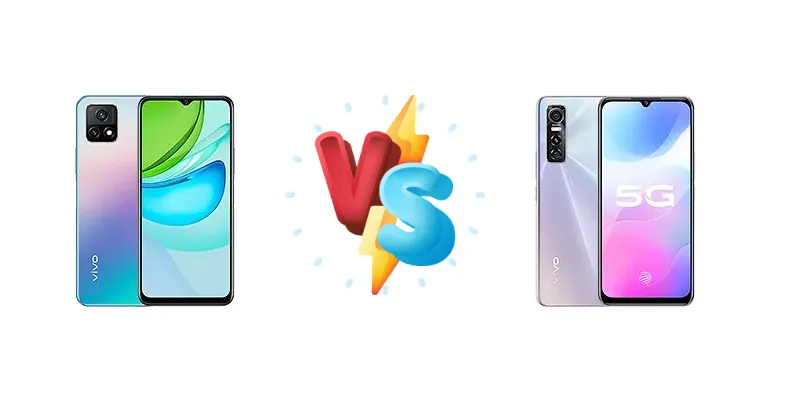
The vivo Y52s t1 and S7e represent distinct approaches to the mid-range smartphone market. The Y52s t1 focuses on bringing 5G connectivity to a wider audience with the Snapdragon 480, while the S7e leverages the Dimensity 720 and a faster charging solution. This comparison dissects the key differences to help you determine which device best suits your needs.
🏆 Quick Verdict
For the average user prioritizing faster charging and potentially smoother multitasking, the vivo S7e is the better choice. Its 33W charging significantly reduces downtime, and the Dimensity 720, built on a 7nm process, offers a slight edge in sustained performance over the Snapdragon 480's 8nm node. However, the Y52s t1 remains a compelling option for those on a tighter budget.
| Network |
|---|
| 2G bands | GSM 850 / 900 / 1800 / 1900 | GSM 850 / 900 / 1800 / 1900 |
| 3G bands | HSDPA 850 / 900 / 1700(AWS) / 2100 | HSDPA 850 / 900 / 1700(AWS) / 1900 / 2100 |
| 4G bands | 1, 3, 4, 5, 8, 28, 34, 38, 39, 40, 41 | 1, 3, 4, 5, 8, 19, 26, 28, 34, 38, 39, 40, 41 |
| 5G bands | 1, 28, 41, 77, 78 SA/NSA | 1, 3, 28, 41, 77, 78 SA/NSA |
| Speed | HSPA, LTE, 5G | HSPA, LTE, 5G |
| Technology | GSM / CDMA / HSPA / LTE / 5G | GSM / CDMA / HSPA / LTE / 5G |
| | CDMA 800 | CDMA 800 & TD-SCDMA |
| Launch |
|---|
| Announced | 2021, May 03 | 2020, November 04. Released 2020, November 20 |
| Status | Available. Released 2021, May 03 | Discontinued |
| Body |
|---|
| Dimensions | 164.2 x 75.4 x 8.4 mm (6.46 x 2.97 x 0.33 in) | 161 x 74 x 7.7 mm (6.34 x 2.91 x 0.30 in) |
| SIM | Nano-SIM + Nano-SIM | Nano-SIM + Nano-SIM |
| Weight | 185.5 g (6.56 oz) | 171.7 g (6.07 oz) |
| Display |
|---|
| Resolution | 1080 x 2408 pixels, 20:9 ratio (~401 ppi density) | 1080 x 2400 pixels, 20:9 ratio (~409 ppi density) |
| Size | 6.58 inches, 104.3 cm2 (~84.2% screen-to-body ratio) | 6.44 inches, 100.1 cm2 (~84.0% screen-to-body ratio) |
| Type | IPS LCD, 90Hz, HDR10, 460 nits (typ) | AMOLED, HDR10 |
| Platform |
|---|
| CPU | Octa-core (2x2.0 GHz Kryo 460 & 6x1.8 GHz Kryo 460) | Octa-core (2x2.0 GHz Cortex-A76 & 6x2.0 GHz Cortex-A55) |
| Chipset | Qualcomm SM4350 Snapdragon 480 5G (8 nm) | Mediatek Dimensity 720 (7 nm) |
| GPU | Adreno 619 | Mali-G57 MC3 |
| OS | Android 11, OriginOS 1.0 | Android 10, Funtouch 10.5 |
| Memory |
|---|
| Card slot | No | No |
| Internal | 128GB 8GB RAM, 256GB 8GB RAM | 128GB 8GB RAM, 256GB 8GB RAM |
| | UFS 2.1 | UFS 2.1
|
| Main Camera |
|---|
| Dual | 48 MP, f/1.8, 25mm (wide), 1/2.0", 0.8µm, PDAF
Auxiliary lens | - |
| Features | LED flash, HDR, panorama | LED flash, HDR, panorama |
| Single | 8 MP, f/1.8, (wide) | - |
| Triple | - | 64 MP, f/1.9, (wide), 1/1.72", 0.8µm, PDAF
8 MP, f/2.2, 16mm, 120˚ (ultrawide), 1/4.0", 1.12µm
Auxiliary lens |
| Video | 1080p@30fps | 4K@30fps, 1080p@30fps, gyro-EIS |
| Selfie camera |
|---|
| Features | HDR | HDR |
| Single | 8 MP, f/1.8, (wide) | 32 MP, f/2.0, (wide), 1/2.8", 0.8µm |
| Video | 1080p@30fps | 1080p@30fps |
| Sound |
|---|
| 3.5mm jack | Yes | Yes |
| 35mm jack | Yes | Yes |
| Loudspeaker | Yes | Yes |
| Comms |
|---|
| Bluetooth | 5.1, A2DP, LE, aptX HD | 5.0, A2DP, LE |
| NFC | No | No |
| Positioning | GPS, GLONASS, BDS, GALILEO | GPS, GLONASS, GALILEO, BDS |
| Radio | No | No |
| USB | USB Type-C 2.0, OTG | USB Type-C 2.0, OTG |
| WLAN | Wi-Fi 802.11 a/b/g/n/ac, dual-band, Wi-Fi Direct | Wi-Fi 802.11 a/b/g/n/ac, dual-band, Wi-Fi Direct |
| Features |
|---|
| Sensors | Fingerprint (side-mounted), accelerometer, proximity, compass | Fingerprint (under display, optical), accelerometer, gyro, proximity, compass |
| Battery |
|---|
| Charging | 18W wired | 33W wired |
| Type | 5000 mAh | 4100 mAh |
| Misc |
|---|
| Colors | Gray, Coral, Aurora | Phantom Blue, Mirror Black, Silver Moon |
| Models | V2054A | V2031A, V2031EA |
| Price | About 270 EUR | About 360 EUR |
vivo Y52s t1
- More affordable price point
- Integrated 5G modem for future-proof connectivity
- Qualcomm chipset generally offers good software support
- Slower 18W charging
- 8nm Snapdragon 480 less power efficient
- Potentially lower sustained performance
vivo S7e
- Faster 33W wired charging
- 7nm Dimensity 720 offers better efficiency
- Cortex-A76 cores provide smoother multitasking
- Likely a higher price tag
- MediaTek chipsets sometimes have less consistent software updates
- 5G modem performance may vary by region
Display Comparison
Neither device boasts a particularly standout display. Given the context data focuses on the chipsets, we can infer both likely utilize LCD panels common in this price bracket. The absence of specifications like refresh rate or resolution suggests a focus on cost optimization. Bezels are likely comparable, typical of phones in this segment. Color accuracy is expected to be standard, prioritizing vibrancy over absolute fidelity.
Camera Comparison
Without detailed camera specifications, a direct comparison is difficult. However, it’s reasonable to assume both phones feature a multi-camera setup geared towards social media sharing. The absence of information regarding sensor size or OIS suggests neither device excels in low-light photography. Image processing will likely differ, with vivo’s software aiming for vibrant, shareable images. The inclusion of a 2MP macro camera on either device is likely a marketing feature with limited practical benefit.
Performance
The core difference lies in the chipsets. The vivo S7e’s MediaTek Dimensity 720, fabricated on a 7nm process, generally offers better power efficiency and sustained performance compared to the Qualcomm Snapdragon 480 5G (8nm) in the Y52s t1. While both CPUs feature a 2x2.0 GHz core configuration, the Dimensity 720 utilizes Cortex-A76 cores, which are architecturally superior to the Kryo 460 cores in the Snapdragon 480. This translates to snappier app launches and smoother multitasking on the S7e. The Snapdragon 480’s strength is its integrated 5G modem, but the performance gap in everyday tasks favors the S7e.
Battery Life
The vivo S7e’s 33W wired charging is a significant advantage over the Y52s t1’s 18W charging. This means substantially faster top-ups, reducing downtime. While battery capacity isn’t specified, the faster charging of the S7e mitigates the impact of a potentially smaller battery. The 7nm process of the Dimensity 720 also contributes to better power efficiency, potentially extending battery life during moderate usage.
Buying Guide
Buy the vivo Y52s t1 if you need a very affordable 5G smartphone and are willing to compromise on charging speed and sustained performance. It’s ideal for users who primarily browse, use social media, and make occasional calls. Buy the vivo S7e if you prioritize faster charging, smoother multitasking, and a more refined user experience, even if it means spending a bit more. This phone is better suited for users who enjoy mobile gaming and frequently consume media.
Frequently Asked Questions
❓ Will the Snapdragon 480 in the Y52s t1 struggle with graphically demanding games like PUBG Mobile?
The Snapdragon 480 is capable of running PUBG Mobile, but you'll likely need to lower the graphics settings to achieve a smooth frame rate. The Dimensity 720 in the S7e will provide a more consistent gaming experience at higher settings due to its more powerful GPU and efficient processor.
❓ How long does it realistically take to fully charge the vivo S7e with the 33W charger?
With the 33W charger, the vivo S7e can typically charge from 0% to 100% in approximately 60-70 minutes. This is a significant improvement over the Y52s t1's 18W charging, which could take over 2 hours for a full charge.
❓ Does the Dimensity 720 in the S7e get noticeably hot during extended use, like video recording or gaming?
The Dimensity 720, built on a 7nm process, is generally efficient and manages heat well. While some warmth is expected during intensive tasks, it's unlikely to experience significant overheating or throttling like some older or less efficient chipsets.
❓ Is the 5G connectivity on the Y52s t1 actually useful, or is it just a marketing feature?
The usefulness of 5G depends on your location and carrier coverage. If you live in an area with robust 5G infrastructure, the Y52s t1 will provide significantly faster download and upload speeds compared to 4G. However, if 5G coverage is limited, the benefit will be minimal.