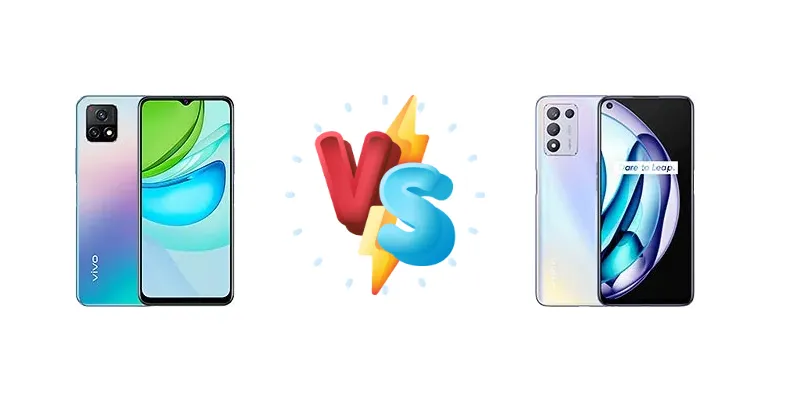
The Realme Q3t and vivo Y52s t1 both target the increasingly competitive budget 5G smartphone market. However, they take distinctly different approaches to achieving affordability. The Y52s t1 relies on the more economical Snapdragon 480, while the Q3t steps up to the considerably more powerful Snapdragon 778G. This comparison dissects the implications of this core difference, and examines where each phone excels.
🏆 Quick Verdict
For most users, the Realme Q3t is the superior choice. Its Snapdragon 778G chipset delivers a significantly smoother and more responsive experience, particularly in demanding tasks and gaming. The faster 30W charging is a substantial convenience. While the Y52s t1 offers a lower entry price, the performance gap is too large to ignore for all but the most basic users.
| Network |
|---|
| 2G bands | GSM 850 / 900 / 1800 / 1900 | GSM 850 / 900 / 1800 / 1900 |
| 3G bands | HSDPA 850 / 900 / 1700(AWS) / 2100 | HSDPA 850 / 900 / 1700(AWS) / 1900 / 2100 |
| 4G bands | 1, 3, 4, 5, 8, 28, 34, 38, 39, 40, 41 | LTE |
| 5G bands | 1, 28, 41, 77, 78 SA/NSA | SA/NSA |
| Speed | HSPA, LTE, 5G | HSPA, LTE, 5G |
| Technology | GSM / CDMA / HSPA / LTE / 5G | GSM / CDMA / HSPA / EVDO / LTE / 5G |
| | CDMA 800 | CDMA2000 1xEV-DO |
| Launch |
|---|
| Announced | 2021, May 03 | 2021, November 10 |
| Status | Available. Released 2021, May 03 | Available. Released 2021, November 15 |
| Body |
|---|
| Dimensions | 164.2 x 75.4 x 8.4 mm (6.46 x 2.97 x 0.33 in) | - |
| SIM | Nano-SIM + Nano-SIM | Nano-SIM + Nano-SIM |
| Weight | 185.5 g (6.56 oz) | - |
| Display |
|---|
| Resolution | 1080 x 2408 pixels, 20:9 ratio (~401 ppi density) | 1080 x 2412 pixels, 20:9 ratio (~400 ppi density) |
| Size | 6.58 inches, 104.3 cm2 (~84.2% screen-to-body ratio) | 6.6 inches, 104.8 cm2 |
| Type | IPS LCD, 90Hz, HDR10, 460 nits (typ) | IPS LCD, 144Hz, 600 nits |
| Platform |
|---|
| CPU | Octa-core (2x2.0 GHz Kryo 460 & 6x1.8 GHz Kryo 460) | Octa-core (1x2.4 GHz Cortex-A78 & 3x2.2 GHz Cortex-A78 & 4x1.9 GHz Cortex-A55) |
| Chipset | Qualcomm SM4350 Snapdragon 480 5G (8 nm) | Qualcomm SM7325 Snapdragon 778G 5G (6 nm) |
| GPU | Adreno 619 | Adreno 642L |
| OS | Android 11, OriginOS 1.0 | Android 11, Realme UI 2.0 |
| Memory |
|---|
| Card slot | No | Unspecified |
| Internal | 128GB 8GB RAM, 256GB 8GB RAM | 256GB 8GB RAM |
| | UFS 2.1 | - |
| Main Camera |
|---|
| Dual | 48 MP, f/1.8, 25mm (wide), 1/2.0", 0.8µm, PDAF
Auxiliary lens | - |
| Features | LED flash, HDR, panorama | LED flash, HDR, panorama |
| Single | 8 MP, f/1.8, (wide) | 16 MP, f/2.1, 26mm (wide) |
| Triple | - | 48 MP, f/1.8, 26mm (wide), PDAF
2 MP (macro)
Auxiliary lens |
| Video | 1080p@30fps | 4K@30fps, 1080p@30/60fps |
| Selfie camera |
|---|
| Features | HDR | HDR, panorama |
| Single | 8 MP, f/1.8, (wide) | 16 MP, f/2.1, 26mm (wide) |
| Video | 1080p@30fps | 1080p@30fps |
| Sound |
|---|
| 3.5mm jack | Yes | Yes |
| 35mm jack | Yes | Yes |
| Loudspeaker | Yes | Yes |
| | - | 24-bit/192kHz audio |
| Comms |
|---|
| Bluetooth | 5.1, A2DP, LE, aptX HD | 5.2, A2DP, LE |
| NFC | No | No |
| Positioning | GPS, GLONASS, BDS, GALILEO | GPS, GLONASS, BDS, GALILEO, QZSS |
| Radio | No | No |
| USB | USB Type-C 2.0, OTG | USB Type-C 2.0, OTG |
| WLAN | Wi-Fi 802.11 a/b/g/n/ac, dual-band, Wi-Fi Direct | Wi-Fi 802.11 a/b/g/n/ac/6, dual-band, Wi-Fi Direct |
| Features |
|---|
| Sensors | Fingerprint (side-mounted), accelerometer, proximity, compass | Fingerprint (side-mounted), accelerometer, gyro, proximity, compass |
| Battery |
|---|
| Charging | 18W wired | 30W wired, 50% in 25 min |
| Type | 5000 mAh | 5000 mAh |
| Misc |
|---|
| Colors | Gray, Coral, Aurora | Aurora, Dark Blue |
| Models | V2054A | - |
| Price | About 270 EUR | About 290 EUR |
vivo Y52s t1
- Potentially lower price point
- Sufficient for basic smartphone tasks
- 5G connectivity
- Significantly weaker performance than the Q3t
- Slower charging speed
- Less future-proof
Realme Q3t
- Much faster Snapdragon 778G processor
- 30W fast charging (50% in 25 min)
- Superior gaming performance
- More efficient chipset
- Likely a higher price tag
- Potentially slightly lower battery life (depending on capacity)
Display Comparison
Neither device's display specifications are provided, so a direct comparison is limited. However, given the Q3t's positioning, it likely features a higher quality panel with potentially better color accuracy and brightness. The Y52s t1, aiming for a lower price point, may utilize a more basic LCD. The absence of details like refresh rate or resolution further complicates a direct assessment, but the Q3t's more powerful chipset suggests a greater investment in the overall user experience, which often extends to the display.
Camera Comparison
Without detailed camera specifications, a precise comparison is difficult. However, the Q3t’s more powerful ISP (Image Signal Processor) within the Snapdragon 778G will likely result in superior image processing, particularly in low-light conditions. The 778G’s capabilities allow for more advanced features like better HDR and noise reduction. While both phones likely feature a standard main sensor, the Q3t’s chipset will extract more detail and dynamic range from it. The Y52s t1 will likely rely on more basic computational photography techniques.
Performance
The core difference lies in the chipsets. The Realme Q3t’s Snapdragon 778G (6nm) is a substantial upgrade over the vivo Y52s t1’s Snapdragon 480 (8nm). The 778G features a Cortex-A78 prime core clocked at 2.4GHz, alongside three additional A78 cores, offering significantly improved single-core and multi-core performance. The 480 relies on Kryo 460 cores, which are less efficient and powerful. This translates to faster app loading times, smoother multitasking, and a far more capable gaming experience on the Q3t. The 6nm process node of the 778G also contributes to better thermal efficiency, reducing the likelihood of performance throttling under sustained load. The Q3t will handle graphically intensive games with higher frame rates and settings.
Battery Life
Battery capacity isn't specified for either device. However, the Realme Q3t’s 30W wired charging is a clear advantage over the Y52s t1’s 18W charging. The Q3t can reach 50% charge in just 25 minutes, offering a significant convenience boost. While a larger battery capacity on the Y52s t1 could partially offset the slower charging, the Q3t’s faster charging speed will likely result in less downtime. The Snapdragon 778G’s 6nm process may also contribute to slightly better power efficiency, potentially mitigating the impact of a smaller battery (if present).
Buying Guide
Buy the vivo Y52s t1 if you prioritize absolute minimum cost and only need a phone for essential tasks like calls, texts, and light social media. Its Snapdragon 480 is sufficient for these workloads. Buy the Realme Q3t if you value performance, enjoy mobile gaming, or frequently multitask. The Snapdragon 778G provides a much more future-proof and enjoyable user experience, and the faster charging is a significant quality-of-life improvement.
Frequently Asked Questions
❓ Will the Snapdragon 480 in the vivo Y52s t1 struggle with demanding apps like video editors or large spreadsheets?
Yes, the Snapdragon 480 is an entry-level 5G chipset. While it can handle basic apps, it will likely exhibit noticeable lag and slowdowns when running resource-intensive applications. The limited processing power and RAM configuration will hinder performance in these scenarios.
❓ Is the 30W charging on the Realme Q3t a significant improvement over the 18W charging on the vivo Y52s t1 in real-world use?
Absolutely. The Q3t's 30W charging can add a substantial amount of battery life in a short period. Reaching 50% charge in 25 minutes is a game-changer for users who frequently need to top up their phone quickly. The Y52s t1's 18W charging will take considerably longer, potentially requiring over an hour to reach a similar charge level.
❓ Can the Realme Q3t handle popular games like PUBG Mobile or Call of Duty Mobile at high settings?
The Snapdragon 778G in the Realme Q3t is well-equipped to handle PUBG Mobile and Call of Duty Mobile at high settings with stable frame rates. You should be able to enjoy a smooth and responsive gaming experience. The Y52s t1, with its Snapdragon 480, will likely require lower settings and may still experience occasional frame drops.
❓ Does the Snapdragon 778G in the Realme Q3t generate significantly more heat during prolonged gaming sessions compared to the Snapdragon 480?
While the 778G is more powerful, its 6nm process node actually contributes to *better* thermal efficiency than the 8nm node of the 480. This means the Q3t is less likely to throttle performance due to overheating during extended gaming sessions. The Y52s t1 may throttle more aggressively to manage heat.