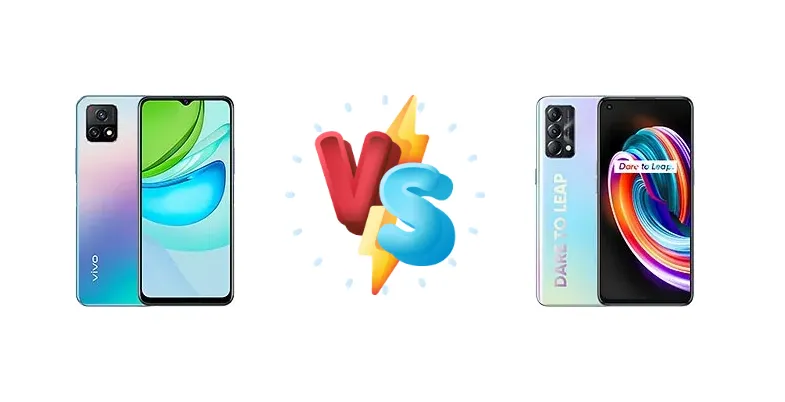
Both the vivo Y52s t1 and the Realme Q3 Pro Carnival target the budget-conscious 5G smartphone user, but they take drastically different approaches to achieving that goal. The Y52s t1 focuses on affordability, while the Q3 Pro Carnival prioritizes performance with a more powerful chipset and significantly faster charging. This comparison will dissect the key differences to determine which device offers the best value.
🏆 Quick Verdict
For the average user prioritizing responsiveness and future-proofing, the Realme Q3 Pro Carnival is the clear winner. Its Snapdragon 768G chipset provides a substantial performance uplift over the Y52s t1’s Snapdragon 480, and the 50W charging dramatically reduces downtime. While the Y52s t1 is cheaper, the performance gap is too significant to ignore for most.
| Network |
|---|
| 2G bands | GSM 850 / 900 / 1800 / 1900 | GSM 850 / 900 / 1800 / 1900 |
| 3G bands | HSDPA 850 / 900 / 1700(AWS) / 2100 | HSDPA 800 / 850 / 900 / 1700(AWS) / 1900 / 2100 |
| 4G bands | 1, 3, 4, 5, 8, 28, 34, 38, 39, 40, 41 | LTE |
| 5G bands | 1, 28, 41, 77, 78 SA/NSA | SA/NSA |
| Speed | HSPA, LTE, 5G | HSPA, LTE, 5G |
| Technology | GSM / CDMA / HSPA / LTE / 5G | GSM / CDMA / HSPA / CDMA2000 / LTE / 5G |
| | CDMA 800 | CDMA2000 1x |
| Launch |
|---|
| Announced | 2021, May 03 | 2021, May 25 |
| Status | Available. Released 2021, May 03 | Available. Released 2021, June 06 |
| Body |
|---|
| Dimensions | 164.2 x 75.4 x 8.4 mm (6.46 x 2.97 x 0.33 in) | 7.9 mm thickness |
| SIM | Nano-SIM + Nano-SIM | Nano-SIM + Nano-SIM |
| Weight | 185.5 g (6.56 oz) | 174 g (6.14 oz) |
| Display |
|---|
| Resolution | 1080 x 2408 pixels, 20:9 ratio (~401 ppi density) | 1080 x 2400 pixels, 20:9 ratio (~409 ppi density) |
| Size | 6.58 inches, 104.3 cm2 (~84.2% screen-to-body ratio) | 6.43 inches, 99.8 cm2 |
| Type | IPS LCD, 90Hz, HDR10, 460 nits (typ) | Super AMOLED, 120Hz, 600 nits |
| Platform |
|---|
| CPU | Octa-core (2x2.0 GHz Kryo 460 & 6x1.8 GHz Kryo 460) | Octa-core (1x2.8 GHz Kryo 475 Prime & 1x2.4 GHz Kryo 475 Gold & 6x1.8 GHz Kryo 475 Silver) |
| Chipset | Qualcomm SM4350 Snapdragon 480 5G (8 nm) | Qualcomm SM7250-AC Snapdragon 768G 5G (7 nm) |
| GPU | Adreno 619 | Adreno 620 |
| OS | Android 11, OriginOS 1.0 | Android 11, Realme UI 2.0 |
| Memory |
|---|
| Card slot | No | No |
| Internal | 128GB 8GB RAM, 256GB 8GB RAM | 128GB 8GB RAM |
| | UFS 2.1 | UFS 3.1 |
| Main Camera |
|---|
| Dual | 48 MP, f/1.8, 25mm (wide), 1/2.0", 0.8µm, PDAF
Auxiliary lens | - |
| Features | LED flash, HDR, panorama | LED flash, HDR, panorama |
| Single | 8 MP, f/1.8, (wide) | 32 MP, (wide), 1/2.74", 0.8µm |
| Triple | - | 64 MP, f/1.8, 26mm (wide), 1/1.73", 0.8µm, PDAF
8 MP, f/2.3, 16mm, 119˚ (ultrawide), 1/4.0", 1.12µm
2 MP (macro) |
| Video | 1080p@30fps | 4K@30/60fps, 1080p@30/60fps, gyro-EIS |
| Selfie camera |
|---|
| Features | HDR | HDR, panorama |
| Single | 8 MP, f/1.8, (wide) | 32 MP, (wide), 1/2.74", 0.8µm |
| Video | 1080p@30fps | 1080p@30fps |
| Sound |
|---|
| 3.5mm jack | Yes | Yes |
| 35mm jack | Yes | Yes |
| Loudspeaker | Yes | Yes, with stereo speakers |
| | - | 24-bit/192kHz audio |
| Comms |
|---|
| Bluetooth | 5.1, A2DP, LE, aptX HD | 5.1, A2DP, LE |
| NFC | No | No |
| Positioning | GPS, GLONASS, BDS, GALILEO | GPS, GLONASS, GALILEO, BDS, QZSS |
| Radio | No | No |
| USB | USB Type-C 2.0, OTG | USB Type-C 2.0 |
| WLAN | Wi-Fi 802.11 a/b/g/n/ac, dual-band, Wi-Fi Direct | Wi-Fi 802.11 a/b/g/n/ac/6, dual-band, Wi-Fi Direct |
| Features |
|---|
| Sensors | Fingerprint (side-mounted), accelerometer, proximity, compass | Fingerprint (under display, optical), accelerometer, gyro, proximity, compass |
| Battery |
|---|
| Charging | 18W wired | 50W wired, 100% in 45 min |
| Type | 5000 mAh | 4500 mAh |
| Misc |
|---|
| Colors | Gray, Coral, Aurora | Black, Aurora |
| Models | V2054A | RMX3142 |
| Price | About 270 EUR | About 230 EUR |
vivo Y52s t1
- More affordable price point
- 5G connectivity for future-proofing
- Functional for basic smartphone tasks
- Significantly slower performance
- Slow 18W charging
- Limited multitasking capabilities
Realme Q3 Pro Carnival
- Faster Snapdragon 768G processor
- Ultra-fast 50W charging (45 minutes)
- Better performance for gaming and demanding apps
- Higher price compared to the Y52s t1
- Potentially shorter battery life due to more powerful processor
- May not be significantly better in basic tasks
Display Comparison
Neither device’s display specifications are provided, so we must infer. Given the price points, both likely feature LCD panels. However, the Realme Q3 Pro Carnival, positioned slightly higher, may benefit from a higher peak brightness and potentially a higher refresh rate. The Snapdragon 768G’s more capable ISP could also translate to slightly better image processing for display output. Bezels are likely comparable, reflecting cost-saving measures in both designs.
Camera Comparison
Without detailed camera specs, a direct comparison is difficult. However, the Snapdragon 768G’s superior ISP in the Realme Q3 Pro Carnival offers advantages in image processing, potentially resulting in better dynamic range, noise reduction, and overall image quality. The Q3 Pro Carnival is more likely to feature a higher-resolution main sensor, though this isn’t guaranteed. The Y52s t1 will likely rely more heavily on software processing to compensate for a potentially less capable sensor.
Performance
The core difference lies in the chipsets. The Realme Q3 Pro Carnival’s Snapdragon 768G (7nm) is a significant step up from the vivo Y52s t1’s Snapdragon 480 (8nm). The 768G features a Kryo 475 Prime core clocked at 2.8GHz, alongside a Kryo 475 Gold core at 2.4GHz, and six Kryo 475 Silver cores at 1.8GHz. This contrasts with the Y52s t1’s dual 2.0GHz Kryo 460 cores and six 1.8GHz Kryo 460 cores. The 7nm process node of the 768G also contributes to better power efficiency and sustained performance, reducing thermal throttling during extended gaming sessions. This translates to a noticeably smoother experience in demanding applications and games for the Q3 Pro Carnival.
Battery Life
The Realme Q3 Pro Carnival’s 50W wired charging is a game-changer, promising a full charge in just 45 minutes. The vivo Y52s t1’s 18W charging is considerably slower. While battery capacity isn’t specified for either device, the faster charging of the Q3 Pro Carnival mitigates the impact of a potentially smaller battery. Users who frequently top up their phones will greatly benefit from the Q3 Pro Carnival’s charging speed.
Buying Guide
Buy the vivo Y52s t1 if you need a functional 5G smartphone for basic tasks like calling, texting, and light social media browsing, and your budget is extremely limited. You’ll accept slower performance and longer charging times. Buy the Realme Q3 Pro Carnival if you prefer a smoother, more responsive experience for gaming, multitasking, and demanding applications, and you value the convenience of rapid 50W charging. It’s a better long-term investment.
Frequently Asked Questions
❓ Will the Snapdragon 480 in the vivo Y52s t1 struggle with graphically intensive games like PUBG Mobile?
Yes, the Snapdragon 480 is an entry-level 5G chipset. While it can run PUBG Mobile, you'll likely need to lower graphics settings significantly to achieve a playable frame rate. Expect stuttering and potential overheating during extended gaming sessions. The Snapdragon 768G in the Realme Q3 Pro Carnival offers a much smoother and more consistent gaming experience.
❓ How much faster is the 50W charging on the Realme Q3 Pro Carnival compared to the 18W charging on the vivo Y52s t1 in real-world use?
The difference is substantial. The Realme Q3 Pro Carnival can go from 0% to 100% in approximately 45 minutes. The vivo Y52s t1, with its 18W charging, will likely take over 2 hours to achieve a full charge. This means you can quickly top up the Q3 Pro Carnival during short breaks, while the Y52s t1 requires a much longer charging commitment.
❓ Is the Snapdragon 768G in the Realme Q3 Pro Carnival capable of handling demanding multitasking, like running multiple apps simultaneously?
Absolutely. The Snapdragon 768G’s more powerful CPU and increased RAM bandwidth (likely LPDDR4X) allow for significantly smoother multitasking compared to the Snapdragon 480. You’ll experience fewer app reloads and a more responsive overall experience when switching between applications.