
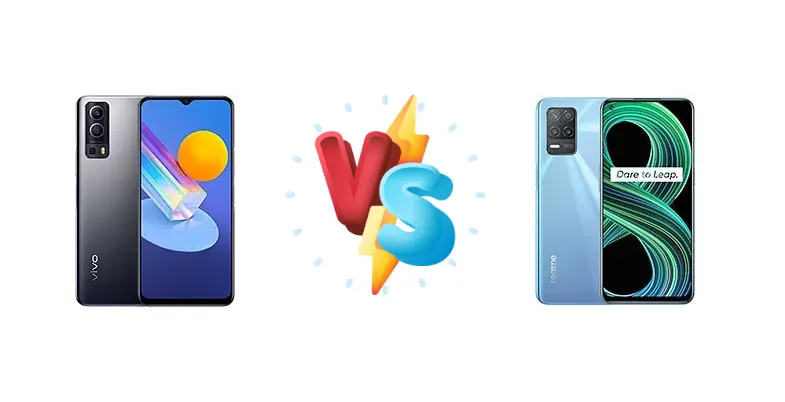
vivo Y52 5G vs Realme 8 5G: A Deep Dive into Budget 5G Contenders
| Phones Images | |||||
|---|---|---|---|---|---|
|
🏆 Quick Verdict
For the average user prioritizing consistent performance and a slightly better-documented software experience, the Realme 8 5G emerges as the winner. While both phones share the same Mediatek Dimensity 700 chipset and 18W charging, the Realme 8 5G’s established endurance rating and wider availability give it a slight edge.
| PHONES | ||
|---|---|---|
| Phone Names | vivo Y52 5G | Realme 8 5G |
| Network | ||
|---|---|---|
| 2G bands | GSM 850 / 900 / 1800 / 1900 | GSM 850 / 900 / 1800 / 1900 |
| 3G bands | HSDPA 850 / 900 / 1700(AWS) / 1900 / 2100 | HSDPA 800 / 850 / 900 / 1900 / 2100 |
| 4G bands | 1, 2, 3, 4, 5, 7, 8, 18, 19, 20, 26, 28, 38, 39, 40, 41 | 1, 2, 3, 4, 5, 7, 8, 12, 17, 18, 19, 20, 26, 28, 38, 39, 40, 41, 66 - International |
| 5G bands | 1, 7, 28, 40, 41, 78 SA/NSA | 1, 3, 5, 7, 8, 20, 28, 38, 40, 41, 77, 78 SA/NSA - International |
| Speed | HSPA, LTE, 5G | HSPA, LTE, 5G |
| Technology | GSM / HSPA / LTE / 5G | GSM / HSPA / LTE / 5G |
| - | 1, 28, 41, 77, 78 SA/NSA - India | |
| Launch | ||
|---|---|---|
| Announced | 2021, May 18 | 2021, April 21 |
| Status | Available. Released 2021, June 20 | Available. Released 2021, April 28 |
| Body | ||
|---|---|---|
| Build | - | Glass front, plastic frame, plastic back |
| Dimensions | 164 x 75.3 x 8.5 mm (6.46 x 2.96 x 0.33 in) | 162.5 x 74.8 x 8.5 mm (6.40 x 2.94 x 0.33 in) |
| SIM | Nano-SIM + Nano-SIM | Nano-SIM + Nano-SIM |
| Weight | 193 g (6.81 oz) | 185 g (6.53 oz) |
| Display | ||
|---|---|---|
| Resolution | 1080 x 2408 pixels, 20:9 ratio (~401 ppi density) | 1080 x 2400 pixels, 20:9 ratio (~405 ppi density) |
| Size | 6.58 inches, 104.3 cm2 (~84.5% screen-to-body ratio) | 6.5 inches, 102.0 cm2 (~83.9% screen-to-body ratio) |
| Type | IPS LCD | IPS LCD, 90Hz, 480 nits (typ), 600 nits |
| Platform | ||
|---|---|---|
| CPU | Octa-core (2x2.2 GHz Cortex-A76 & 6x2.0 GHz Cortex-A55) | Octa-core (2x2.2 GHz Cortex-A76 & 6x2.0 GHz Cortex-A55) |
| Chipset | Mediatek Dimensity 700 (7 nm) | Mediatek Dimensity 700 (7 nm) |
| GPU | Mali-G57 MC2 | Mali-G57 MC2 |
| OS | Android 11, Funtouch 11.1 | Android 11, upgradable to Android 13, Realme UI 4.0 |
| Memory | ||
|---|---|---|
| Card slot | microSDXC (uses shared SIM slot) | microSDXC (dedicated slot) |
| Internal | 128GB 4GB RAM | 64GB 4GB RAM, 128GB 4GB RAM, 128GB 6GB RAM, 128GB 8GB RAM |
| - | UFS 2.1 | |
| Main Camera | ||
|---|---|---|
| Features | LED flash, HDR, panorama | LED flash, HDR, panorama |
| Single | 8 MP, f/2.0, (wide) | 16 MP, f/2.1, 26mm (wide) |
| Triple | 48 MP, f/1.8, (wide), 1/2.0", 0.8µm, PDAF 2 MP (macro) Auxiliary lens | 48 MP, f/1.8, 26mm (wide), PDAF 2 MP (macro) Auxiliary lens |
| Video | 1080p@30fps | 1080p@30fps |
| Selfie camera | ||
|---|---|---|
| Features | HDR | HDR |
| Single | 8 MP, f/2.0, (wide) | 16 MP, f/2.1, 26mm (wide) |
| Video | 1080p@30fps | 1080p@30fps |
| Sound | ||
|---|---|---|
| 3.5mm jack | Yes | Yes |
| 35mm jack | Yes | Yes |
| Loudspeaker | Yes | Yes |
| - | 24-bit/192kHz audio | |
| Comms | ||
|---|---|---|
| Bluetooth | 5.1, A2DP, LE | 5.1, A2DP, LE |
| NFC | Yes | Yes |
| Positioning | GPS, GLONASS, GALILEO, BDS | GPS, GLONASS, BDS, GALILEO, QZSS |
| Radio | Unspecified | Unspecified |
| USB | USB Type-C 2.0, OTG | USB Type-C 2.0, OTG |
| WLAN | Wi-Fi 802.11 a/b/g/n/ac, dual-band, Wi-Fi Direct | Wi-Fi 802.11 a/b/g/n/ac, dual-band, Wi-Fi Direct |
| Features | ||
|---|---|---|
| Sensors | Fingerprint (side-mounted), accelerometer, gyro, proximity, compass | Fingerprint (side-mounted), accelerometer, gyro, proximity, compass |
| Battery | ||
|---|---|---|
| Charging | 18W wired | 18W wired |
| Type | 5000 mAh | 5000 mAh |
| Misc | ||
|---|---|---|
| Colors | Shiny Black, Glacier Blue | Supersonic Blue, Supersonic Black |
| Models | V2053 | RMX3241 |
| Price | About 240 EUR | About 170 EUR |
| Tests | ||
|---|---|---|
| Battery life | - | Endurance rating 118h |
| Camera | - | Photo / Video |
| Display | - | Contrast ratio: 1413:1 (nominal) |
| Loudspeaker | - | -27.8 LUFS (Good) |
| Performance | - | AnTuTu: 302059 (v8), 361505 (v9) GeekBench: 1784 (v5.1) GFXBench: 13fps (ES 3.1 onscreen) |
vivo Y52 5G
- Potentially cleaner software experience (typical of vivo)
- May offer unique color options
- Shares the same capable Dimensity 700 chipset
- Limited availability in some regions
- Battery life is unknown and potentially weaker than Realme 8 5G
- Lack of detailed specifications hinders a thorough assessment
Realme 8 5G
- Proven 118-hour endurance rating
- Wider availability and established user base
- Shares the same capable Dimensity 700 chipset
- Software can be more cluttered with pre-installed apps
- 18W charging is relatively slow
- Camera performance likely similar to vivo Y52 5G (no clear advantage)
Display Comparison
Both the vivo Y52 5G and Realme 8 5G share a nominal contrast ratio of 1413:1, suggesting similar visual pop and black levels. However, detailed display specifications like peak brightness, color gamut coverage (DCI-P3), and panel type (IPS vs. AMOLED) are missing. Given the price point, both likely utilize IPS LCD panels. The absence of high refresh rate technology (90Hz or 120Hz) is expected, but a higher peak brightness on one device would be beneficial for outdoor visibility. Without further data, it's difficult to declare a clear winner in display quality.
Camera Comparison
Both phones feature 'Photo / Video' capabilities, but lack specific details regarding sensor size, aperture, or image processing algorithms. The absence of information makes a direct comparison challenging. It’s reasonable to assume both utilize a primary sensor paired with auxiliary lenses (depth, macro). Given the market segment, image quality will likely be adequate for social media sharing but won’t compete with flagship devices. The usefulness of a 2MP macro lens on either device is questionable, offering limited detail and dynamic range. The quality of the image signal processor (ISP) within the Dimensity 700 will be a significant factor, but without sample images, it’s impossible to assess.
Performance
Both devices are powered by the Mediatek Dimensity 700 (7nm) chipset, featuring an octa-core CPU configuration with 2x2.2 GHz Cortex-A76 and 6x2.0 GHz Cortex-A55 cores. This means CPU performance will be virtually identical for everyday tasks and moderate gaming. The GPU performance will also be comparable. The key differentiator, if any, will lie in thermal management and RAM speed (LPDDR4X is likely on both). Realme’s software optimizations often prioritize sustained performance, potentially leading to less throttling during extended gaming sessions. However, without benchmark data, this remains speculative.
Battery Life
The Realme 8 5G boasts an endurance rating of 118 hours, indicating strong battery life under typical usage conditions. The vivo Y52 5G’s battery capacity and endurance rating are not specified. Both devices support 18W wired charging, which is relatively slow compared to modern fast-charging standards. A full 0-100% charge will likely take around 2 hours. The Realme 8 5G’s documented endurance rating suggests it will comfortably last a full day for most users, while the vivo Y52 5G’s battery performance remains uncertain.
Buying Guide
Buy the vivo Y52 5G if you prioritize a clean, minimalist software experience and are comfortable with potentially limited regional availability. Buy the Realme 8 5G if you value a proven track record of battery life, a more established community for support, and a slightly more refined user interface. Both are excellent choices for first-time 5G users.