
Google Pixel 4a 5G vs vivo Y52 5G: A Deep Dive into Mid-Range 5G Contenders
| Phones Images | |||||
|---|---|---|---|---|---|
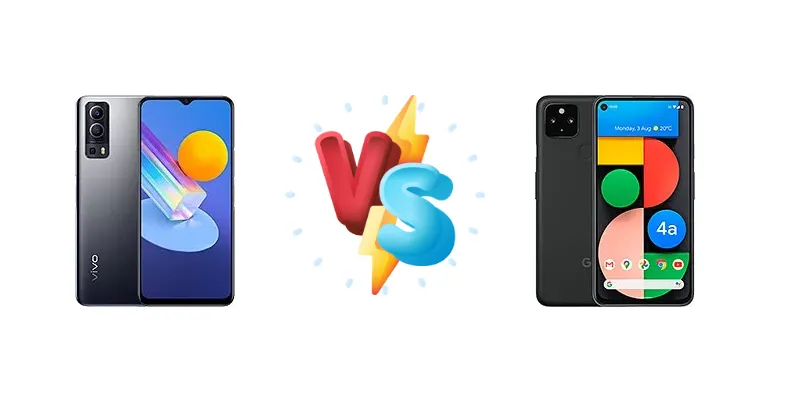
|
🏆 Quick Verdict
For the average user prioritizing camera quality and software experience, the Google Pixel 4a 5G emerges as the stronger choice. Its Snapdragon 765G chipset and Google's computational photography prowess deliver superior image quality and a smoother overall user experience, despite the vivo Y52 5G offering a slightly newer chipset.
| PHONES | ||
|---|---|---|
| Phone Names | vivo Y52 5G | Google Pixel 4a 5G |
| Network | ||
|---|---|---|
| 2G bands | GSM 850 / 900 / 1800 / 1900 | GSM 850 / 900 / 1800 / 1900 |
| 3G bands | HSDPA 850 / 900 / 1700(AWS) / 1900 / 2100 | HSDPA 850 / 900 / 1700(AWS) / 1900 / 2100 |
| 4G bands | 1, 2, 3, 4, 5, 7, 8, 18, 19, 20, 26, 28, 38, 39, 40, 41 | 1, 2, 3, 4, 5, 7, 8, 12, 13, 14, 17, 18, 19, 20, 25, 26, 28, 29, 30, 32, 38, 39, 40, 41, 42, 46, 48, 66, 71 |
| 5G bands | 1, 7, 28, 40, 41, 78 SA/NSA | 1, 2, 3, 5, 7, 8, 12, 28, 41, 66, 71, 77, 78 Sub6, mmWave (market dependant) |
| Speed | HSPA, LTE, 5G | HSPA, LTE, 5G |
| Technology | GSM / HSPA / LTE / 5G | GSM / HSPA / LTE / 5G |
| Launch | ||
|---|---|---|
| Announced | 2021, May 18 | 2020, September 30 |
| Status | Available. Released 2021, June 20 | Available. Released 2020, November 05 |
| Body | ||
|---|---|---|
| Build | - | Glass front (Gorilla Glass 3), plastic back, plastic frame |
| Dimensions | 164 x 75.3 x 8.5 mm (6.46 x 2.96 x 0.33 in) | 153.9 x 74 x 8.2 mm (Sub-6) or 8.5 mm (Sub-6 and mmWave) |
| SIM | Nano-SIM + Nano-SIM | Nano-SIM + eSIM |
| Weight | 193 g (6.81 oz) | 168 g (5G Sub-6); 171 g ( 5G Sub-6 and mmWave) (5.93 oz) |
| Display | ||
|---|---|---|
| Protection | - | Corning Gorilla Glass 3 |
| Resolution | 1080 x 2408 pixels, 20:9 ratio (~401 ppi density) | 1080 x 2340 pixels, 19.5:9 ratio (~413 ppi density) |
| Size | 6.58 inches, 104.3 cm2 (~84.5% screen-to-body ratio) | 6.2 inches, 95.7 cm2 (~84.1% screen-to-body ratio) |
| Type | IPS LCD | OLED, HDR |
| - | Always-on display | |
| Platform | ||
|---|---|---|
| CPU | Octa-core (2x2.2 GHz Cortex-A76 & 6x2.0 GHz Cortex-A55) | Octa-core (1x2.4 GHz Kryo 475 Prime & 1x2.2 GHz Kryo 475 Gold & 6x1.8 GHz Kryo 475 Silver) |
| Chipset | Mediatek Dimensity 700 (7 nm) | Qualcomm SM7250 Snapdragon 765G 5G (7 nm) |
| GPU | Mali-G57 MC2 | Adreno 620 |
| OS | Android 11, Funtouch 11.1 | Android 11, upgradable to Android 14 |
| Memory | ||
|---|---|---|
| Card slot | microSDXC (uses shared SIM slot) | No |
| Internal | 128GB 4GB RAM | 128GB 6GB RAM |
| - | UFS 2.1 | |
| Main Camera | ||
|---|---|---|
| Dual | - | 12.2 MP, f/1.7, 27mm (wide), 1/2.55", 1.4µm, dual pixel PDAF, OIS 16 MP, f/2.2, 107˚ (ultrawide), 1.0µm |
| Features | LED flash, HDR, panorama | LED flash, Pixel Shift, Auto-HDR, panorama |
| Single | 8 MP, f/2.0, (wide) | - |
| Triple | 48 MP, f/1.8, (wide), 1/2.0", 0.8µm, PDAF 2 MP (macro) Auxiliary lens | - |
| Video | 1080p@30fps | 4K@30/60fps, 1080p@30/60/120/240fps; gyro-EIS |
| Selfie camera | ||
|---|---|---|
| Features | HDR | HDR |
| Single | 8 MP, f/2.0, (wide) | 8 MP, f/2.0, 24mm (wide), 1/4.0", 1.12µm |
| Video | 1080p@30fps | 1080p@30fps |
| Sound | ||
|---|---|---|
| 3.5mm jack | Yes | Yes |
| 35mm jack | Yes | Yes |
| Loudspeaker | Yes | Yes, with stereo speakers |
| Comms | ||
|---|---|---|
| Bluetooth | 5.1, A2DP, LE | 5.0, A2DP, LE, aptX HD |
| NFC | Yes | Yes |
| Positioning | GPS, GLONASS, GALILEO, BDS | GPS, GLONASS, GALILEO, QZSS, BDS |
| Radio | Unspecified | No |
| USB | USB Type-C 2.0, OTG | USB Type-C 3.1 |
| WLAN | Wi-Fi 802.11 a/b/g/n/ac, dual-band, Wi-Fi Direct | Wi-Fi 802.11 a/b/g/n/ac, dual-band, Wi-Fi Direct |
| Features | ||
|---|---|---|
| Sensors | Fingerprint (side-mounted), accelerometer, gyro, proximity, compass | Fingerprint (rear-mounted), accelerometer, gyro, proximity, compass, barometer |
| Battery | ||
|---|---|---|
| Charging | 18W wired | 18W wired, PD2.0 |
| Type | 5000 mAh | Li-Po 3885 mAh |
| Misc | ||
|---|---|---|
| Colors | Shiny Black, Glacier Blue | Just Black, Clearly White |
| Models | V2053 | GD1YQ, G025I, G025E, G025H, G6QU3 |
| Price | About 240 EUR | About 140 EUR |
vivo Y52 5G
- Superior camera performance thanks to Google’s software.
- Clean and optimized Android experience.
- Faster and more consistent performance with Snapdragon 765G.
- PD2.0 charging support for potentially faster charging.
- Smaller battery capacity compared to likely Y52 5G.
- Older chipset generation.
Google Pixel 4a 5G
- Likely larger battery capacity for extended usage.
- Newer Dimensity 700 chipset.
- Larger display size.
- Potentially lower price point.
- Less refined software experience with Funtouch OS.
- Inferior camera performance compared to Pixel.
- Potentially less consistent performance under sustained load.
Display Comparison
Neither device boasts a particularly standout display. Both likely utilize LCD panels, a common cost-saving measure in this segment. The focus here isn't on cutting-edge tech like LTPO or OLED. However, the Pixel 4a 5G’s 6.2-inch display offers a slightly larger viewing area than the Y52 5G’s 6.53-inch screen. While size is a preference, the Pixel’s display benefits from Google’s color calibration, likely resulting in more accurate color reproduction. Bezels are comparable, and neither phone is expected to offer high peak brightness levels.
Camera Comparison
This is where the Pixel 4a 5G truly shines. While the vivo Y52 5G likely features a higher megapixel count on its main sensor (specifications not provided, but typical for vivo), the Pixel 4a 5G leverages Google’s renowned computational photography algorithms. The Pixel’s image processing excels in dynamic range, detail preservation, and low-light performance. The Snapdragon 765G’s ISP is also more capable than the Dimensity 700’s. The Y52 5G likely includes standard auxiliary lenses (ultrawide, macro), but these are often of limited utility. The Pixel 4a 5G prioritizes quality over quantity, focusing on delivering exceptional results from its primary sensor.
Performance
The core of the performance difference lies in the chipsets. The Google Pixel 4a 5G’s Qualcomm Snapdragon 765G (7nm) features a Kryo 475 Prime core clocked at 2.4GHz, designed for peak performance. The vivo Y52 5G utilizes the MediaTek Dimensity 700 (7nm), with a slightly higher clocked Cortex-A76 core at 2.2GHz, but lacks the dedicated 'Prime' core. While both are 7nm chips, Qualcomm’s architecture generally provides a more consistent and optimized experience, particularly in sustained workloads. The Snapdragon 765G’s Adreno 620 GPU is also likely to outperform the Mali-G57 MP2 in the Dimensity 700, translating to better gaming performance. Both phones likely feature 6GB or 8GB of RAM, but the Pixel’s software optimization will likely make better use of available resources.
Battery Life
Both devices feature 18W wired charging, but the Pixel 4a 5G adds support for PD2.0 (Power Delivery), potentially allowing for slightly faster charging with compatible chargers. Battery capacity is a critical factor, but not provided for the Y52 5G. Assuming a typical 4500-5000mAh battery for the Y52 5G and a 3880mAh battery for the Pixel 4a 5G, the Y52 5G *should* offer longer battery life. However, the Pixel’s more efficient chipset and software optimization could partially offset this capacity difference. Real-world usage will determine the ultimate winner, but the Y52 5G has a theoretical advantage in longevity.
Buying Guide
Buy the vivo Y52 5G if you prioritize a newer chipset and are comfortable with vivo’s Funtouch OS, and are looking for a phone primarily for basic tasks and moderate 5G usage. Buy the Google Pixel 4a 5G if you value a clean Android experience, exceptional camera performance, and a more refined software ecosystem, even if it means sacrificing the absolute latest chipset generation.