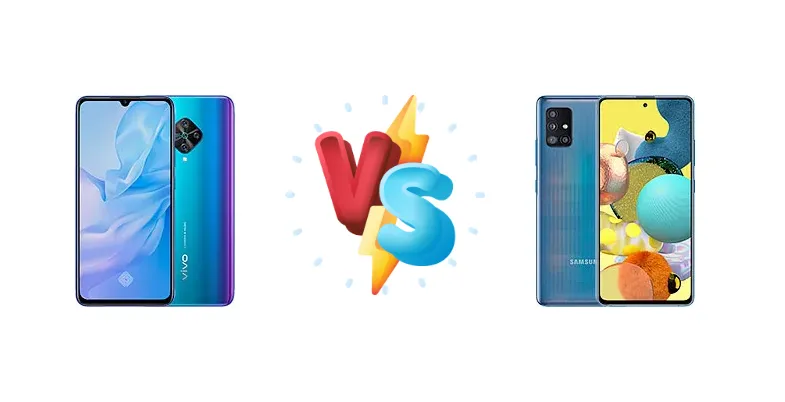
Both the vivo Y51 (2020) and the Samsung Galaxy A51 5G UW represent attempts to deliver 5G connectivity at a more accessible price point. However, they diverge significantly in their internal hardware, creating a clear performance gap. This comparison dissects those differences, focusing on how the chipset choices impact real-world usage.
🏆 Quick Verdict
For the average user prioritizing performance and future-proofing, the Samsung Galaxy A51 5G UW is the clear winner. Its Snapdragon 765G chipset provides a substantial upgrade over the vivo Y51’s Snapdragon 665, offering smoother multitasking, faster app loading, and better gaming capabilities. While the Y51 is more affordable, the A51 5G UW delivers a more compelling overall experience.
| Network |
|---|
| 2G bands | GSM 850 / 900 / 1800 / 1900 | GSM 850 / 900 / 1800 / 1900 |
| 3G bands | HSDPA 850 / 900 / 2100 | HSDPA 850 / 900 / 1900 / 2100 |
| 4G bands | 1, 3, 5, 8, 40 | 2, 4, 5, 13, 66 |
| 5G bands | - | 260, 261 mmWave |
| Speed | HSPA, LTE | HSPA, LTE, 5G |
| Technology | GSM / HSPA / LTE | GSM / HSPA / LTE / 5G |
| Launch |
|---|
| Announced | 2020, September 15. Released 2020, September 19 | 2020, August 14 |
| Status | Discontinued | Available. Released 2020, August 14 |
| Body |
|---|
| Build | - | Glass front (Gorilla Glass 3), plastic back, aluminum frame |
| Dimensions | 159.3 x 75.2 x 8.7 mm (6.27 x 2.96 x 0.34 in) | 158.8 x 73.4 x 8.6 mm (6.25 x 2.89 x 0.34 in) |
| SIM | Nano-SIM + Nano-SIM | Nano-SIM (pre-installed) |
| Weight | 186.7 g (6.60 oz) | 188.8 g (6.67 oz) |
| Display |
|---|
| Protection | - | Corning Gorilla Glass 3 |
| Resolution | 1080 x 2340 pixels, 19.5:9 ratio (~404 ppi density) | 1080 x 2400 pixels, 20:9 ratio (~405 ppi density) |
| Size | 6.38 inches, 99.9 cm2 (~83.4% screen-to-body ratio) | 6.5 inches, 102.0 cm2 (~87.5% screen-to-body ratio) |
| Type | Super AMOLED | Super AMOLED |
| Platform |
|---|
| CPU | Octa-core (4x2.0 GHz Kryo 260 Gold & 4x1.8 GHz Kryo 260 Silver) | Octa-core (1x2.4 GHz Kryo 475 Prime & 1x2.2 GHz Kryo 475 Gold & 6x1.8 GHz Kryo 475 Silver) |
| Chipset | Qualcomm SDM665 Snapdragon 665 (11 nm) | Qualcomm SM7250 Snapdragon 765G 5G (7 nm) |
| GPU | Adreno 610 | Adreno 620 |
| OS | Android 10, Funtouch 10 | Android 10, One UI 2 |
| Memory |
|---|
| Card slot | microSDXC (uses shared SIM slot) | microSDXC (uses shared SIM slot) |
| Internal | 128GB 4GB RAM | 128GB 6GB RAM |
| | - | UFS 2.1 |
| Main Camera |
|---|
| Features | LED flash, HDR, panorama | LED flash, panorama, HDR |
| Quad | 48 MP, f/1.8, (wide), 1/2.0", 0.8µm, PDAF
8 MP, f/2.2, 120˚, (ultrawide), 1/4.0", 1.12µm
2 MP (macro)
Auxiliary lens | 48 MP, f/2.0, 26mm (wide), 1/2.0", 0.8µm, PDAF
12 MP, f/2.2, 123˚ (ultrawide)
5 MP (macro)
Auxiliary lens |
| Single | - | 5 MP, AF |
| Video | 1080p@30fps, gyro-EIS | 4K@30fps, 1080p@30/120fps; gyro-EIS |
| Selfie camera |
|---|
| Features | HDR | HDR |
| Single | 16 MP, f/2.0, (wide), 1/3.06" 1.0µm | 32 MP, f/2.2, 26mm (wide), 1/2.8", 0.8µm |
| Video | 1080p@30fps | 4K@30fps, 1080p@30fps |
| Sound |
|---|
| 3.5mm jack | Yes | Yes |
| 35mm jack | Yes | Yes |
| Loudspeaker | Yes | Yes |
| Comms |
|---|
| Bluetooth | 5.0, A2DP, LE | 5.0, A2DP, LE |
| NFC | No | Yes |
| Positioning | GPS, GLONASS, GALILEO, BDS | GPS, GLONASS, GALILEO, BDS |
| Radio | FM radio | FM radio, RDS, recording |
| USB | USB Type-C 2.0, OTG | USB Type-C 2.0, OTG |
| WLAN | Wi-Fi 802.11 a/b/g/n/ac, dual-band, Wi-Fi Direct | Wi-Fi 802.11 a/b/g/n/ac, dual-band, Wi-Fi Direct |
| Features |
|---|
| Sensors | Fingerprint (under display, optical), accelerometer, gyro, proximity, compass | Fingerprint (under display, optical), accelerometer, gyro, proximity, compass |
| | - | ANT+ |
| Battery |
|---|
| Charging | 18W wired | 15W wired |
| Stand-by | - | Up to 672 h |
| Talk time | - | Up to 5 h |
| Type | 4500 mAh | Li-Po 4500 mAh |
| Misc |
|---|
| Colors | Mystic Black, Jazzy Blue, Dreamy White | Prism Bricks Blue |
| Models | - | SM-A516V |
| Price | About 180 EUR | About 470 EUR |
| SAR | - | 0.70 W/kg (head) 1.25 W/kg (body) |
| SAR EU | - | 0.59 W/kg (head) 1.32 W/kg (body) |
vivo Y51 (2020, September)
- More affordable price point
- Slightly faster charging (18W)
- Potentially longer battery life for basic usage
- Significantly weaker performance
- Less efficient chipset (Snapdragon 665)
- Limited 5G capabilities compared to A51 5G UW
Samsung Galaxy A51 5G UW
- Superior performance with Snapdragon 765G
- More efficient 7nm process
- Better 5G connectivity
- Improved gaming and multitasking capabilities
- Slightly slower charging (15W)
- Higher price tag
- Potentially slightly shorter battery life under heavy load
Display Comparison
Neither device boasts a particularly standout display. While specific panel details (like peak brightness or color gamut coverage) are unavailable for the Y51, its market positioning suggests a standard LCD panel. The A51 5G UW also utilizes an LCD, but the focus here is on the chipset's ability to drive the display smoothly. The A51 5G UW benefits from the more powerful GPU within the Snapdragon 765G, resulting in a more responsive user interface and potentially better graphics rendering in games, even if the panel technology itself is similar.
Camera Comparison
Without detailed sensor information for the vivo Y51, a direct camera comparison is challenging. However, the A51 5G UW likely benefits from the more powerful ISP (Image Signal Processor) within the Snapdragon 765G, enabling faster image processing and potentially better low-light performance. While both phones likely include a standard macro lens, the real-world utility of such sensors is limited. The A51 5G UW’s chipset allows for more sophisticated computational photography features, potentially resulting in more detailed and vibrant images.
Performance
The core difference lies in the chipsets. The Samsung Galaxy A51 5G UW’s Snapdragon 765G, built on a 7nm process, is a significant leap over the vivo Y51’s Snapdragon 665 (11nm). The 765G features a Kryo 475 Prime core clocked at 2.4GHz, alongside a Kryo 475 Gold core at 2.2GHz, and six Kryo 475 Silver cores at 1.8GHz. This contrasts with the Y51’s quad 2.0GHz Kryo 260 Gold and quad 1.8GHz Kryo 260 Silver configuration. The 7nm process node of the 765G translates to greater transistor density and improved power efficiency, meaning less thermal throttling during sustained workloads. Users who engage in mobile gaming or video editing will see a noticeable advantage with the A51 5G UW.
Battery Life
The vivo Y51’s 18W charging is slightly faster than the A51 5G UW’s 15W charging. However, the Snapdragon 765G’s improved power efficiency in the A51 5G UW partially offsets this difference. While the Y51 might charge slightly quicker initially, the A51 5G UW is likely to offer comparable, if not better, real-world battery life due to the chipset’s more efficient architecture. The 7nm process allows the A51 5G UW to accomplish tasks with less power draw.
Buying Guide
Buy the vivo Y51 (2020, September) if you need a very budget-friendly device for basic tasks like calling, texting, and light social media use, and battery life is paramount. Buy the Samsung Galaxy A51 5G UW if you prioritize smoother performance for gaming, streaming, and multitasking, and want the benefits of 5G connectivity without breaking the bank.
Frequently Asked Questions
❓ Will the Snapdragon 665 in the vivo Y51 struggle with demanding apps like PUBG Mobile?
Yes, the Snapdragon 665 is a budget-oriented chipset. While PUBG Mobile may be playable at lower settings, expect noticeable frame drops and potential lag, especially during intense firefights. The A51 5G UW’s Snapdragon 765G offers a significantly smoother gaming experience.
❓ Does the Samsung Galaxy A51 5G UW experience significant overheating during prolonged gaming sessions?
The Snapdragon 765G is generally well-managed in terms of thermals. While some heat is expected during extended gaming, the 7nm process and Samsung’s thermal design should prevent significant throttling. However, sustained peak performance may see a slight reduction in clock speeds over time.
❓ Is the 5G connectivity on the A51 5G UW actually useful, or is it just a marketing feature?
The usefulness of 5G depends on your location and carrier coverage. However, the A51 5G UW supports Sub-6 5G, which is becoming increasingly widespread. In areas with 5G coverage, you’ll experience significantly faster download and upload speeds compared to 4G LTE.
❓ How does the Snapdragon 765G's image processing compare to the Y51's in low-light conditions?
The Snapdragon 765G's ISP (Image Signal Processor) is far more advanced. It excels at noise reduction and detail preservation in low-light scenarios, resulting in clearer and more usable photos compared to the Y51's likely more basic image processing capabilities.