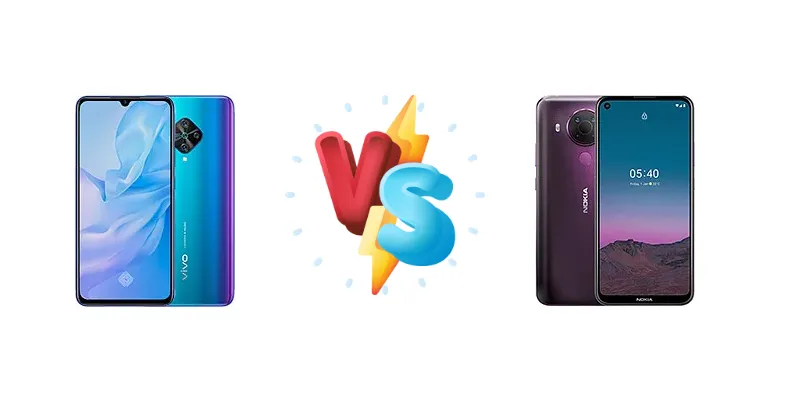
The vivo Y51 (2020) and Nokia 5.4 represent compelling options in the crowded budget smartphone market. Both devices leverage Qualcomm's Snapdragon 6-series, but subtle differences in chipset and charging capabilities can significantly impact the user experience. This comparison dissects these nuances to determine which phone delivers the best value.
🏆 Quick Verdict
For the average user prioritizing consistent performance and faster charging, the vivo Y51 (2020) emerges as the slightly better choice. While both phones share a similar CPU configuration, the 18W charging support of the Y51 offers a tangible advantage over the Nokia 5.4’s slower 10W charging.
| Network |
|---|
| 2G bands | GSM 850 / 900 / 1800 / 1900 | GSM 850 / 900 / 1800 / 1900 |
| 3G bands | HSDPA 850 / 900 / 2100 | HSDPA 850 / 900 / 1900 / 2100 - International |
| 4G bands | 1, 3, 5, 8, 40 | 1, 3, 5, 7, 8, 20, 28, 38, 40, 41 - International |
| Speed | HSPA, LTE | HSPA 42.2/5.76 Mbps, LTE Cat4 150/50 Mbps |
| Technology | GSM / HSPA / LTE | GSM / HSPA / LTE |
| | - | 1, 2, 3, 4, 5, 7, 8, 12, 13, 17, 28, 66 - NA, LATAM |
| Launch |
|---|
| Announced | 2020, September 15. Released 2020, September 19 | 2020, December 15. Released 2020, December 25 |
| Status | Discontinued | Discontinued |
| Body |
|---|
| Dimensions | 159.3 x 75.2 x 8.7 mm (6.27 x 2.96 x 0.34 in) | 161 x 76 x 8.7 mm (6.34 x 2.99 x 0.34 in) |
| SIM | Nano-SIM + Nano-SIM | · Nano-SIM· Nano-SIM + Nano-SIM |
| Weight | 186.7 g (6.60 oz) | 181 g (6.38 oz) |
| Display |
|---|
| Resolution | 1080 x 2340 pixels, 19.5:9 ratio (~404 ppi density) | 720 x 1560 pixels, 19.5:9 ratio (~269 ppi density) |
| Size | 6.38 inches, 99.9 cm2 (~83.4% screen-to-body ratio) | 6.39 inches, 100.2 cm2 (~81.9% screen-to-body ratio) |
| Type | Super AMOLED | IPS LCD, 400 nits (typ) |
| Platform |
|---|
| CPU | Octa-core (4x2.0 GHz Kryo 260 Gold & 4x1.8 GHz Kryo 260 Silver) | Octa-core (4x2.0 GHz Kryo 260 Gold & 4x1.8 GHz Kryo 260 Silver) |
| Chipset | Qualcomm SDM665 Snapdragon 665 (11 nm) | Qualcomm SM6115 Snapdragon 662 (11 nm) |
| GPU | Adreno 610 | Adreno 610 |
| OS | Android 10, Funtouch 10 | Android 10, upgradable to Android 12 |
| Memory |
|---|
| Card slot | microSDXC (uses shared SIM slot) | microSDXC (dedicated slot) |
| Internal | 128GB 4GB RAM | 64GB 4GB RAM, 64GB 6GB RAM, 128GB 4GB RAM |
| Main Camera |
|---|
| Features | LED flash, HDR, panorama | LED flash, HDR, panorama |
| Quad | 48 MP, f/1.8, (wide), 1/2.0", 0.8µm, PDAF
8 MP, f/2.2, 120˚, (ultrawide), 1/4.0", 1.12µm
2 MP (macro)
Auxiliary lens | 48 MP, f/1.8, (wide), PDAF
5 MP, 13mm (ultrawide)
2 MP (macro)
Auxiliary lens |
| Video | 1080p@30fps, gyro-EIS | 1080p@30fps |
| Selfie camera |
|---|
| Features | HDR | - |
| Single | 16 MP, f/2.0, (wide), 1/3.06" 1.0µm | 16 MP, f/2.0, (wide) |
| Video | 1080p@30fps | 1080p@30fps |
| Sound |
|---|
| 3.5mm jack | Yes | Yes |
| 35mm jack | Yes | Yes |
| Loudspeaker | Yes | Yes |
| Comms |
|---|
| Bluetooth | 5.0, A2DP, LE | 4.2, A2DP, aptX Adaptive |
| NFC | No | Yes (market/region dependent) |
| Positioning | GPS, GLONASS, GALILEO, BDS | GPS, GLONASS, GALILEO, BDS |
| Radio | FM radio | FM radio |
| USB | USB Type-C 2.0, OTG | USB Type-C 2.0, OTG |
| WLAN | Wi-Fi 802.11 a/b/g/n/ac, dual-band, Wi-Fi Direct | Wi-Fi 802.11 b/g/n |
| Features |
|---|
| Sensors | Fingerprint (under display, optical), accelerometer, gyro, proximity, compass | Fingerprint (rear-mounted), accelerometer, gyro, proximity |
| Battery |
|---|
| Charging | 18W wired | 10W wired |
| Type | 4500 mAh | Li-Po 4000 mAh |
| Misc |
|---|
| Colors | Mystic Black, Jazzy Blue, Dreamy White | Polar Night, Dusk |
| Models | - | TA-1333, TA-1340, TA-1337, TA-1328, TA-1325 |
| Price | About 180 EUR | About 90 EUR |
| SAR | - | 0.68 W/kg (head) 1.02 W/kg (body) |
| SAR EU | - | 0.99 W/kg (head) 0.96 W/kg (body) |
vivo Y51 (2020, September)
- Faster 18W charging
- Potentially slightly better performance with Snapdragon 665
- Likely more aggressive image processing for vibrant photos
- Software experience may be less clean than Nokia
- Update support may be limited
Nokia 5.4
- Cleaner Android experience with guaranteed updates (Nokia's strength)
- Potentially more natural image processing
- Reliable brand reputation for software support
- Slower 10W charging
- Snapdragon 662 offers minimal performance gain over 665
- May be slightly more expensive
Display Comparison
Neither vivo nor Nokia provide display specifications beyond resolution in their marketing materials. Assuming typical IPS LCD panels for this price bracket, the display experience will likely be similar. However, the absence of high refresh rate support on either device means users won't benefit from smoother scrolling or animations. Color accuracy and peak brightness are likely to be average, making outdoor visibility a potential concern.
Camera Comparison
Detailed camera specifications are scarce for both devices. However, the focus should be on the main sensor performance. Without knowing the sensor size or aperture, it’s difficult to definitively declare a winner. The inclusion of a 2MP macro lens on both phones is largely a marketing gimmick, offering limited practical benefit. Image processing will likely be the differentiating factor, with Nokia historically favoring a more natural look, while vivo often employs more aggressive sharpening and color boosting.
Performance
Both the vivo Y51 (2020) and Nokia 5.4 utilize an octa-core CPU configuration with the same Kryo 260 Gold and Silver cores clocked at 2.0 GHz and 1.8 GHz respectively. The key difference lies in the chipset: the Y51 features the Snapdragon 665, while the Nokia 5.4 uses the Snapdragon 662. The 662 represents a minor iterative upgrade over the 665, offering slightly improved AI processing capabilities, but the real-world performance difference will be minimal for most users. Both phones will handle everyday tasks like browsing, social media, and light gaming adequately. Thermal management is unlikely to be a significant issue given the relatively low power draw of these chipsets.
Battery Life
Battery capacity is not specified in the provided data. However, the charging wattage is a clear differentiator. The vivo Y51 (2020) supports 18W wired charging, allowing for a significantly faster 0-100% charge compared to the Nokia 5.4’s 10W charging. This difference is particularly impactful for users who frequently need to top up their phones throughout the day. While a larger battery capacity on the Nokia 5.4 could partially offset the slower charging, the convenience of 18W charging on the Y51 is a substantial advantage.
Buying Guide
Buy the vivo Y51 (2020, September) if you need quicker top-ups and value a slightly faster overall experience, even if the differences are marginal. Buy the Nokia 5.4 if you prioritize a cleaner Android experience with guaranteed updates and are less concerned about charging speed or absolute performance benchmarks.
Frequently Asked Questions
❓ Will I notice a significant difference in performance between the Snapdragon 665 and 662 in everyday use?
The performance difference between the Snapdragon 665 and 662 is minimal for typical smartphone tasks like browsing, social media, and messaging. Both chipsets are capable of handling these workloads smoothly. You might see a slight improvement in app loading times or multitasking on the Nokia 5.4, but it won't be dramatic.
❓ How long will it take to fully charge each phone from 0%?
With 18W charging, the vivo Y51 (2020) should fully charge in approximately 2-2.5 hours, assuming a typical battery capacity for this class of phone. The Nokia 5.4, with its 10W charging, will likely take 3.5-4 hours to reach 100%, making it less convenient for users who need a quick top-up.
❓ Which phone is better for playing mobile games like PUBG Mobile or Call of Duty?
Both phones can run PUBG Mobile and Call of Duty, but you'll likely need to lower the graphics settings to achieve a smooth frame rate. The Snapdragon 662 in the Nokia 5.4 *might* offer slightly better sustained performance due to its improved thermal efficiency, but the difference will be minimal. Neither phone is ideal for demanding gaming.
❓ How long will Nokia support the Nokia 5.4 with software updates?
Nokia is known for its commitment to software updates. The Nokia 5.4 is guaranteed to receive at least 2 years of Android OS upgrades and 3 years of security updates, ensuring your phone remains secure and up-to-date for a longer period.