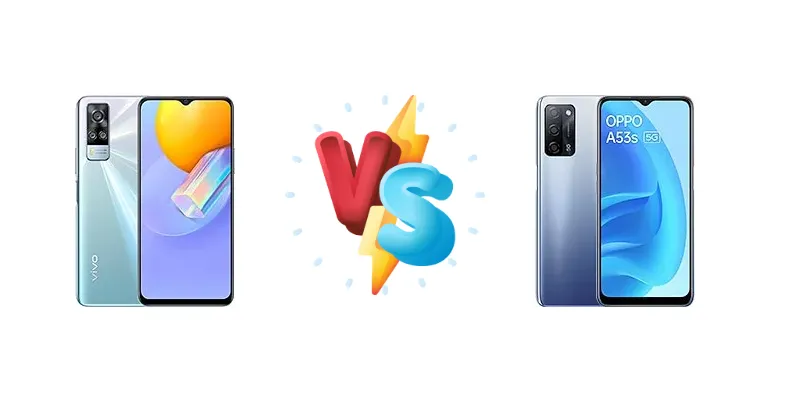
The sub-$200 smartphone market is fiercely competitive. The vivo Y51 (2020) and Oppo A53s 5G represent two distinct approaches: the Y51 prioritizes a refined Qualcomm chipset and efficient power management, while the A53s 5G leaps into the 5G era with a Mediatek Dimensity processor. This comparison dissects their key differences to determine which device delivers the best value.
🏆 Quick Verdict
For users prioritizing future-proofing and faster data speeds, the Oppo A53s 5G is the clear winner. Its Mediatek Dimensity 700 chipset offers a significant performance uplift over the Snapdragon 665 in the vivo Y51. However, the Y51’s more efficient charging and potentially optimized software experience make it a viable option for those on a tighter budget and with less demanding needs.
| Network |
|---|
| 2G bands | GSM 850 / 900 / 1800 / 1900 | GSM 850 / 900 / 1800 / 1900 |
| 3G bands | HSDPA 850 / 900 / 2100 | HSDPA 800 / 850 / 900 / 2100 |
| 4G bands | 1, 3, 5, 8, 40 | 1, 3, 5, 8, 34, 38, 39, 40, 41 |
| 5G bands | - | 1, 28, 41, 77, 78 SA/NSA |
| Speed | HSPA, LTE | HSPA, LTE, 5G |
| Technology | GSM / HSPA / LTE | GSM / HSPA / LTE / 5G |
| Launch |
|---|
| Announced | 2020, December 03. Released 2020, December 07 | 2021, April 27 |
| Status | Discontinued | Available. Released 2021, May 07 |
| Body |
|---|
| Dimensions | 163.9 x 75.3 x 8.4 mm (6.45 x 2.96 x 0.33 in) | 164 x 75.7 x 8.4 mm (6.46 x 2.98 x 0.33 in) |
| SIM | Nano-SIM + Nano-SIM | Nano-SIM + Nano-SIM |
| Weight | 188 g (6.63 oz) | 189.6 g (6.70 oz) |
| Display |
|---|
| Resolution | 1080 x 2408 pixels, 20:9 ratio (~401 ppi density) | 720 x 1600 pixels, 20:9 ratio (~269 ppi density) |
| Size | 6.58 inches, 104.3 cm2 (~84.5% screen-to-body ratio) | 6.52 inches, 102.6 cm2 (~82.7% screen-to-body ratio) |
| Type | IPS LCD | IPS LCD, 480 nits (typ) |
| Platform |
|---|
| CPU | Octa-core (4x2.0 GHz Kryo 260 Gold & 4x1.8 GHz Kryo 260 Silver) | Octa-core (2x2.2 GHz Cortex-A76 & 6x2.0 GHz Cortex-A55) |
| Chipset | Qualcomm SDM665 Snapdragon 665 (11 nm) | Mediatek Dimensity 700 (7 nm) |
| GPU | Adreno 610 | Mali-G57 MC2 |
| OS | Android 11, Funtouch 11 | Android 11, ColorOS 11.1 |
| Memory |
|---|
| Card slot | microSDXC (dedicated slot) | microSDXC (dedicated slot) |
| Internal | 128GB 8GB RAM | 128GB 6GB RAM, 128GB 8GB RAM |
| | - | UFS 2.2 |
| Main Camera |
|---|
| Features | LED flash, HDR, panorama | LED flash, HDR, panorama |
| Single | - | 8 MP, f/2.0, 26mm (wide) |
| Triple | 48 MP, f/1.8, (wide), 1/2.0", 0.8µm, PDAF
8 MP, f/2.2, 120˚, (ultrawide), 1/4.0", 1.12µm
2 MP (macro) | 13 MP, f/2.2, 25mm (wide), 1/3.06", 1.12µm, PDAF
2 MP (macro)
Auxiliary lens |
| Video | 4K@30fps, 1080p@30fps, gyro-EIS | 1080p@30fps |
| Selfie camera |
|---|
| Features | HDR | HDR |
| Single | 16 MP, f/2.0, (wide), 1/3.06" 1.0µm | 8 MP, f/2.0, 26mm (wide) |
| Video | 1080p@30fps | 1080p@30fps |
| Sound |
|---|
| 3.5mm jack | Yes | Yes |
| 35mm jack | Yes | Yes |
| Loudspeaker | Yes | Yes |
| Comms |
|---|
| Bluetooth | 5.0, A2DP, LE | 5.0, A2DP, LE, aptX HD |
| NFC | No | No |
| Positioning | GPS, GLONASS, GALILEO, BDS | GPS, GLONASS, GALILEO, BDS, QZSS |
| Radio | FM radio | No |
| USB | USB Type-C 2.0, OTG | USB Type-C 2.0, OTG |
| WLAN | Wi-Fi 802.11 a/b/g/n/ac, dual-band, Wi-Fi Direct | Wi-Fi 802.11 a/b/g/n/ac, dual-band, Wi-Fi Direct |
| Features |
|---|
| Sensors | Fingerprint (side-mounted), accelerometer, gyro, proximity, compass | Fingerprint (side-mounted), accelerometer, gyro, proximity, compass |
| Battery |
|---|
| Charging | 18W wired, 70% in 67 min | 10W wired |
| Type | 5000 mAh | Li-Po 5000 mAh |
| Misc |
|---|
| Colors | Titanium Sapphire, Crystal Symphony | Crystal Blue, Ink Black |
| Models | V2030 | CPH2321 |
| Price | About 210 EUR | About 170 EUR |
vivo Y51 (2020, December)
- Faster 18W charging for quicker top-ups.
- Potentially better battery life due to Snapdragon 665 efficiency.
- Proven and reliable Qualcomm chipset.
- Less powerful processor compared to the Dimensity 700.
- Lacks 5G connectivity, limiting future-proofing.
Oppo A53s 5G
- 5G connectivity for faster data speeds.
- More powerful Mediatek Dimensity 700 processor.
- Improved image processing capabilities.
- Slower 10W charging.
- Potentially shorter battery life due to 5G and more powerful processor.
Display Comparison
Neither device boasts a standout display. While specific display specs (resolution, panel type) are missing, both likely utilize LCD panels common in this price bracket. The focus here is on the underlying processing power to drive the display, where the A53s 5G has an advantage. The more powerful GPU in the Dimensity 700 will translate to smoother scrolling and potentially better performance in graphically intensive apps, even if the panel itself is similar.
Camera Comparison
Without detailed camera specs beyond the presence of a 2MP macro lens (which is largely irrelevant), it’s difficult to make a definitive judgment. However, the chipset plays a role in image processing. The Dimensity 700’s image signal processor (ISP) is more advanced than the Snapdragon 665’s, potentially leading to better dynamic range and noise reduction in photos and videos. The A53s 5G likely benefits from faster image processing speeds, resulting in quicker capture times and improved overall image quality. The main sensor resolution is likely similar on both, making the ISP the key differentiator.
Performance
The core difference lies in the chipsets. The Oppo A53s 5G’s Mediatek Dimensity 700, built on a 7nm process, is a substantial upgrade over the vivo Y51’s Qualcomm Snapdragon 665 (11nm). The Dimensity 700’s Cortex-A76 performance cores deliver significantly faster single-core performance, crucial for app responsiveness. The Snapdragon 665 relies on older Kryo 260 cores, which, while efficient, lack the raw power of the A76. This translates to faster app launches, smoother multitasking, and a more enjoyable gaming experience on the A53s 5G. The 7nm node also contributes to better thermal efficiency, potentially reducing throttling during sustained workloads.
Battery Life
The vivo Y51’s 18W charging is a clear advantage over the Oppo A53s 5G’s 10W charging. While battery capacity isn’t specified, 18W charging can deliver a 70% charge in 67 minutes, offering a significantly faster top-up time. The Snapdragon 665 is also known for its power efficiency, potentially offsetting any capacity differences. The A53s 5G’s 5G connectivity will consume more power, potentially negating some of the benefits of the Dimensity 700’s 7nm process. Users prioritizing minimal downtime will favor the Y51’s faster charging.
Buying Guide
Buy the vivo Y51 (2020, December) if you need a reliable daily driver with a focus on efficient power usage and a proven chipset. It’s ideal for users who primarily browse, use social media, and make calls. Buy the Oppo A53s 5G if you prioritize 5G connectivity, faster app loading times, and a more responsive experience for light gaming and multitasking. It’s best suited for users who want a taste of next-generation network speeds without breaking the bank.
Frequently Asked Questions
❓ Will the Oppo A53s 5G experience significant battery drain when using 5G networks?
Yes, 5G connectivity inherently consumes more power than 4G. While the Dimensity 700's 7nm process helps mitigate this, expect a noticeable reduction in battery life when actively using 5G compared to Wi-Fi or 4G. Optimizing app background activity and limiting 5G usage when not needed can help extend battery life.
❓ Is the Snapdragon 665 in the vivo Y51 capable of handling popular games like PUBG Mobile or Call of Duty Mobile?
The Snapdragon 665 can run PUBG Mobile and Call of Duty Mobile, but likely at lower graphics settings and frame rates. Expect some stuttering and frame drops during intense gameplay. The Oppo A53s 5G’s Dimensity 700 will provide a significantly smoother and more enjoyable gaming experience with higher settings.
❓ Does the Oppo A53s 5G support all 5G bands available in the US?
This depends on the specific variant of the Oppo A53s 5G. It's crucial to check the phone's specifications and carrier compatibility before purchasing to ensure it supports the 5G bands used by your mobile provider. Some variants may only support a limited range of 5G frequencies.