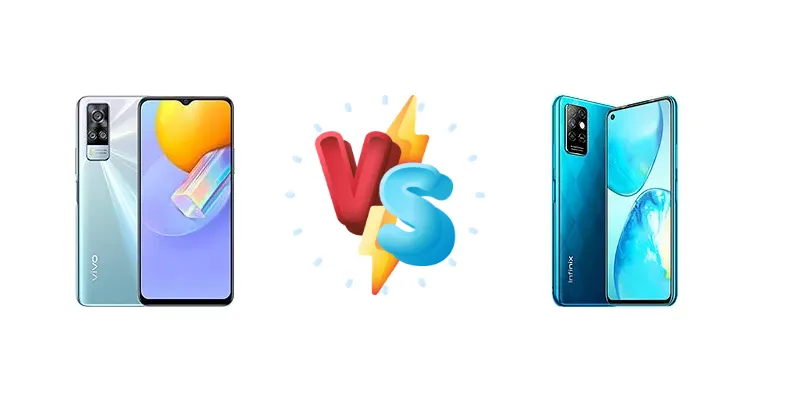
The sub-$200 smartphone market is fiercely competitive. The vivo Y51 (2020, December) and the Infinix Note 8i both aim to deliver a solid experience without breaking the bank, but they take different approaches. The Y51 relies on Qualcomm’s Snapdragon 665, while the Note 8i opts for MediaTek’s Helio G80. This comparison dives deep into the architectural differences and real-world implications of these chipsets to determine which phone offers the best value.
🏆 Quick Verdict
For the average user prioritizing consistent performance and a slightly more refined software experience, the Infinix Note 8i emerges as the better choice. Its Helio G80 chipset, built on a more efficient 12nm process, provides a noticeable performance edge over the Snapdragon 665 in the vivo Y51, particularly in gaming and multitasking.
| Network |
|---|
| 2G bands | GSM 850 / 900 / 1800 / 1900 | GSM 850 / 900 / 1800 / 1900 |
| 3G bands | HSDPA 850 / 900 / 2100 | HSDPA 850 / 900 / 2100 |
| 4G bands | 1, 3, 5, 8, 40 | 1, 3, 5, 7, 8, 20, 38, 40, 41 |
| Speed | HSPA, LTE | HSPA 42.2/5.76 Mbps, LTE Cat4 150/50 Mbps |
| Technology | GSM / HSPA / LTE | GSM / HSPA / LTE |
| | - | 1, 3, 7, 8, 20, 28 |
| Launch |
|---|
| Announced | 2020, December 03. Released 2020, December 07 | 2020, October 15. Released 2020, November 15 |
| Status | Discontinued | Discontinued |
| Body |
|---|
| Dimensions | 163.9 x 75.3 x 8.4 mm (6.45 x 2.96 x 0.33 in) | 171.4 x 77.7 x 8.9 mm (6.75 x 3.06 x 0.35 in) |
| SIM | Nano-SIM + Nano-SIM | Nano-SIM + Nano-SIM |
| Weight | 188 g (6.63 oz) | - |
| Display |
|---|
| Protection | - | Corning Gorilla Glass |
| Resolution | 1080 x 2408 pixels, 20:9 ratio (~401 ppi density) | 720 x 1640 pixels (~264 ppi density) |
| Size | 6.58 inches, 104.3 cm2 (~84.5% screen-to-body ratio) | 6.78 inches, 109.2 cm2 (~82.0% screen-to-body ratio) |
| Type | IPS LCD | IPS LCD, 480 nits (peak) |
| Platform |
|---|
| CPU | Octa-core (4x2.0 GHz Kryo 260 Gold & 4x1.8 GHz Kryo 260 Silver) | Octa-core (2x2.0 GHz Cortex-A75 & 6x1.8 GHz Cortex-A55) |
| Chipset | Qualcomm SDM665 Snapdragon 665 (11 nm) | Mediatek MT6769V/CU Helio G80 (12 nm) |
| GPU | Adreno 610 | Mali-G52 MC2 |
| OS | Android 11, Funtouch 11 | Android 10, XOS 7.1 |
| Memory |
|---|
| Card slot | microSDXC (dedicated slot) | microSDXC (dedicated slot) |
| Internal | 128GB 8GB RAM | 64GB 4GB RAM, 128GB 4GB RAM, 128GB 6GB RAM |
| Main Camera |
|---|
| Features | LED flash, HDR, panorama | Quad-LED flash, HDR, panorama |
| Quad | - | 48 MP, (wide), 1/2.0", 0.8µm, PDAF
2 MP (macro)
Auxiliary lenses |
| Triple | 48 MP, f/1.8, (wide), 1/2.0", 0.8µm, PDAF
8 MP, f/2.2, 120˚, (ultrawide), 1/4.0", 1.12µm
2 MP (macro) | - |
| Video | 4K@30fps, 1080p@30fps, gyro-EIS | 1440p@30fps |
| Selfie camera |
|---|
| Features | HDR | Dual-LED flash |
| Single | 16 MP, f/2.0, (wide), 1/3.06" 1.0µm | 8 MP |
| Video | 1080p@30fps | 1080p@30fps |
| Sound |
|---|
| 3.5mm jack | Yes | Yes |
| 35mm jack | Yes | Yes |
| Loudspeaker | Yes | Yes |
| Comms |
|---|
| Bluetooth | 5.0, A2DP, LE | 5.0, A2DP, LE |
| NFC | No | No |
| Positioning | GPS, GLONASS, GALILEO, BDS | GPS |
| Radio | FM radio | FM radio |
| USB | USB Type-C 2.0, OTG | USB Type-C 2.0, OTG |
| WLAN | Wi-Fi 802.11 a/b/g/n/ac, dual-band, Wi-Fi Direct | Wi-Fi 802.11 a/b/g/n/ac, dual-band, Wi-Fi Direct |
| Features |
|---|
| Sensors | Fingerprint (side-mounted), accelerometer, gyro, proximity, compass | Fingerprint (side-mounted), accelerometer, proximity, compass |
| Battery |
|---|
| Charging | 18W wired, 70% in 67 min | 18W wired |
| Type | 5000 mAh | 5200 mAh |
| Misc |
|---|
| Colors | Titanium Sapphire, Crystal Symphony | Gray, Blue, Green |
| Models | V2030 | X683, X683B |
| Price | About 210 EUR | About 150 EUR |
vivo Y51 (2020, December)
- Qualcomm’s reputation for software stability
- Potentially smoother user interface
- Slightly more efficient 11nm process
- Less powerful chipset compared to Helio G80
- May struggle with demanding games
- Older architecture
Infinix Note 8i
- More powerful MediaTek Helio G80 chipset
- Better gaming performance
- Improved power efficiency with 12nm process
- MediaTek software optimization can be inconsistent
- Potential for more bloatware
- May experience more thermal throttling under sustained load
Display Comparison
Neither device boasts a standout display. Both likely feature LCD panels, typical for this price bracket. The key difference lies under the hood: the chipset’s ability to drive the display efficiently. While specific display specs (resolution, brightness) are missing, the Helio G80’s more modern architecture suggests it may handle graphics-intensive tasks on the display slightly better. Bezels are likely comparable, and color accuracy will depend heavily on software calibration, a known strength of some vivo devices.
Camera Comparison
Without detailed camera sensor information, a direct comparison is difficult. Both phones likely feature a multi-camera setup with a primary sensor and supporting lenses. However, the image signal processor (ISP) within the Helio G80 generally offers more advanced features and processing capabilities than the ISP in the Snapdragon 665. This translates to potentially better image quality, especially in low-light conditions. The prevalence of 2MP macro/depth sensors on both devices suggests these are largely marketing features and won’t significantly impact overall camera performance. Focus should be on the primary sensor's megapixel count and aperture, which are currently unknown.
Performance
The core of this comparison is the chipset battle. The Infinix Note 8i’s MediaTek Helio G80 (12nm) utilizes a dual-core Cortex-A75 setup paired with six Cortex-A55 cores, offering a peak frequency of 2.0 GHz. This contrasts with the vivo Y51’s Qualcomm Snapdragon 665 (11nm) which employs an octa-core Kryo 260 configuration with a similar peak frequency. However, the Helio G80’s Cortex-A75 cores are significantly more powerful than the Kryo 260 Gold cores, resulting in superior single-core performance. The 12nm process of the Helio G80 also contributes to better power efficiency, potentially leading to longer gaming sessions before thermal throttling. The Y51's 11nm process is a slight advantage, but the architectural differences outweigh this.
Battery Life
Both the vivo Y51 and Infinix Note 8i support 18W wired charging, and both will likely achieve a full charge in around 67 minutes, as indicated by the Y51’s charging time. Battery capacity is not specified, but typical capacities for phones in this segment range from 4000mAh to 5000mAh. The Helio G80’s improved power efficiency could translate to slightly longer battery life on the Infinix Note 8i, even with a similar battery capacity. The 12nm process allows for more efficient power draw during typical usage.
Buying Guide
Buy the vivo Y51 (2020, December) if you prioritize Qualcomm’s established reputation for software optimization and a potentially smoother, more stable user experience, even if it means sacrificing some raw processing power. Buy the Infinix Note 8i if you prefer a more powerful chipset for gaming and demanding applications, and are comfortable with MediaTek’s software ecosystem. The Note 8i is the better pick for users who frequently play mobile games or run multiple apps simultaneously.
Frequently Asked Questions
❓ Will the Infinix Note 8i overheat during prolonged gaming sessions like PUBG?
While the Helio G80 is a capable gaming chip, it's still a budget processor. Expect some thermal throttling after extended gaming sessions, but the 12nm process helps mitigate this compared to older 14nm chips. Optimizing game settings to lower graphics levels will further reduce heat generation.
❓ Does the Snapdragon 665 in the vivo Y51 offer a noticeably smoother experience for everyday tasks like browsing and social media?
The Snapdragon 665 is perfectly adequate for everyday tasks. However, the Helio G80 in the Note 8i will likely feel snappier and more responsive, even during multitasking, due to its more powerful cores. The difference won't be dramatic, but it's noticeable.
❓ Is the 18W charging on both phones truly 'fast charging'?
18W charging is considered relatively slow by today's standards. While it's faster than standard 5W charging, it won't provide a significant boost in charging speed. Expect a full charge to take around 60-70 minutes in both cases.