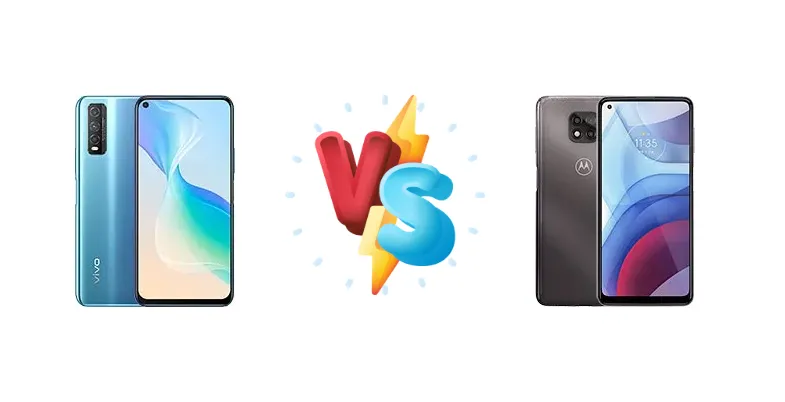
The vivo Y50t and Motorola Moto G Power (2021) represent compelling options in the sub-$200 smartphone market. While both aim to deliver essential features at an accessible price, they diverge significantly in their core processing power. This comparison dissects the architectural differences between the Snapdragon 720G and 662, evaluating their impact on everyday use, gaming, and battery efficiency.
🏆 Quick Verdict
For the average user prioritizing responsiveness and future-proofing, the vivo Y50t emerges as the stronger choice. Its Snapdragon 720G chipset, built on an 8nm process, offers a noticeable performance advantage over the Moto G Power’s Snapdragon 662, despite the Motorola’s larger battery. However, the Moto G Power’s battery life will likely be longer in real-world use.
| Network |
|---|
| 2G bands | GSM 850 / 900 / 1800 / 1900 | GSM 850 / 900 / 1800 / 1900 |
| 3G bands | HSDPA 850 / 900 / 2100 | HSDPA 850 / 900 / 1700(AWS) / 1900 / 2100 |
| 4G bands | 1, 3, 5, 8, 34, 38, 39, 40, 41 | 1, 2, 3, 4, 5, 7, 8, 12, 13, 14, 17, 25, 26, 29, 30, 38, 41, 66, 71 |
| Speed | HSPA, LTE | HSPA, LTE |
| Technology | GSM / CDMA / HSPA / CDMA2000 / LTE | GSM / CDMA / HSPA / EVDO / LTE |
| | CDMA2000 1x | CDMA2000 1xEV-DO |
| Launch |
|---|
| Announced | 2021, November 16 | 2021, January 08 |
| Status | Available. Released 2021, November 16 | Available. Released 2021, January 14 |
| Body |
|---|
| Build | - | Glass front, plastic back, plastic frame |
| Dimensions | 162 x 76.6 x 8.5 mm (6.38 x 3.02 x 0.33 in) | 165.3 x 75.9 x 9.5 mm (6.51 x 2.99 x 0.37 in) |
| SIM | Nano-SIM + Nano-SIM | Nano-SIM |
| Weight | 190 g (6.70 oz) | 206.5 g (7.30 oz) |
| | - | Water-repellent coating |
| Display |
|---|
| Resolution | 1080 x 2340 pixels, 19.5:9 ratio (~395 ppi density) | 720 x 1600 pixels, 20:9 ratio (~266 ppi density) |
| Size | 6.53 inches, 104.7 cm2 (~84.4% screen-to-body ratio) | 6.6 inches, 105.2 cm2 (~83.8% screen-to-body ratio) |
| Type | IPS LCD | IPS LCD |
| Platform |
|---|
| CPU | Octa-core (2x2.3 GHz Kryo 465 Gold & 6x1.8 GHz Kryo 465 Silver) | Octa-core (4x2.0 GHz Kryo 260 Gold & 4x1.8 GHz Kryo 260 Silver) |
| Chipset | Qualcomm SM7125 Snapdragon 720G (8 nm) | Qualcomm SM6115 Snapdragon 662 (11 nm) |
| GPU | Adreno 618 | Adreno 610 |
| OS | Android 10, OriginOS | Android 10 |
| Memory |
|---|
| Card slot | microSDXC | microSDXC (dedicated slot) |
| Internal | 128GB 8GB RAM | 32GB 3GB RAM, 64GB 4GB RAM |
| | UFS 2.1 | eMMC 5.1 |
| Main Camera |
|---|
| Features | LED flash, HDR, panorama | LED flash, HDR, panorama |
| Single | 8 MP, f/2.0, (wide) | - |
| Triple | 48 MP, f/1.8, 25mm (wide), PDAF
2 MP (macro)
Auxiliary lens | 48 MP, f/1.7, (wide), 1/2.0", 0.8µm, PDAF
2 MP (macro)
Auxiliary lens |
| Video | 4K@30fps, 1080p@30/60fps; gyro-EIS | 1080p@30/60fps, gyro-EIS |
| Selfie camera |
|---|
| Features | HDR | HDR |
| Single | 8 MP, f/2.0, (wide) | 8 MP, f/2.0, 1.12µm |
| Video | 1080p@30fps | 1080p@30fps, gyro-EIS |
| Sound |
|---|
| 3.5mm jack | Yes | Yes |
| 35mm jack | Yes | Yes |
| Loudspeaker | Yes | Yes |
| Comms |
|---|
| Bluetooth | 5.1, A2DP, LE, aptX HD | 5.0, A2DP, LE |
| NFC | No | No |
| Positioning | GPS, GLONASS, BDS, GALILEO | GPS, GLONASS, GALILEO |
| Radio | No | FM radio |
| USB | microUSB 2.0, OTG | USB Type-C 2.0 |
| WLAN | Wi-Fi 802.11 a/b/g/n/ac, dual-band, Wi-Fi Direct | Wi-Fi 802.11 a/b/g/n/ac, dual-band, Wi-Fi Direct |
| Features |
|---|
| Sensors | Fingerprint (side-mounted), accelerometer, gyro, proximity, compass | Fingerprint (side-mounted), accelerometer, gyro, proximity, compass, barometer |
| Battery |
|---|
| Charging | 18W wired | 15W wired |
| Type | 4500 mAh | Li-Po 5000 mAh |
| Misc |
|---|
| Colors | Black, Blue | Flash Gray, Polar Silver |
| Models | V2023EA | - |
| Price | About 190 EUR | About 60 EUR |
vivo Y50t
- More powerful Snapdragon 720G chipset
- More efficient 8nm process for better battery life and thermal management
- Faster 18W charging
- Potentially better image processing
- Likely smaller battery capacity than Moto G Power
- May be slightly more expensive
Motorola Moto G Power (2021)
- Likely larger battery capacity for extended runtime
- Generally more affordable
- Reliable Motorola brand reputation
- Simple and clean Android experience
- Less powerful Snapdragon 662 chipset
- Slower 15W charging
- Less efficient 11nm process
Display Comparison
Neither device is known for a standout display. Given the context data focuses on the chipset, we can infer both likely utilize LCD panels common in this price bracket. The key difference lies in the processing power driving the display; the Snapdragon 720G in the Y50t has a more capable ISP which *could* translate to slightly better image processing for display output, though this is difficult to quantify without direct testing. Bezels are likely comparable, and color accuracy will be standard for the segment.
Camera Comparison
Without detailed camera specs, it’s difficult to make a definitive judgment. However, the Snapdragon 720G’s superior Image Signal Processor (ISP) gives the vivo Y50t an advantage in image processing. This translates to potentially better dynamic range, noise reduction, and overall image quality, especially in challenging lighting conditions. We can assume both phones include a standard array of cameras, but the Y50t’s ISP is more likely to extract more detail and clarity from the sensors. The Moto G Power may rely more heavily on software processing to compensate for a less powerful ISP.
Performance
The core distinction here is the chipset architecture. The vivo Y50t’s Snapdragon 720G (8nm) boasts a more modern CPU configuration – octa-core with 2x2.3 GHz Kryo 465 Gold and 6x1.8 GHz Kryo 465 Silver cores – compared to the Moto G Power’s Snapdragon 662 (11nm) with 4x2.0 GHz Kryo 260 Gold and 4x1.8 GHz Kryo 260 Silver. The 8nm process node of the 720G is significantly more efficient, leading to better thermal management and sustained performance under load. While both are octa-core, the 720G’s higher clock speeds and more efficient architecture will result in faster app launch times, smoother multitasking, and a more responsive user experience. The Snapdragon 662, while capable, is a generation older and will show its limitations with more demanding tasks.
Battery Life
The Motorola Moto G Power (2021) likely has a larger battery capacity, a hallmark of the 'Power' line. However, the vivo Y50t’s more efficient Snapdragon 720G chipset will consume less power during typical usage. The Moto G Power supports 15W charging, while the Y50t supports 18W. While the difference isn’t massive, the 18W charging on the Y50t will offer a slightly faster top-up time. The Moto G Power will likely provide longer screen-on time, but the Y50t’s efficiency could close the gap, especially with optimized software.
Buying Guide
Buy the vivo Y50t if you need a phone that feels snappier in daily tasks, handles multitasking more efficiently, and offers a better gaming experience. This is the phone for users who want a bit more headroom for demanding apps and occasional gaming. Buy the Motorola Moto G Power (2021) if you prioritize maximizing battery life above all else and primarily use your phone for basic communication, social media, and light web browsing. It’s the ideal choice for users who frequently find themselves away from a charger.
Frequently Asked Questions
❓ Will the Snapdragon 662 in the Moto G Power struggle with graphically intensive games like PUBG Mobile?
The Snapdragon 662 can run PUBG Mobile, but you'll likely need to lower the graphics settings to achieve a smooth frame rate. The Snapdragon 720G in the vivo Y50t offers a significantly better gaming experience, allowing for higher settings and more consistent performance.
❓ How much faster will the 18W charging on the vivo Y50t be compared to the 15W charging on the Moto G Power?
While not a dramatic difference, the 18W charging on the Y50t will likely shave off around 15-20 minutes from a full 0-100% charge compared to the Moto G Power. The actual time will depend on battery size and usage during charging.
❓ Does the Snapdragon 720G offer 5G connectivity?
No, the Snapdragon 720G does not natively support 5G. Both the vivo Y50t and Moto G Power (2021) are 4G LTE devices. If 5G is a priority, you'll need to consider phones with newer chipsets.
❓ Is the difference in performance between these two phones noticeable for everyday tasks like browsing and social media?
Yes, the Snapdragon 720G in the vivo Y50t will provide a noticeably smoother and more responsive experience for everyday tasks. App launch times will be faster, multitasking will be more fluid, and scrolling will feel less laggy compared to the Moto G Power.