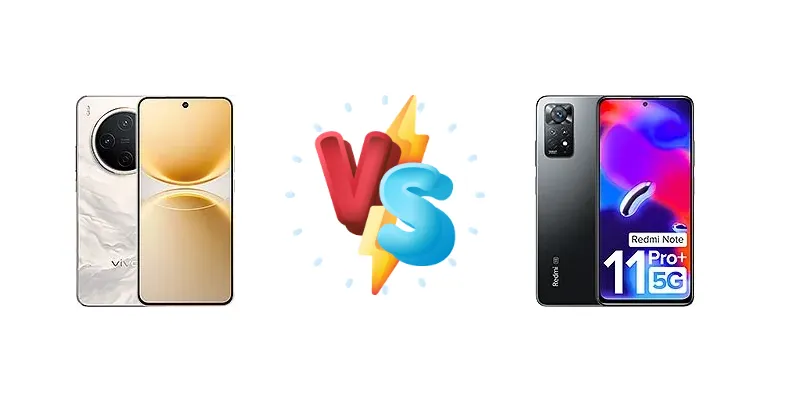
The mid-range 5G smartphone market is fiercely competitive, and the vivo Y500 Pro and Xiaomi Redmi Note 11 Pro+ 5G (India) represent compelling options. The Y500 Pro boasts a newer, more efficient chipset and significantly faster charging, while the Redmi Note 11 Pro+ 5G leverages Xiaomi’s established ecosystem and a well-regarded camera system. This comparison dissects the key differences to help you choose the right device.
🏆 Quick Verdict
For users prioritizing raw performance and ultra-fast charging, the vivo Y500 Pro is the clear winner. Its Dimensity 7400 chipset offers a substantial performance uplift over the Snapdragon 695, and the 90W charging is a game-changer. However, the Redmi Note 11 Pro+ 5G remains a strong contender for those valuing a more established brand and potentially better camera software.
| Network |
|---|
| 2G bands | GSM 850 / 900 / 1800 / 1900 | GSM 850 / 900 / 1800 / 1900 - SIM 1 & SIM 2 |
| 3G bands | HSDPA 800 / 850 / 900 / 2100 | HSDPA 850 / 900 / 1900 / 2100 |
| 4G bands | 1, 3, 5, 8, 19, 28, 34, 38, 39, 40, 41, 42, 48 | 1, 3, 5, 8, 40, 41 |
| 5G bands | 1, 3, 5, 8, 28, 38, 40, 41, 48, 77, 78 SA/NSA | 1, 3, 5, 8, 28, 40, 78 SA/NSA |
| Speed | HSPA, LTE, 5G | HSPA, LTE-A (CA), 5G |
| Technology | GSM / CDMA / HSPA / LTE / 5G | GSM / HSPA / LTE / 5G |
| Launch |
|---|
| Announced | 2025, November 10 | 2022, March 09 |
| Status | Available. Released 2025, November 14 | Available. Released 2022, March 15 |
| Body |
|---|
| Build | Glass front (Diamond Shield Glass), glass back, plastic frame | Glass front (Gorilla Glass 5), glass back |
| Dimensions | 160.2 x 74.5 x 7.8 mm (6.31 x 2.93 x 0.31 in) | 164.2 x 76.1 x 8.1 mm (6.46 x 3.00 x 0.32 in) |
| SIM | Nano-SIM + Nano-SIM | Hybrid Dual SIM (Nano-SIM, dual stand-by) |
| Weight | 198.6 g (7.02 oz) | 202 g (7.13 oz) |
| | - | IP53, dust and splash resistant |
| Display |
|---|
| Protection | Diamond Shield Glass | Corning Gorilla Glass 5 |
| Resolution | 1260 x 2800 pixels, 20:9 ratio (~460 ppi density) | 1080 x 2400 pixels, 20:9 ratio (~395 ppi density) |
| Size | 6.67 inches, 107.4 cm2 (~90.0% screen-to-body ratio) | 6.67 inches, 107.4 cm2 (~86.0% screen-to-body ratio) |
| Type | AMOLED, 1B colors, 120Hz, 3840 PWM, 800 nits (typ), 1600 nits (HBM) | Super AMOLED, 120Hz, 700 nits, 1200 nits (peak) |
| Platform |
|---|
| CPU | Octa-core (4x2.6 GHz Cortex-A78 & 4x2.0 GHz Cortex-A55) | Octa-core (2x2.2 GHz Kryo 660 Gold & 6x1.7 GHz Kryo 660 Silver) |
| Chipset | Mediatek Dimensity 7400 (4 nm) | Qualcomm SM6375 Snapdragon 695 5G (6 nm) |
| GPU | Mali-G615 MC2 | Adreno 619 |
| OS | Android 16, OriginOS 6 | Android 11, MIUI 13 |
| Memory |
|---|
| Card slot | No | microSDXC (uses shared SIM slot) |
| Internal | 128GB 8GB RAM, 256GB 8GB RAM, 256GB 12GB RAM, 512GB 12GB RAM | 64GB 6GB RAM, 128GB 6GB RAM, 128GB 8GB RAM, 256GB 8GB RAM |
| | - | UFS 2.2 |
| Main Camera |
|---|
| Dual | 200 MP, f/1.9, 23mm (wide), 1/1.56", 0.5µm, PDAF, OIS
Auxiliary lens | - |
| Features | LED flash, panorama, HDR | LED flash, HDR, panorama |
| Triple | - | 108 MP, f/1.9, 26mm (wide), 1/1.52", 0.7µm, PDAF
8 MP, f/2.2, 118˚ (ultrawide)
2 MP, f/2.4, (macro) |
| Video | 4K, 1080p, gyro-EIS | 1080p@30fps |
| Selfie camera |
|---|
| Features | Panorama | - |
| Single | 32 MP, f/2.5, (wide) | 16 MP, f/2.5, (wide), 1/3.06" 1.0µm |
| Video | 4K, 1080p | 1080p@30fps |
| Sound |
|---|
| 3.5mm jack | - | Yes |
| 35mm jack | No | - |
| Loudspeaker | Yes | Yes, with stereo speakers |
| | - | 24-bit/192kHz audio |
| Comms |
|---|
| Bluetooth | 5.4, A2DP, LE, aptX HD | 5.1, A2DP, LE |
| Infrared port | Yes | Yes |
| NFC | Yes | No |
| Positioning | GPS (L1+L5), BDS (B1I+B1a), GALILEO (E1+E5a), QZSS (L1+L5), GLONASS | GPS, GLONASS, BDS, GALILEO |
| Radio | No | Unspecified |
| USB | USB Type-C 2.0, OTG | USB Type-C 2.0, OTG |
| WLAN | Wi-Fi 802.11 a/b/g/n/ac/6, dual-band | Wi-Fi 802.11 a/b/g/n/ac, dual-band, Wi-Fi Direct |
| Features |
|---|
| Sensors | Fingerprint (under display, optical), accelerometer, gyro, proximity, compass | Fingerprint (side-mounted), accelerometer, gyro, proximity, compass |
| Battery |
|---|
| Charging | 90W wired
Reverse wired | 67W wired, PD3.0, QC3, 50% in 15 min, 100% in 42 min (advertised) |
| Type | Si/C Li-Ion 7000 mAh | Li-Po 5000 mAh, non-removable |
| Misc |
|---|
| Colors | Black, Green, Pink, Gold | Mirage Blue, Phantom White, Stealth Black |
| Models | V2516A | 2201116SI |
| Price | About 220 EUR | About 250 EUR |
vivo Y500 Pro
- Significantly faster 90W charging
- More powerful and efficient Dimensity 7400 chipset
- Potentially better thermal management due to 4nm process
- Brand recognition may be lower than Xiaomi
- Camera performance is unknown and potentially less refined
Xiaomi Redmi Note 11 Pro+ 5G (India)
- Established brand reputation and ecosystem
- Likely strong camera software and image processing
- Good 67W fast charging support
- Less powerful Snapdragon 695 chipset
- 6nm process node may lead to more thermal throttling
- Slower charging compared to vivo Y500 Pro
Display Comparison
Neither device's display specifications are provided, so a direct comparison is limited. However, given the Redmi Note 11 Pro+ 5G's positioning, it likely features a Super AMOLED panel, common in Xiaomi's mid-range offerings. The vivo Y500 Pro, being newer, *could* incorporate advancements like higher peak brightness or a more efficient panel technology. Without specific data, we can assume both offer acceptable viewing experiences for their price points, but the Redmi may have an edge in color vibrancy.
Camera Comparison
Camera details are absent for both devices. However, Xiaomi’s Redmi Note series is generally known for its strong camera performance, often featuring high-resolution sensors. The Redmi Note 11 Pro+ 5G (India) likely prioritizes image processing and software features. Without knowing the sensor sizes or apertures of the vivo Y500 Pro, it’s difficult to assess its camera capabilities. It's reasonable to assume Xiaomi has a more mature camera software pipeline at this stage.
Performance
The core difference lies in the chipsets. The vivo Y500 Pro’s Mediatek Dimensity 7400 (4nm) is architecturally superior to the Xiaomi’s Qualcomm Snapdragon 695 5G (6nm). The Dimensity 7400 utilizes Cortex-A78 cores for peak performance, while the Snapdragon 695 relies on Kryo 660 Gold cores. The 4nm process node of the Dimensity 7400 translates to better power efficiency and potentially lower thermal throttling during sustained workloads. This means the Y500 Pro will likely deliver smoother performance in demanding games and applications. The Snapdragon 695 is still capable for everyday tasks, but will struggle to match the Y500 Pro's sustained performance.
Battery Life
The vivo Y500 Pro’s 90W wired charging is a significant advantage. While the Redmi Note 11 Pro+ 5G (India) advertises 67W charging with a 0-100% claim of 42 minutes, the Y500 Pro’s 90W will demonstrably reduce charging times. The advertised 50% in 15 minutes for the Redmi is respectable, but the Y500 Pro will likely surpass this. Battery capacity isn't specified for either, but the faster charging of the Y500 Pro mitigates the impact of a potentially smaller battery.
Buying Guide
Buy the vivo Y500 Pro if you need a phone that can handle demanding tasks like gaming and video editing with ease, and if minimizing charging time is a priority. Buy the Xiaomi Redmi Note 11 Pro+ 5G (India) if you prefer a phone with a well-established brand reputation, a potentially more refined camera experience, and are comfortable with slightly slower charging speeds and less raw processing power.
Frequently Asked Questions
❓ Will the Snapdragon 695 in the Redmi Note 11 Pro+ 5G struggle with graphically intensive games like Genshin Impact?
The Snapdragon 695 is capable of running Genshin Impact, but you'll likely need to lower the graphics settings to medium or low to maintain a stable frame rate. The Dimensity 7400 in the vivo Y500 Pro will provide a significantly smoother experience at higher settings due to its more powerful CPU and GPU.
❓ How much faster is the 90W charging on the vivo Y500 Pro compared to the 67W charging on the Redmi Note 11 Pro+ 5G in real-world use?
While the Redmi Note 11 Pro+ 5G claims 0-100% in 42 minutes, the vivo Y500 Pro's 90W charging will likely achieve a full charge in around 30-35 minutes. The difference is most noticeable in the initial stages of charging, with the Y500 Pro gaining a substantial percentage in the first 15-20 minutes.
❓ Does the Dimensity 7400 chipset in the vivo Y500 Pro support advanced features like ray tracing?
The Dimensity 7400 does *not* natively support hardware-accelerated ray tracing. This feature is typically reserved for higher-end chipsets. However, the Dimensity 7400's powerful GPU can still handle demanding graphics tasks and provide a smooth gaming experience.