
vivo Y500 Pro vs Samsung Galaxy A53 5G: Which Mid-Range 5G Phone Reigns Supreme?
| Phones Images | |||||
|---|---|---|---|---|---|
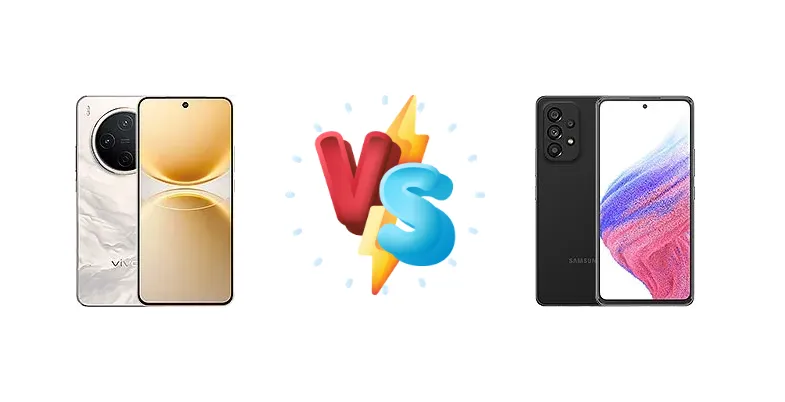
|
🏆 Quick Verdict
For the average user prioritizing charging speed and potentially better long-term performance, the vivo Y500 Pro emerges as the winner. Its 90W charging is a game-changer, and the Dimensity 7400’s 4nm process offers efficiency advantages. However, the Galaxy A53 5G remains a strong contender with its proven reliability and display.
| PHONES | ||
|---|---|---|
| Phone Names | vivo Y500 Pro | Samsung Galaxy A53 5G |
| Network | ||
|---|---|---|
| 2G bands | GSM 850 / 900 / 1800 / 1900 | GSM 850 / 900 / 1800 / 1900 |
| 3G bands | HSDPA 800 / 850 / 900 / 2100 | HSDPA 850 / 900 / 1700(AWS) / 1900 / 2100 |
| 4G bands | 1, 3, 5, 8, 19, 28, 34, 38, 39, 40, 41, 42, 48 | 1, 2, 3, 4, 5, 7, 12, 14, 20, 29, 30, 38, 39, 40, 41, 46, 48, 66 - SM-A536U |
| 5G bands | 1, 3, 5, 8, 28, 38, 40, 41, 48, 77, 78 SA/NSA | 2, 5, 41, 66, 77, 78 SA/NSA/Sub6/mmWave - SM-A536U |
| Speed | HSPA, LTE, 5G | HSPA, LTE, 5G |
| Technology | GSM / CDMA / HSPA / LTE / 5G | GSM / HSPA / LTE / 5G |
| - | 2, 5, 48, 66, 77, 78, 260, 261 SA/NSA/Sub6/mmWave - SM-A536V | |
| Launch | ||
|---|---|---|
| Announced | 2025, November 10 | 2022, March 17 |
| Status | Available. Released 2025, November 14 | Available. Released 2022, March 24 |
| Body | ||
|---|---|---|
| Build | Glass front (Diamond Shield Glass), glass back, plastic frame | Glass front (Gorilla Glass 5), plastic frame, plastic back |
| Dimensions | 160.2 x 74.5 x 7.8 mm (6.31 x 2.93 x 0.31 in) | 159.6 x 74.8 x 8.1 mm (6.28 x 2.94 x 0.32 in) |
| SIM | Nano-SIM + Nano-SIM | · Nano-SIM· Nano-SIM + Nano-SIM |
| Weight | 198.6 g (7.02 oz) | 189 g (6.67 oz) |
| - | IP67 dust/water resistant (up to 1m for 30 min) | |
| Display | ||
|---|---|---|
| Protection | Diamond Shield Glass | Corning Gorilla Glass 5 |
| Resolution | 1260 x 2800 pixels, 20:9 ratio (~460 ppi density) | 1080 x 2400 pixels, 20:9 ratio (~405 ppi density) |
| Size | 6.67 inches, 107.4 cm2 (~90.0% screen-to-body ratio) | 6.5 inches, 102.0 cm2 (~85.4% screen-to-body ratio) |
| Type | AMOLED, 1B colors, 120Hz, 3840 PWM, 800 nits (typ), 1600 nits (HBM) | Super AMOLED, 120Hz, 800 nits (HBM) |
| Platform | ||
|---|---|---|
| CPU | Octa-core (4x2.6 GHz Cortex-A78 & 4x2.0 GHz Cortex-A55) | Octa-core (2x2.4 GHz Cortex-A78 & 6x2.0 GHz Cortex-A55) |
| Chipset | Mediatek Dimensity 7400 (4 nm) | Exynos 1280 (5 nm) |
| GPU | Mali-G615 MC2 | Mali-G68 |
| OS | Android 16, OriginOS 6 | Android 12, up to 4 major Android upgrades, One UI 8 |
| Memory | ||
|---|---|---|
| Card slot | No | microSDXC (uses shared SIM slot) |
| Internal | 128GB 8GB RAM, 256GB 8GB RAM, 256GB 12GB RAM, 512GB 12GB RAM | 128GB 4GB RAM, 128GB 6GB RAM, 128GB 8GB RAM, 256GB 6GB RAM, 256GB 8GB RAM |
| Main Camera | ||
|---|---|---|
| Dual | 200 MP, f/1.9, 23mm (wide), 1/1.56", 0.5µm, PDAF, OIS Auxiliary lens | - |
| Features | LED flash, panorama, HDR | LED flash, panorama, HDR |
| Quad | - | 64 MP, f/1.8, 26mm (wide), 1/1.7X", 0.8µm, PDAF, OIS 12 MP, f/2.2, 123˚ (ultrawide), 1.12µm 5 MP (macro) Auxiliary lens |
| Single | - | 32 MP, f/2.2, 26mm (wide), 1/2.8", 0.8µm |
| Video | 4K, 1080p, gyro-EIS | 4K@30fps, 1080p@30/60fps; gyro-EIS |
| Selfie camera | ||
|---|---|---|
| Features | Panorama | HDR |
| Single | 32 MP, f/2.5, (wide) | 32 MP, f/2.2, 26mm (wide), 1/2.8", 0.8µm |
| Video | 4K, 1080p | 4K@30fps, 1080p@30fps |
| Sound | ||
|---|---|---|
| 3.5mm jack | - | No |
| 35mm jack | No | No |
| Loudspeaker | Yes | Yes, with stereo speakers |
| Comms | ||
|---|---|---|
| Bluetooth | 5.4, A2DP, LE, aptX HD | 5.1, A2DP, LE |
| Infrared port | Yes | - |
| NFC | Yes | Yes (market/region dependent) |
| Positioning | GPS (L1+L5), BDS (B1I+B1a), GALILEO (E1+E5a), QZSS (L1+L5), GLONASS | GPS, GLONASS, GALILEO, BDS |
| Radio | No | No |
| USB | USB Type-C 2.0, OTG | USB Type-C 2.0, OTG |
| WLAN | Wi-Fi 802.11 a/b/g/n/ac/6, dual-band | Wi-Fi 802.11 a/b/g/n/ac, dual-band, Wi-Fi Direct |
| Features | ||
|---|---|---|
| Sensors | Fingerprint (under display, optical), accelerometer, gyro, proximity, compass | Fingerprint (under display, optical), accelerometer, gyro, compass, barometer (market/region dependent) |
| - | Virtual proximity sensing | |
| Battery | ||
|---|---|---|
| Charging | 90W wired Reverse wired | 25W wired |
| Type | Si/C Li-Ion 7000 mAh | Li-Po 5000 mAh |
| Misc | ||
|---|---|---|
| Colors | Black, Green, Pink, Gold | Black, White, Blue, Peach |
| Models | V2516A | SM-A536B, SM-A536B/DS, SM-A536U, SM-A536U1, SM-A5360, SM-A536E, SM-A536E/DS, SM-A536V, SM-A536W, SM-A536N, SM-S536DL |
| Price | About 220 EUR | $ 151.42 / £ 185.00 / € 169.14 |
| SAR | - | 0.75 W/kg (head) 1.58 W/kg (body) |
| SAR EU | - | 0.89 W/kg (head) 1.60 W/kg (body) |
| Tests | ||
|---|---|---|
| Battery life | - | Endurance rating 113h |
| Camera | - | Photo / Video |
| Display | - | Contrast ratio: Infinite (nominal) |
| Loudspeaker | - | -26.5 LUFS (Good) |
| Performance | - | AnTuTu: 329802 (v8), 379313 (v9) GeekBench: 1891 (v5.1) GFXBench: 19fps (ES 3.1 onscreen) |
vivo Y500 Pro
- Ultra-fast 90W charging
- Newer, more efficient Dimensity 7400 chipset
- Potentially better gaming performance
- Camera specs largely unknown
- Brand recognition lower than Samsung
Samsung Galaxy A53 5G
- Bright and vibrant Super AMOLED display
- Proven reliability and software support
- Established camera processing pipeline
- Slow 25W charging
- Older Exynos 1280 chipset
- Potential for throttling under heavy load
Display Comparison
The Samsung Galaxy A53 5G boasts a measured peak brightness of 830 nits, ensuring excellent visibility outdoors. While the vivo Y500 Pro’s display specs are not provided, Samsung’s Super AMOLED panel is known for its vibrant colors and ‘Infinite’ contrast ratio. The A53’s display is likely to offer a more visually striking experience, but the Y500 Pro may compensate with a higher refresh rate (spec not provided). The lack of LTPO on either device suggests neither will dynamically adjust refresh rates for optimal power saving.
Camera Comparison
Both devices offer photo and video capabilities, but detailed sensor information is lacking for the Y500 Pro. The Galaxy A53 5G likely features a more refined image processing pipeline, leveraging Samsung’s expertise. Without knowing the main sensor size on the Y500 Pro, it’s difficult to assess its low-light performance. The presence of OIS (Optical Image Stabilization) on the A53 is a significant advantage for video recording and sharper photos in challenging conditions. We can assume both phones include standard features like portrait mode and night mode, but the A53’s established software is likely more polished.
Performance
The vivo Y500 Pro’s Mediatek Dimensity 7400 (4nm) and the Galaxy A53 5G’s Exynos 1280 (5nm) represent different approaches to mid-range performance. The Dimensity 7400’s newer architecture (Cortex-A78 cores clocked at 2.6GHz vs 2.4GHz on the A53) and smaller 4nm node suggest superior CPU and GPU performance, alongside improved thermal efficiency. The A53’s octa-core CPU configuration (2x A78, 6x A55) is competent, but the Y500 Pro is likely to handle demanding games and multitasking with greater ease. The 4nm process of the Dimensity 7400 should result in less throttling under sustained load.
Battery Life
Both phones share an endurance rating of 113 hours, indicating similar overall battery life. However, the charging experience is drastically different. The vivo Y500 Pro’s 90W wired charging is a massive advantage, potentially achieving a full charge in under 40 minutes. The Galaxy A53 5G’s 25W charging is comparatively slow, requiring significantly longer to replenish the battery. While battery capacity isn’t specified, the Y500 Pro’s faster charging mitigates the impact of a potentially smaller battery.
Buying Guide
Buy the vivo Y500 Pro if you need blazing-fast charging, prioritize future-proofing with a newer chipset, and frequently engage in power-intensive tasks. Buy the Samsung Galaxy A53 5G if you prefer a well-rounded experience with a proven track record, value a bright and vibrant display, and prioritize established brand reliability over cutting-edge specs.