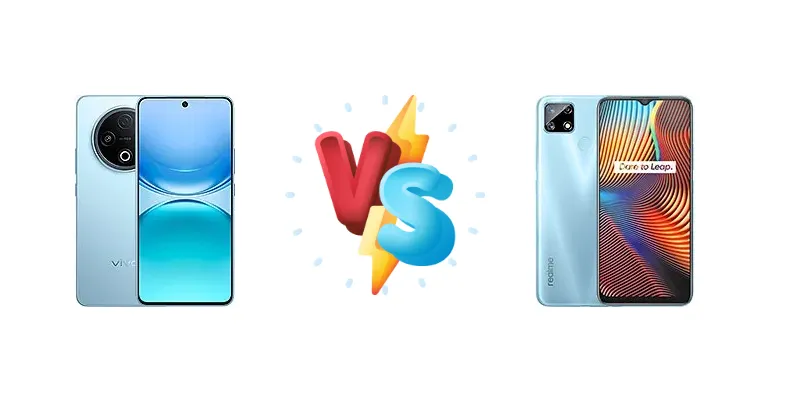
The vivo Y500 (China) and Realme 7i (Global) represent distinct approaches to the budget smartphone market. The Y500 prioritizes raw processing power with its Dimensity 7300, while the 7i focuses on a more balanced experience with the Helio G85. This comparison dissects their key differences to help you determine which device best suits your needs.
🏆 Quick Verdict
For users prioritizing performance and future-proofing, the vivo Y500 is the clear winner thanks to its significantly more powerful Dimensity 7300 chipset and blazing-fast 90W charging. However, the Realme 7i remains a viable option for those seeking a more efficient, globally-supported device with a reasonable price.
| Network |
|---|
| 2G bands | GSM 850 / 900 / 1800 / 1900 | GSM 850 / 900 / 1800 / 1900 |
| 3G bands | HSDPA 850 / 900 / 2100 | HSDPA 850 / 900 / 1700(AWS) / 1900 / 2100 |
| 4G bands | 1, 3, 5, 8, 28, 34, 38, 39, 40, 41 | 1, 2, 3, 4, 5, 7, 8, 20, 28, 38, 40, 41 |
| 5G bands | 1, 3, 5, 8, 28, 38, 40, 41, 77, 78 SA/NSA | - |
| Speed | HSPA, LTE, 5G | HSPA, LTE |
| Technology | GSM / CDMA / HSPA / LTE / 5G | GSM / HSPA / LTE |
| Launch |
|---|
| Announced | 2025, September 01 | 2020, December 22. Released 2020, December 23 |
| Status | Available. Released 2025, September 05 | Discontinued |
| Body |
|---|
| Dimensions | 163.1 x 75.9 x 8.2 mm (6.42 x 2.99 x 0.32 in) | 164.5 x 75.9 x 9.8 mm (6.48 x 2.99 x 0.39 in) |
| SIM | Nano-SIM + Nano-SIM | Nano-SIM + Nano-SIM |
| Weight | 213 g (7.51 oz) | 208 g (7.34 oz) |
| Display |
|---|
| Protection | Diamond Shield Glass | - |
| Resolution | 1080 x 2392 pixels (~388 ppi density) | 720 x 1600 pixels, 20:9 ratio (~270 ppi density) |
| Size | 6.77 inches, 110.9 cm2 (~89.6% screen-to-body ratio) | 6.5 inches, 102.0 cm2 (~81.7% screen-to-body ratio) |
| Type | AMOLED, 1B colors, 120Hz, 3840Hz PWM, 5000 nits (peak) | IPS LCD, 450 nits (typ), 560 nits (peak) |
| Platform |
|---|
| CPU | Octa-core (4x2.5 GHz Cortex-A78 & 4x2.0 GHz Cortex-A55) | Octa-core (2x2.0 GHz Cortex-A75 & 6x1.8 GHz Cortex-A55) |
| Chipset | Mediatek Dimensity 7300 (4 nm) | Mediatek MT6769Z Helio G85 (12 nm) |
| GPU | Mali-G615 MC2 | Mali-G52 MC2 |
| OS | Android 15, OriginOS 5 | Android 10, Realme UI |
| Memory |
|---|
| Card slot | No | microSDXC (dedicated slot) |
| Internal | 128GB 8GB RAM, 256GB 8GB RAM, 256GB 12GB RAM, 512GB 12GB RAM | 64GB 4GB RAM |
| | - | eMMC 5.1 |
| Main Camera |
|---|
| Dual | 50 MP, f/1.8, (wide), PDAF
Auxiliary lens | - |
| Features | Ring-LED flash, panorama, HDR | LED flash, HDR, panorama |
| Triple | - | 48 MP, f/1.8, 26mm (wide), 1/2.0", 0.8µm, PDAF
8 MP, f/2.3, 16mm, 119˚ (ultrawide), 1/4.0", 1.12µm
2 MP (macro) |
| Video | 4K@30fps, 1080p@30fps, gyro-EIS | 1080p@30/60fps |
| Selfie camera |
|---|
| Features | Panorama | HDR, panorama |
| Single | 8 MP, f/2.1, (wide) | 8 MP, f/2.0, 26mm (wide), 1/4.0", 1.12µm |
| Video | 1080p@30fps | 1080p@30fps |
| Sound |
|---|
| 3.5mm jack | - | Yes |
| 35mm jack | No | Yes |
| Loudspeaker | Yes, with stereo speakers | Yes |
| Comms |
|---|
| Bluetooth | 5.4, A2DP, LE, aptX HD | 5.0, A2DP, LE, aptX HD |
| NFC | Yes | No |
| Positioning | GPS, GALILEO, GLONASS, QZSS, BDS | GPS, GLONASS, BDS |
| Radio | No | FM radio |
| USB | USB Type-C 2.0, OTG | USB Type-C 2.0, OTG |
| WLAN | Wi-Fi 802.11 a/b/g/n/ac/6, dual-band | Wi-Fi 802.11 a/b/g/n/ac, dual-band, Wi-Fi Direct |
| Features |
|---|
| Sensors | Fingerprint (under display, optical), accelerometer, gyro, proximity, compass | Fingerprint (rear-mounted), accelerometer, proximity, compass |
| Battery |
|---|
| Charging | 90W wired
Reverse wired | 18W wired
5W reverse wired |
| Type | Si/C Li-Ion 8200 mAh | 6000 mAh |
| Misc |
|---|
| Colors | Black, Blue, Purple | Glory Silver, Victory Blue |
| Models | V2506A | - |
| Price | About 170 EUR | About 190 EUR |
vivo Y500 (China)
- Significantly faster processor (Dimensity 7300)
- Ultra-fast 90W charging
- Potentially better image processing
- Reverse wired charging
- China-specific model – potential software/support issues
- May have limited global availability
Realme 7i (Global)
- Globally available and supported
- More power-efficient processor (Helio G85)
- Generally lower price point
- Reliable and established brand
- Significantly slower processor
- Slow 18W charging
- Less capable for demanding tasks
Display Comparison
Neither device's display specifications are provided, so a direct comparison is limited. However, given the Y500's higher overall positioning, it's reasonable to expect a panel with higher peak brightness and potentially a higher refresh rate. Realme typically focuses on color accuracy in its displays, so the 7i likely offers a well-calibrated viewing experience. The absence of details necessitates assuming typical LCD panels for this price bracket.
Camera Comparison
Without specific camera sensor details, a detailed comparison is challenging. However, the Y500's higher-tier chipset suggests a potentially more advanced image signal processor (ISP), leading to better image processing capabilities. The Realme 7i likely relies on software optimizations to enhance image quality. The presence or absence of Optical Image Stabilization (OIS) would be a key differentiator, but this information is unavailable. It's safe to assume both devices feature a primary camera, ultrawide, and depth sensor, but the quality will vary significantly based on sensor size and lens aperture.
Performance
The performance gap between these two devices is substantial. The vivo Y500's Mediatek Dimensity 7300, built on a 4nm process, offers a significant advantage over the Realme 7i's 12nm Helio G85. The Dimensity 7300's octa-core configuration, featuring four high-performance Cortex-A78 cores clocked at 2.5 GHz, delivers considerably more processing power than the 7i's two Cortex-A75 cores at 2.0 GHz. This translates to faster app loading times, smoother multitasking, and a more enjoyable gaming experience. The 4nm node also contributes to improved thermal efficiency, reducing the likelihood of throttling during sustained workloads. The Realme 7i, while capable for everyday tasks, will struggle with graphically intensive games and demanding applications.
Battery Life
The charging capabilities are a major point of divergence. The vivo Y500's 90W wired charging is exceptionally fast, allowing for a full charge in under 40 minutes. The Realme 7i's 18W charging is considerably slower, requiring significantly longer to reach 100%. While battery capacity isn't specified, the faster charging of the Y500 mitigates the impact of a potentially smaller battery. The Y500 also offers reverse wired charging, a convenient feature for topping up accessories, while the 7i provides a slower 5W reverse wired charging option.
Buying Guide
Buy the vivo Y500 (China) if you need a smartphone capable of handling demanding games and applications, and if rapid charging is a must-have feature. You'll benefit from a smoother, more responsive experience. Buy the Realme 7i (Global) if you prefer a globally-supported device with a focus on battery efficiency and a more conservative price point, and aren't heavily reliant on intensive mobile gaming.
Frequently Asked Questions
❓ Is the Dimensity 7300 in the vivo Y500 powerful enough for demanding games like Genshin Impact?
Yes, the Dimensity 7300 is a substantial upgrade over the Helio G85 and is capable of running Genshin Impact and other demanding games at medium to high settings. The 4nm process also helps mitigate thermal throttling, providing a more consistent gaming experience.
❓ Does the Realme 7i support VoLTE and 5G connectivity?
The Realme 7i supports VoLTE for improved call quality. However, the Helio G85 chipset does *not* support 5G connectivity. It is a 4G-only device. The vivo Y500's 5G support is dependent on the specific variant, but the Dimensity 7300 is inherently 5G capable.
❓ What are the potential drawbacks of buying a China-specific phone like the vivo Y500?
China-specific phones may have limited or no official support outside of China. Software updates might be delayed or unavailable, and warranty claims can be difficult to process. Additionally, the software may include pre-installed Chinese apps and services.
❓ How long does it take to fully charge the Realme 7i with the 18W charger?
With the included 18W charger, the Realme 7i will typically take around 2 to 2.5 hours to fully charge from 0% to 100%. This is significantly slower than the vivo Y500's 90W charging.