
vivo Y500 (China) vs Oppo A98: A Deep Dive into Mid-Range Performance and Charging
| Phones Images | |||||
|---|---|---|---|---|---|
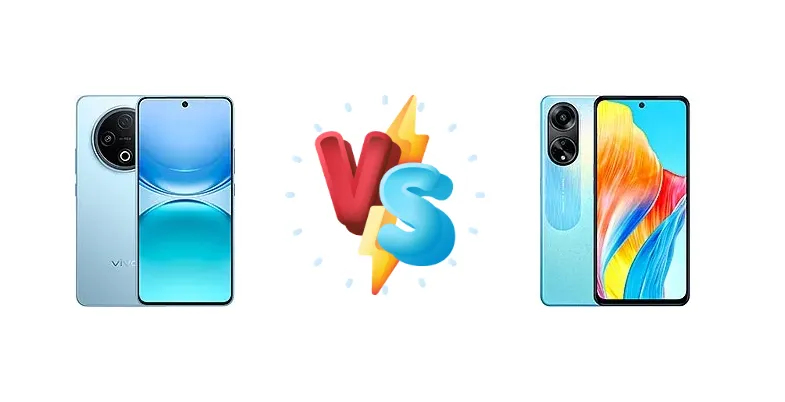
|
🏆 Quick Verdict
For users prioritizing raw performance and incredibly fast charging, the vivo Y500 (China) is the clear winner. Its Dimensity 7300 chipset offers a significant performance leap over the Snapdragon 695 in the Oppo A98. However, the Oppo A98 remains a viable option for those seeking a balanced experience with reliable 5G connectivity and respectable charging speeds.
| PHONES | ||
|---|---|---|
| Phone Names | vivo Y500 (China) | Oppo A98 |
| Network | ||
|---|---|---|
| 2G bands | GSM 850 / 900 / 1800 / 1900 | GSM 850 / 900 / 1800 / 1900 |
| 3G bands | HSDPA 850 / 900 / 2100 | HSDPA 800 / 850 / 900 / 1700(AWS) / 1900 / 2100 |
| 4G bands | 1, 3, 5, 8, 28, 34, 38, 39, 40, 41 | 1, 2, 3, 4, 5, 7, 8, 12, 13, 17, 18, 19, 20, 26, 28, 32, 38, 39, 40, 41, 66 |
| 5G bands | 1, 3, 5, 8, 28, 38, 40, 41, 77, 78 SA/NSA | 1, 3, 5, 7, 8, 20, 28, 38, 40, 41, 66, 77, 78 SA/NSA |
| Speed | HSPA, LTE, 5G | HSPA, LTE, 5G |
| Technology | GSM / CDMA / HSPA / LTE / 5G | GSM / HSPA / LTE / 5G |
| Launch | ||
|---|---|---|
| Announced | 2025, September 01 | 2023, May 09 |
| Status | Available. Released 2025, September 05 | Available. Released 2023, May 19 |
| Body | ||
|---|---|---|
| Dimensions | 163.1 x 75.9 x 8.2 mm (6.42 x 2.99 x 0.32 in) | 165.6 x 76.1 x 8.2 mm (6.52 x 3.00 x 0.32 in) |
| SIM | Nano-SIM + Nano-SIM | Nano-SIM + Nano-SIM |
| Weight | 213 g (7.51 oz) | 192 g (6.77 oz) |
| Display | ||
|---|---|---|
| Protection | Diamond Shield Glass | - |
| Resolution | 1080 x 2392 pixels (~388 ppi density) | 1080 x 2400 pixels, 20:9 ratio (~392 ppi density) |
| Size | 6.77 inches, 110.9 cm2 (~89.6% screen-to-body ratio) | 6.72 inches, 109.0 cm2 (~86.5% screen-to-body ratio) |
| Type | AMOLED, 1B colors, 120Hz, 3840Hz PWM, 5000 nits (peak) | IPS LCD, 120Hz, 550 nits (typ), 680 nits (HBM) |
| Platform | ||
|---|---|---|
| CPU | Octa-core (4x2.5 GHz Cortex-A78 & 4x2.0 GHz Cortex-A55) | Octa-core (2x2.2 GHz Kryo 660 Gold & 6x1.7 GHz Kryo 660 Silver) |
| Chipset | Mediatek Dimensity 7300 (4 nm) | Qualcomm SM6375 Snapdragon 695 5G (6 nm) |
| GPU | Mali-G615 MC2 | Adreno 619 |
| OS | Android 15, OriginOS 5 | Android 13, upgradable to Android 14, ColorOS 14 |
| Memory | ||
|---|---|---|
| Card slot | No | microSDXC |
| Internal | 128GB 8GB RAM, 256GB 8GB RAM, 256GB 12GB RAM, 512GB 12GB RAM | 256GB 8GB RAM |
| - | UFS 2.2 | |
| Main Camera | ||
|---|---|---|
| Dual | 50 MP, f/1.8, (wide), PDAF Auxiliary lens | 64 MP, f/1.7, 26mm (wide), PDAF 2 MP, f/3.3, 34mm (microscope) Auxiliary lens |
| Features | Ring-LED flash, panorama, HDR | LED flash, HDR, panorama |
| Video | 4K@30fps, 1080p@30fps, gyro-EIS | 1080p@30fps |
| Selfie camera | ||
|---|---|---|
| Features | Panorama | Panorama |
| Single | 8 MP, f/2.1, (wide) | 32 MP, f/2.4, 22mm (wide) |
| Video | 1080p@30fps | 1080p@30fps |
| Sound | ||
|---|---|---|
| 3.5mm jack | - | Yes |
| 35mm jack | No | Yes |
| Loudspeaker | Yes, with stereo speakers | Yes, with stereo speakers |
| Comms | ||
|---|---|---|
| Bluetooth | 5.4, A2DP, LE, aptX HD | 5.1, A2DP, LE, aptX HD |
| Infrared port | - | Yes |
| NFC | Yes | Yes |
| Positioning | GPS, GALILEO, GLONASS, QZSS, BDS | GPS (L1), GLONASS (G1), BDS (B1I), GALILEO (E1), QZSS (L1) |
| Radio | No | No |
| USB | USB Type-C 2.0, OTG | USB Type-C 2.0, OTG |
| WLAN | Wi-Fi 802.11 a/b/g/n/ac/6, dual-band | Wi-Fi 802.11 a/b/g/n/ac, dual-band |
| Features | ||
|---|---|---|
| Sensors | Fingerprint (under display, optical), accelerometer, gyro, proximity, compass | Fingerprint (side-mounted), accelerometer, gyro, proximity, compass |
| Battery | ||
|---|---|---|
| Charging | 90W wired Reverse wired | 67W wired, PD, 50% in 18 min |
| Type | Si/C Li-Ion 8200 mAh | Li-Po 5000 mAh |
| Misc | ||
|---|---|---|
| Colors | Black, Blue, Purple | Cool Black, Dreamy Blue |
| Models | V2506A | CPH2529 |
| Price | About 170 EUR | About 290 EUR |
vivo Y500 (China)
- Significantly faster processor (Dimensity 7300)
- Ultra-fast 90W wired charging
- Potentially better image processing due to ISP
- Limited global availability (China-specific)
- Display specs unknown, potentially average
Oppo A98
- Reliable 5G connectivity (Snapdragon 695)
- Established brand reputation (Oppo)
- PD support for charging
- Noticeably slower processor (Snapdragon 695)
- Slower charging speed (67W)
- Potentially less advanced camera features
Display Comparison
Unfortunately, display specifications are missing for both devices. However, given their market positioning, we can expect both to feature LCD panels, likely with FHD+ resolution. The Oppo A98, being a slightly more globally-focused device, *may* have a marginally better color calibration out of the box. The absence of LTPO technology suggests neither phone will offer adaptive refresh rates, impacting battery life during prolonged use.
Camera Comparison
Without detailed camera specs, a direct comparison is difficult. However, both phones likely feature a multi-camera setup with a primary sensor. The Dimensity 7300’s ISP (Image Signal Processor) is generally more capable than the Snapdragon 695’s, potentially leading to better image processing, especially in low-light conditions. We anticipate the vivo Y500 will offer more advanced computational photography features. The inclusion of a 2MP macro lens on either device is likely a marketing gimmick and shouldn't be a deciding factor.
Performance
The core difference lies in the chipsets. The vivo Y500’s Mediatek Dimensity 7300 (4nm) is a substantial upgrade over the Oppo A98’s Qualcomm Snapdragon 695 5G (6nm). The Dimensity 7300’s Cortex-A78 cores, clocked at 2.5 GHz, provide significantly more processing power than the Snapdragon 695’s Kryo 660 Gold cores at 2.2 GHz. This translates to faster app loading times, smoother multitasking, and a more responsive gaming experience. The 4nm process node of the Dimensity 7300 also contributes to better thermal efficiency, reducing the likelihood of performance throttling under sustained load. While the Snapdragon 695 is adequate for everyday tasks, the Dimensity 7300 is in a different league.
Battery Life
The vivo Y500’s 90W wired charging is a standout feature, allowing for incredibly fast top-ups. While the Oppo A98 offers 67W wired charging with PD and claims 50% charge in 18 minutes, the 90W charging on the Y500 will be significantly faster. The actual battery capacity is unknown for both devices, but the faster charging speed of the Y500 mitigates the impact of a potentially smaller battery. The efficiency gains from the Dimensity 7300’s 4nm process could also contribute to longer battery life despite potentially similar capacities.
Buying Guide
Buy the vivo Y500 (China) if you need a phone capable of handling demanding tasks like gaming and video editing, and if minimizing charging times is a top priority. Its 90W charging is a game-changer. Buy the Oppo A98 if you prefer a more energy-efficient chipset for everyday tasks, prioritize a well-established brand reputation, and are content with a more moderate charging experience.