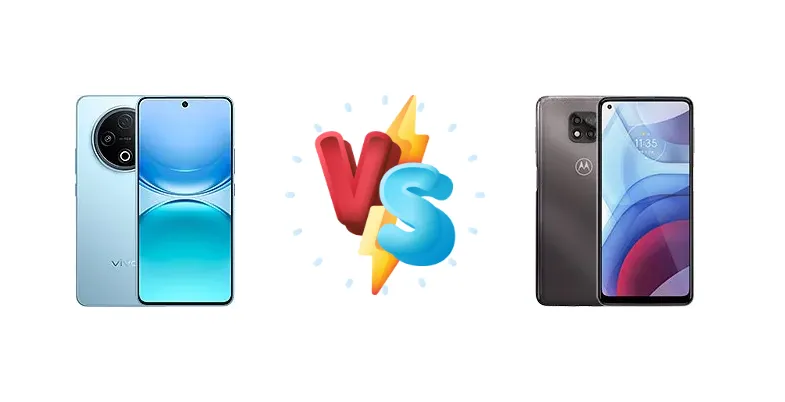
The vivo Y500 (China) and Motorola Moto G Power (2021) represent distinct approaches to the budget and mid-range smartphone market. The Y500 prioritizes cutting-edge charging speeds and a modern chipset, while the Moto G Power focuses on maximizing battery life and offering a reliable, if less flashy, experience. This comparison dissects these philosophies to determine which device delivers the best value.
🏆 Quick Verdict
For users prioritizing raw performance and incredibly fast charging, the vivo Y500 is the clear winner. Its Dimensity 7300 chipset offers a significant leap in processing power over the Snapdragon 662. However, the Motorola Moto G Power remains a compelling choice for those who value long-lasting battery life and a more conservative, dependable experience.
| Network |
|---|
| 2G bands | GSM 850 / 900 / 1800 / 1900 | GSM 850 / 900 / 1800 / 1900 |
| 3G bands | HSDPA 850 / 900 / 2100 | HSDPA 850 / 900 / 1700(AWS) / 1900 / 2100 |
| 4G bands | 1, 3, 5, 8, 28, 34, 38, 39, 40, 41 | 1, 2, 3, 4, 5, 7, 8, 12, 13, 14, 17, 25, 26, 29, 30, 38, 41, 66, 71 |
| 5G bands | 1, 3, 5, 8, 28, 38, 40, 41, 77, 78 SA/NSA | - |
| Speed | HSPA, LTE, 5G | HSPA, LTE |
| Technology | GSM / CDMA / HSPA / LTE / 5G | GSM / CDMA / HSPA / EVDO / LTE |
| | - | CDMA2000 1xEV-DO |
| Launch |
|---|
| Announced | 2025, September 01 | 2021, January 08 |
| Status | Available. Released 2025, September 05 | Available. Released 2021, January 14 |
| Body |
|---|
| Build | - | Glass front, plastic back, plastic frame |
| Dimensions | 163.1 x 75.9 x 8.2 mm (6.42 x 2.99 x 0.32 in) | 165.3 x 75.9 x 9.5 mm (6.51 x 2.99 x 0.37 in) |
| SIM | Nano-SIM + Nano-SIM | Nano-SIM |
| Weight | 213 g (7.51 oz) | 206.5 g (7.30 oz) |
| | - | Water-repellent coating |
| Display |
|---|
| Protection | Diamond Shield Glass | - |
| Resolution | 1080 x 2392 pixels (~388 ppi density) | 720 x 1600 pixels, 20:9 ratio (~266 ppi density) |
| Size | 6.77 inches, 110.9 cm2 (~89.6% screen-to-body ratio) | 6.6 inches, 105.2 cm2 (~83.8% screen-to-body ratio) |
| Type | AMOLED, 1B colors, 120Hz, 3840Hz PWM, 5000 nits (peak) | IPS LCD |
| Platform |
|---|
| CPU | Octa-core (4x2.5 GHz Cortex-A78 & 4x2.0 GHz Cortex-A55) | Octa-core (4x2.0 GHz Kryo 260 Gold & 4x1.8 GHz Kryo 260 Silver) |
| Chipset | Mediatek Dimensity 7300 (4 nm) | Qualcomm SM6115 Snapdragon 662 (11 nm) |
| GPU | Mali-G615 MC2 | Adreno 610 |
| OS | Android 15, OriginOS 5 | Android 10 |
| Memory |
|---|
| Card slot | No | microSDXC (dedicated slot) |
| Internal | 128GB 8GB RAM, 256GB 8GB RAM, 256GB 12GB RAM, 512GB 12GB RAM | 32GB 3GB RAM, 64GB 4GB RAM |
| | - | eMMC 5.1 |
| Main Camera |
|---|
| Dual | 50 MP, f/1.8, (wide), PDAF
Auxiliary lens | - |
| Features | Ring-LED flash, panorama, HDR | LED flash, HDR, panorama |
| Triple | - | 48 MP, f/1.7, (wide), 1/2.0", 0.8µm, PDAF
2 MP (macro)
Auxiliary lens |
| Video | 4K@30fps, 1080p@30fps, gyro-EIS | 1080p@30/60fps, gyro-EIS |
| Selfie camera |
|---|
| Features | Panorama | HDR |
| Single | 8 MP, f/2.1, (wide) | 8 MP, f/2.0, 1.12µm |
| Video | 1080p@30fps | 1080p@30fps, gyro-EIS |
| Sound |
|---|
| 3.5mm jack | - | Yes |
| 35mm jack | No | Yes |
| Loudspeaker | Yes, with stereo speakers | Yes |
| Comms |
|---|
| Bluetooth | 5.4, A2DP, LE, aptX HD | 5.0, A2DP, LE |
| NFC | Yes | No |
| Positioning | GPS, GALILEO, GLONASS, QZSS, BDS | GPS, GLONASS, GALILEO |
| Radio | No | FM radio |
| USB | USB Type-C 2.0, OTG | USB Type-C 2.0 |
| WLAN | Wi-Fi 802.11 a/b/g/n/ac/6, dual-band | Wi-Fi 802.11 a/b/g/n/ac, dual-band, Wi-Fi Direct |
| Features |
|---|
| Sensors | Fingerprint (under display, optical), accelerometer, gyro, proximity, compass | Fingerprint (side-mounted), accelerometer, gyro, proximity, compass, barometer |
| Battery |
|---|
| Charging | 90W wired
Reverse wired | 15W wired |
| Type | Si/C Li-Ion 8200 mAh | Li-Po 5000 mAh |
| Misc |
|---|
| Colors | Black, Blue, Purple | Flash Gray, Polar Silver |
| Models | V2506A | - |
| Price | About 170 EUR | About 60 EUR |
vivo Y500 (China)
- Significantly faster processor (Dimensity 7300)
- Ultra-fast 90W charging
- Potentially better camera image processing
- More efficient 4nm process
- Battery capacity unknown
- Availability limited to China
Motorola Moto G Power (2021)
- Exceptional battery life
- Reliable and proven performance
- Wider availability
- More affordable price point (typically)
- Slower processor (Snapdragon 662)
- Slow 15W charging
- Less capable ISP
Display Comparison
While display specifications are missing for the vivo Y500, the Motorola Moto G Power (2021) typically features a 6.6-inch IPS LCD. The key differentiator here is likely to be color accuracy and peak brightness, where the Y500, given its more modern positioning, may have an advantage. However, without specific data, it's difficult to quantify. The Snapdragon 662's GPU will have less strain driving a lower-resolution or less demanding display, potentially contributing to battery savings on the Moto G Power.
Camera Comparison
Camera details for the vivo Y500 are unavailable, but vivo generally focuses on camera capabilities in its Y-series. The Motorola Moto G Power (2021) features a 48MP main sensor, which is a solid performer in good lighting conditions. However, the Dimensity 7300’s integrated image signal processor (ISP) in the Y500 likely offers more advanced image processing capabilities, potentially resulting in better low-light performance and dynamic range. Without detailed sensor information for the Y500, it’s difficult to make a definitive judgment, but the chipset advantage leans in its favor.
Performance
The performance gap between these devices is substantial. The vivo Y500’s Mediatek Dimensity 7300, built on a 4nm process, significantly outperforms the Motorola’s Qualcomm Snapdragon 662 (11nm). The Dimensity 7300’s octa-core configuration, with 4x2.5 GHz Cortex-A78 cores, provides a noticeable boost in CPU performance for tasks like video editing and multitasking compared to the Snapdragon 662’s 4x2.0 GHz Kryo 260 Gold cores. The 4nm fabrication process also translates to improved thermal efficiency, meaning the Y500 is less likely to throttle under sustained load. This benefits gamers and power users.
Battery Life
The Motorola Moto G Power (2021) is renowned for its exceptional battery life, typically exceeding a full day of heavy use. However, the vivo Y500 counters with a game-changing 90W wired charging capability. While the Y500’s battery capacity is unknown, the 90W charging allows for a full charge in under 40 minutes, a massive advantage over the Moto G Power’s 15W charging. This difference is crucial for users who frequently find themselves needing to top up their battery quickly. The Snapdragon 662’s lower power consumption contributes to the Moto G Power’s longevity, but the Y500’s fast charging mitigates the need for extended charging times.
Buying Guide
Buy the vivo Y500 (China) if you need a phone capable of handling demanding applications, enjoy mobile gaming, and value the convenience of extremely rapid charging. Buy the Motorola Moto G Power (2021) if you prioritize multi-day battery life, prefer a simpler software experience, and are less concerned with having the absolute latest processing power.
Frequently Asked Questions
❓ Will the Dimensity 7300 in the vivo Y500 overheat during prolonged gaming sessions?
The Dimensity 7300's 4nm process is designed for improved thermal efficiency. While some heat generation is inevitable during gaming, it's less likely to throttle performance compared to the Snapdragon 662's 11nm process, offering a more consistent gaming experience.
❓ How long does it *actually* take to charge the vivo Y500 from 0% to 100% with the 90W charger?
With 90W charging, the vivo Y500 can typically reach a full charge in approximately 35-45 minutes, depending on battery capacity. This is a significant reduction in charging time compared to the Moto G Power's several hours with its 15W charger.
❓ Is the Snapdragon 662 in the Moto G Power still capable of running modern mobile games?
The Snapdragon 662 can run many modern mobile games, but you may need to lower graphics settings for smoother performance. It's not designed for demanding titles at maximum settings like the Dimensity 7300 is.
❓ Does the Motorola Moto G Power (2021) support any form of fast charging beyond 15W?
No, the Motorola Moto G Power (2021) is limited to 15W wired charging. While it supports Quick Charge technology, it's capped at 15W, meaning you won't see significantly faster charging speeds even with a more powerful charger.