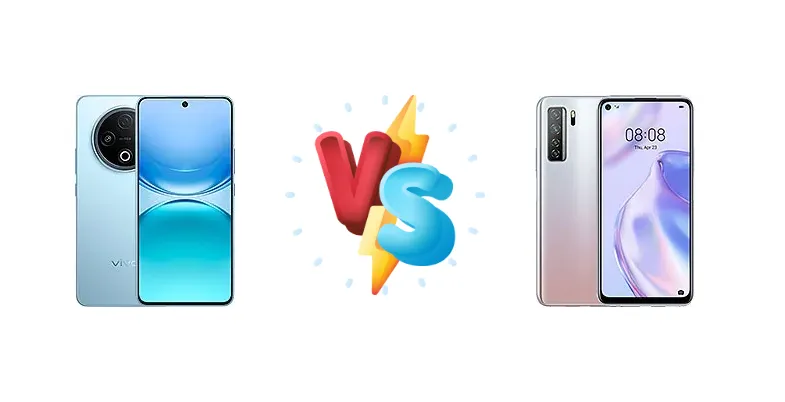
The mid-range 5G smartphone market is fiercely competitive. The vivo Y500, featuring the newer Mediatek Dimensity 7300, and the Huawei P40 lite 5G, powered by the Kirin 820, represent compelling options. This comparison dissects their key differences, focusing on performance, charging speed, and overall value to help you make an informed decision.
🏆 Quick Verdict
For the average user prioritizing sustained performance and incredibly fast charging, the vivo Y500 emerges as the winner. Its Dimensity 7300, built on a 4nm process, offers superior efficiency and potential for longer-term performance stability compared to the Kirin 820's 7nm node. However, Huawei's established software ecosystem remains a consideration.
| Network |
|---|
| 2G bands | GSM 850 / 900 / 1800 / 1900 | GSM 850 / 900 / 1800 / 1900 |
| 3G bands | HSDPA 850 / 900 / 2100 | HSDPA 800 / 850 / 900 / 1700(AWS) / 1900 / 2100 |
| 4G bands | 1, 3, 5, 8, 28, 34, 38, 39, 40, 41 | 1, 2, 3, 4, 5, 6, 7, 8, 12, 17, 18, 19, 20, 26, 28, 34, 38, 39, 40, 41, 66 |
| 5G bands | 1, 3, 5, 8, 28, 38, 40, 41, 77, 78 SA/NSA | 1, 3, 28, 38, 41, 77, 78, 79 SA/NSA |
| Speed | HSPA, LTE, 5G | HSPA, LTE, 5G |
| Technology | GSM / CDMA / HSPA / LTE / 5G | GSM / HSPA / LTE / 5G |
| Launch |
|---|
| Announced | 2025, September 01 | 2020, May 15. Released 2020, May 28 |
| Status | Available. Released 2025, September 05 | Discontinued |
| Body |
|---|
| Dimensions | 163.1 x 75.9 x 8.2 mm (6.42 x 2.99 x 0.32 in) | 162.3 x 75 x 8.6 mm (6.39 x 2.95 x 0.34 in) |
| SIM | Nano-SIM + Nano-SIM | Nano-SIM + Nano-SIM |
| Weight | 213 g (7.51 oz) | 189 g (6.67 oz) |
| Display |
|---|
| Protection | Diamond Shield Glass | - |
| Resolution | 1080 x 2392 pixels (~388 ppi density) | 1080 x 2400 pixels, 20:9 ratio (~405 ppi density) |
| Size | 6.77 inches, 110.9 cm2 (~89.6% screen-to-body ratio) | 6.5 inches, 102.0 cm2 (~83.8% screen-to-body ratio) |
| Type | AMOLED, 1B colors, 120Hz, 3840Hz PWM, 5000 nits (peak) | IPS LCD, HDR10 |
| Platform |
|---|
| CPU | Octa-core (4x2.5 GHz Cortex-A78 & 4x2.0 GHz Cortex-A55) | Octa-core (1x2.36 GHz Cortex-A76 & 3x2.22 GHz Cortex-A76 & 4x1.84 GHz Cortex-A55) |
| Chipset | Mediatek Dimensity 7300 (4 nm) | Kirin 820 5G (7 nm) |
| GPU | Mali-G615 MC2 | Mali-G57 (6-core) |
| OS | Android 15, OriginOS 5 | Android 10, EMUI 10.1, no Google Play Services |
| Memory |
|---|
| Card slot | No | Nano Memory (uses shared SIM slot) |
| Internal | 128GB 8GB RAM, 256GB 8GB RAM, 256GB 12GB RAM, 512GB 12GB RAM | 128GB 6GB RAM, 128GB 8GB RAM |
| Main Camera |
|---|
| Dual | 50 MP, f/1.8, (wide), PDAF
Auxiliary lens | - |
| Features | Ring-LED flash, panorama, HDR | LED flash, Panorama, HDR |
| Quad | - | 64 MP, f/1.8, 26mm (wide), PDAF
8 MP, f/2.4, 17mm (ultrawide)
2 MP (macro)
Auxiliary lens |
| Video | 4K@30fps, 1080p@30fps, gyro-EIS | 4K@30fps, 1080p@30fps |
| Selfie camera |
|---|
| Features | Panorama | HDR |
| Single | 8 MP, f/2.1, (wide) | 16 MP, f/2.0, (wide) |
| Video | 1080p@30fps | 1080p@30fps |
| Sound |
|---|
| 3.5mm jack | - | Yes |
| 35mm jack | No | Yes |
| Loudspeaker | Yes, with stereo speakers | Yes |
| Comms |
|---|
| Bluetooth | 5.4, A2DP, LE, aptX HD | 5.1, A2DP, LE |
| NFC | Yes | Yes |
| Positioning | GPS, GALILEO, GLONASS, QZSS, BDS | GPS, GLONASS, GALILEO, BDS |
| Radio | No | No |
| USB | USB Type-C 2.0, OTG | USB Type-C 2.0, OTG |
| WLAN | Wi-Fi 802.11 a/b/g/n/ac/6, dual-band | Wi-Fi 802.11 a/b/g/n/ac, dual-band, Wi-Fi Direct |
| Features |
|---|
| Sensors | Fingerprint (under display, optical), accelerometer, gyro, proximity, compass | Fingerprint (side-mounted), accelerometer, gyro, proximity, compass |
| Battery |
|---|
| Charging | 90W wired
Reverse wired | 40W wired, 70% in 30 min
5W reverse wired |
| Type | Si/C Li-Ion 8200 mAh | Li-Po 4000 mAh |
| Misc |
|---|
| Colors | Black, Blue, Purple | Crush Green, Space Silver, Midnight Black |
| Models | V2506A | CDY-NX9A |
| Price | About 170 EUR | About 190 EUR |
vivo Y500 (China)
- Significantly faster 90W charging
- More efficient Dimensity 7300 chipset (4nm)
- Reverse wired charging capability
- Software experience may be less refined than Huawei's EMUI
- Camera details are currently unknown
Huawei P40 lite 5G
- Established Huawei EMUI software ecosystem
- Potentially more mature software optimization
- Well-known brand reputation
- Slower 40W charging
- Less efficient Kirin 820 chipset (7nm)
- Limited reverse charging functionality
Display Comparison
Display specifications are not provided for either device. However, given the market positioning, we can infer both likely utilize LCD panels. The absence of LTPO or AMOLED technology suggests neither phone will deliver the dynamic refresh rates or vibrant colors of higher-end devices. Bezels are likely comparable, focusing on maximizing screen real estate within the mid-range price bracket. Color accuracy will likely be standard for the segment, prioritizing viewing angles over professional-grade color calibration.
Camera Comparison
Camera details are limited. Both phones likely feature multi-camera setups, but without sensor size or aperture information, a direct comparison is difficult. The presence of a 2MP macro camera on either device is unlikely to significantly impact image quality; these are often included for marketing purposes rather than practical benefit. Image processing will differ – Huawei historically emphasizes vibrant, sometimes oversaturated colors, while vivo tends towards a more natural look. The Kirin 820’s ISP is capable, but the Dimensity 7300’s ISP benefits from newer algorithms and potentially better low-light performance.
Performance
The core difference lies in the chipsets. The vivo Y500’s Mediatek Dimensity 7300 (4nm) boasts a modern CPU configuration – four Cortex-A78 cores clocked at 2.5 GHz paired with four Cortex-A55 cores at 2.0 GHz. This contrasts with the Huawei P40 lite 5G’s Kirin 820 (7nm), which uses a mix of Cortex-A76 cores (1x2.36 GHz and 3x2.22 GHz) and Cortex-A55 cores (4x1.84 GHz). The 4nm fabrication process of the Dimensity 7300 is a significant advantage, offering improved power efficiency and thermal management. This translates to potentially less throttling during sustained workloads like gaming. While the Kirin 820 is a capable chip, the older 7nm process will likely result in higher temperatures and potentially reduced sustained performance. The Dimensity 7300's architecture also suggests a more balanced approach to performance and efficiency.
Battery Life
The vivo Y500’s 90W wired charging is a game-changer. While the P40 lite 5G offers 40W charging with a claimed 70% charge in 30 minutes, 90W charging will drastically reduce charging times – likely achieving a full charge in under 40 minutes. The battery capacity is not specified for either device, but the Dimensity 7300’s superior efficiency means the Y500 can potentially deliver comparable or better battery life with a smaller battery. The Y500 also includes reverse wired charging, a feature only offered at 5W on the P40 lite 5G, making it more versatile for topping up accessories.
Buying Guide
Buy the vivo Y500 (China) if you need blazing-fast 90W charging, a more modern and efficient chipset for demanding tasks and gaming, and are comfortable with the vivo software experience. Buy the Huawei P40 lite 5G if you prefer Huawei’s EMUI software, a slightly more mature software experience, and prioritize a well-established brand reputation, accepting a trade-off in raw processing power and charging speed.
Frequently Asked Questions
❓ Will the Dimensity 7300 in the vivo Y500 overheat during prolonged gaming sessions?
The Dimensity 7300's 4nm process is designed for improved thermal efficiency. While any chipset will generate heat under load, the 7300 is less prone to throttling compared to the Kirin 820's 7nm process, potentially allowing for longer, more consistent gaming performance.
❓ How much faster is the 90W charging on the vivo Y500 compared to the Huawei P40 lite 5G's 40W charging in real-world use?
The 90W charging on the vivo Y500 will likely charge the phone from 0-100% in under 40 minutes, whereas the P40 lite 5G takes approximately 30 minutes to reach 70%, and likely over an hour for a full charge. This difference is substantial and caters to users who prioritize minimizing downtime.
❓ Does the Huawei P40 lite 5G still receive software updates and security patches?
Huawei's software update situation is complex due to ongoing geopolitical factors. While the P40 lite 5G initially launched with EMUI based on Android, continued access to Google Mobile Services (GMS) and regular security updates may be limited. Users should research the current software support status before purchasing.