
vivo Y500 (Dimensity 7300) vs. Google Pixel 4a 5G (Snapdragon 765G): A Detailed Comparison
| Phones Images | |||||
|---|---|---|---|---|---|
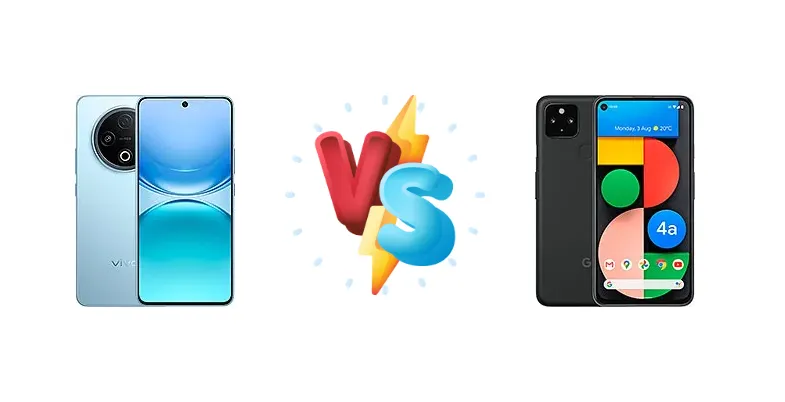
|
🏆 Quick Verdict
For users prioritizing charging speed and potentially higher sustained performance, the vivo Y500 is the clear winner. Its 90W charging dwarfs the Pixel 4a 5G’s 18W, and the Dimensity 7300’s 4nm process offers efficiency advantages. However, the Pixel 4a 5G remains a strong contender for those valuing camera software and a streamlined software experience.
| PHONES | ||
|---|---|---|
| Phone Names | vivo Y500 (China) | Google Pixel 4a 5G |
| Network | ||
|---|---|---|
| 2G bands | GSM 850 / 900 / 1800 / 1900 | GSM 850 / 900 / 1800 / 1900 |
| 3G bands | HSDPA 850 / 900 / 2100 | HSDPA 850 / 900 / 1700(AWS) / 1900 / 2100 |
| 4G bands | 1, 3, 5, 8, 28, 34, 38, 39, 40, 41 | 1, 2, 3, 4, 5, 7, 8, 12, 13, 14, 17, 18, 19, 20, 25, 26, 28, 29, 30, 32, 38, 39, 40, 41, 42, 46, 48, 66, 71 |
| 5G bands | 1, 3, 5, 8, 28, 38, 40, 41, 77, 78 SA/NSA | 1, 2, 3, 5, 7, 8, 12, 28, 41, 66, 71, 77, 78 Sub6, mmWave (market dependant) |
| Speed | HSPA, LTE, 5G | HSPA, LTE, 5G |
| Technology | GSM / CDMA / HSPA / LTE / 5G | GSM / HSPA / LTE / 5G |
| Launch | ||
|---|---|---|
| Announced | 2025, September 01 | 2020, September 30 |
| Status | Available. Released 2025, September 05 | Available. Released 2020, November 05 |
| Body | ||
|---|---|---|
| Build | - | Glass front (Gorilla Glass 3), plastic back, plastic frame |
| Dimensions | 163.1 x 75.9 x 8.2 mm (6.42 x 2.99 x 0.32 in) | 153.9 x 74 x 8.2 mm (Sub-6) or 8.5 mm (Sub-6 and mmWave) |
| SIM | Nano-SIM + Nano-SIM | Nano-SIM + eSIM |
| Weight | 213 g (7.51 oz) | 168 g (5G Sub-6); 171 g ( 5G Sub-6 and mmWave) (5.93 oz) |
| Display | ||
|---|---|---|
| Protection | Diamond Shield Glass | Corning Gorilla Glass 3 |
| Resolution | 1080 x 2392 pixels (~388 ppi density) | 1080 x 2340 pixels, 19.5:9 ratio (~413 ppi density) |
| Size | 6.77 inches, 110.9 cm2 (~89.6% screen-to-body ratio) | 6.2 inches, 95.7 cm2 (~84.1% screen-to-body ratio) |
| Type | AMOLED, 1B colors, 120Hz, 3840Hz PWM, 5000 nits (peak) | OLED, HDR |
| - | Always-on display | |
| Platform | ||
|---|---|---|
| CPU | Octa-core (4x2.5 GHz Cortex-A78 & 4x2.0 GHz Cortex-A55) | Octa-core (1x2.4 GHz Kryo 475 Prime & 1x2.2 GHz Kryo 475 Gold & 6x1.8 GHz Kryo 475 Silver) |
| Chipset | Mediatek Dimensity 7300 (4 nm) | Qualcomm SM7250 Snapdragon 765G 5G (7 nm) |
| GPU | Mali-G615 MC2 | Adreno 620 |
| OS | Android 15, OriginOS 5 | Android 11, upgradable to Android 14 |
| Memory | ||
|---|---|---|
| Card slot | No | No |
| Internal | 128GB 8GB RAM, 256GB 8GB RAM, 256GB 12GB RAM, 512GB 12GB RAM | 128GB 6GB RAM |
| - | UFS 2.1 | |
| Main Camera | ||
|---|---|---|
| Dual | 50 MP, f/1.8, (wide), PDAF Auxiliary lens | 12.2 MP, f/1.7, 27mm (wide), 1/2.55", 1.4µm, dual pixel PDAF, OIS 16 MP, f/2.2, 107˚ (ultrawide), 1.0µm |
| Features | Ring-LED flash, panorama, HDR | LED flash, Pixel Shift, Auto-HDR, panorama |
| Video | 4K@30fps, 1080p@30fps, gyro-EIS | 4K@30/60fps, 1080p@30/60/120/240fps; gyro-EIS |
| Selfie camera | ||
|---|---|---|
| Features | Panorama | HDR |
| Single | 8 MP, f/2.1, (wide) | 8 MP, f/2.0, 24mm (wide), 1/4.0", 1.12µm |
| Video | 1080p@30fps | 1080p@30fps |
| Sound | ||
|---|---|---|
| 3.5mm jack | - | Yes |
| 35mm jack | No | Yes |
| Loudspeaker | Yes, with stereo speakers | Yes, with stereo speakers |
| Comms | ||
|---|---|---|
| Bluetooth | 5.4, A2DP, LE, aptX HD | 5.0, A2DP, LE, aptX HD |
| NFC | Yes | Yes |
| Positioning | GPS, GALILEO, GLONASS, QZSS, BDS | GPS, GLONASS, GALILEO, QZSS, BDS |
| Radio | No | No |
| USB | USB Type-C 2.0, OTG | USB Type-C 3.1 |
| WLAN | Wi-Fi 802.11 a/b/g/n/ac/6, dual-band | Wi-Fi 802.11 a/b/g/n/ac, dual-band, Wi-Fi Direct |
| Features | ||
|---|---|---|
| Sensors | Fingerprint (under display, optical), accelerometer, gyro, proximity, compass | Fingerprint (rear-mounted), accelerometer, gyro, proximity, compass, barometer |
| Battery | ||
|---|---|---|
| Charging | 90W wired Reverse wired | 18W wired, PD2.0 |
| Type | Si/C Li-Ion 8200 mAh | Li-Po 3885 mAh |
| Misc | ||
|---|---|---|
| Colors | Black, Blue, Purple | Just Black, Clearly White |
| Models | V2506A | GD1YQ, G025I, G025E, G025H, G6QU3 |
| Price | About 170 EUR | About 140 EUR |
vivo Y500 (China)
- Blazing-fast 90W charging
- More modern and efficient Dimensity 7300 chipset
- Potentially better sustained performance due to 4nm process
- China-exclusive, potentially limited software support
- Camera performance is unknown and may not match the Pixel
Google Pixel 4a 5G
- Excellent camera software and image quality
- Clean and timely Android updates
- Wider availability
- Slow 18W charging
- Older Snapdragon 765G chipset
- Potential for thermal throttling under heavy load
Display Comparison
Neither device is known for a groundbreaking display. While specific display specs for the Y500 are unavailable, the Pixel 4a 5G features a 6.2-inch FHD+ OLED panel. The Pixel’s OLED technology provides excellent contrast, but the Y500’s potential for a higher refresh rate (though unconfirmed) could offer a smoother visual experience. The Snapdragon 765G’s Adreno 620 GPU will handle display tasks adequately, but the Dimensity 7300’s Mali-G57 MC7 GPU may offer a slight edge in graphics processing, potentially benefiting gaming and video playback.
Camera Comparison
The Pixel 4a 5G’s strength is its software. Google’s computational photography algorithms are renowned for producing excellent images, even with a relatively modest 12.2MP main sensor. While the Y500’s camera specs are unknown, it’s unlikely to match the Pixel’s image processing prowess. The Pixel 4a 5G also benefits from OIS (Optical Image Stabilization), resulting in sharper photos and smoother videos. Without detailed Y500 camera specs, it’s difficult to make a direct comparison, but the Pixel’s established track record gives it a significant advantage in image quality.
Performance
The core difference lies in the chipsets. The vivo Y500’s Mediatek Dimensity 7300, built on a 4nm process, boasts a more modern architecture than the Pixel 4a 5G’s 7nm Qualcomm Snapdragon 765G. The Dimensity 7300’s octa-core configuration (4x2.5 GHz Cortex-A78 & 4x2.0 GHz Cortex-A55) is designed for both peak performance and efficiency. The Snapdragon 765G’s (1x2.4 GHz Kryo 475 Prime & 1x2.2 GHz Kryo 475 Gold & 6x1.8 GHz Kryo 475 Silver) configuration is competent, but the newer Cortex-A78 cores in the Dimensity 7300 should deliver a noticeable performance uplift in CPU-intensive tasks. The 4nm process also translates to better thermal management, potentially reducing throttling during extended gaming sessions.
Battery Life
The Pixel 4a 5G has a 3885 mAh battery and supports 18W wired charging with PD2.0. The vivo Y500, however, features a staggering 90W wired charging capability, a game-changer for charging speed. While the Y500’s battery capacity is unknown, the 90W charging will likely result in a full charge in under 30 minutes, significantly faster than the Pixel 4a 5G. This difference is crucial for users who prioritize minimizing downtime. The Dimensity 7300’s 4nm process also contributes to better power efficiency, potentially offsetting a smaller battery capacity.
Buying Guide
Buy the vivo Y500 (China) if you need blazing-fast charging, potentially better long-term performance due to the newer chipset and efficient 4nm process, and are comfortable with a China-specific ROM. Buy the Google Pixel 4a 5G if you prefer a guaranteed smooth software experience with timely updates, Google’s exceptional computational photography, and a wider availability outside of China.