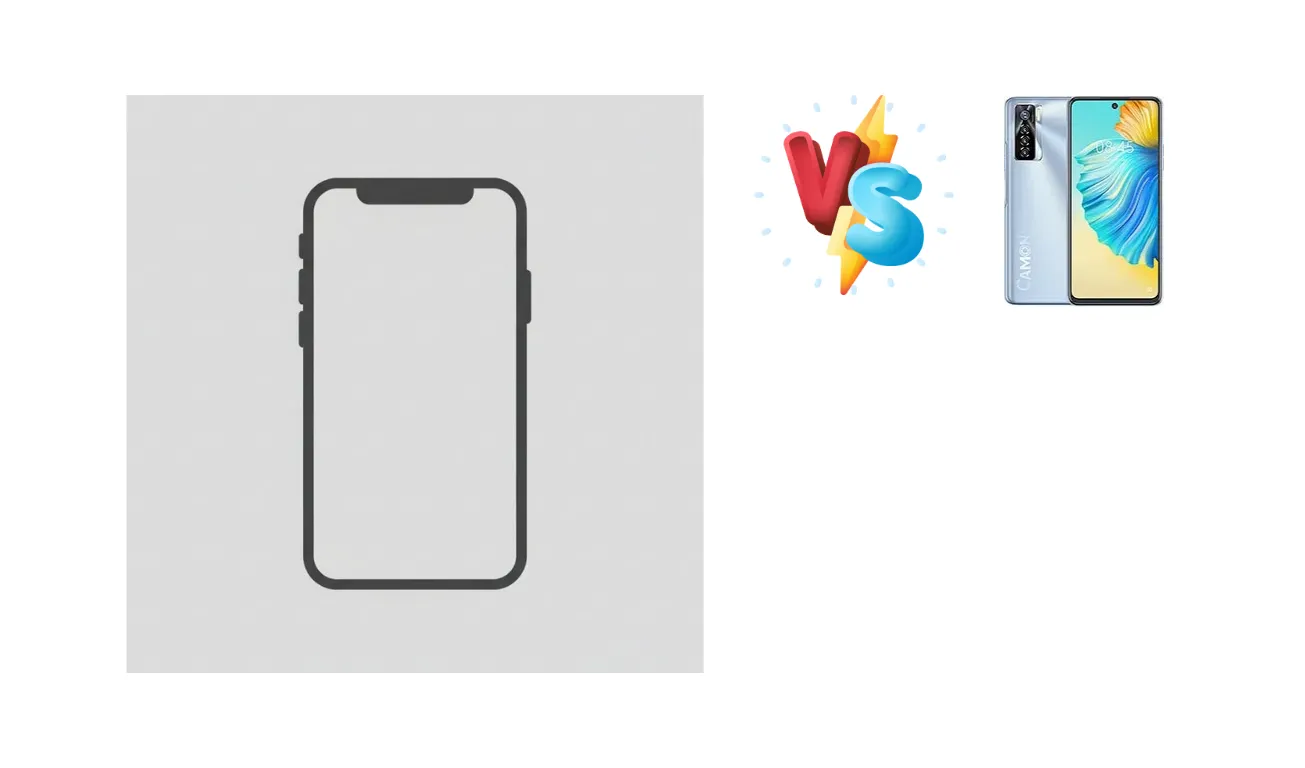
The sub-$200 smartphone market is fiercely competitive. The vivo Y50, with its reliable Qualcomm chipset, and the Tecno Camon 17 Pro, boasting a more powerful MediaTek processor and faster charging, represent compelling options. This comparison dissects their key differences to determine which device delivers the best value for your money.
🏆 Quick Verdict
For most users, the Tecno Camon 17 Pro emerges as the superior choice. Its Helio G95 chipset provides a noticeable performance boost over the Snapdragon 665 in the vivo Y50, and the inclusion of 25W/33W charging significantly reduces downtime. While both offer similar battery endurance ratings, the Camon 17 Pro’s faster charging is a key advantage.
| Network |
|---|
| 2G bands | GSM 850 / 900 / 1800 / 1900 - SIM 1 & SIM 2 | GSM 850 / 900 / 1800 / 1900 |
| 3G bands | HSDPA 850 / 900 / 2100 | HSDPA 900 / 2100 |
| 4G bands | 1, 3, 5, 7, 8, 38, 40, 41 | LTE |
| Speed | HSPA, LTE-A | HSPA, LTE |
| Technology | GSM / HSPA / LTE | GSM / HSPA / LTE |
| Launch |
|---|
| Announced | 2020, April 06 | 2021, May 08 |
| Status | Available. Released 2020, April 12 | Available. Released 2021, June 03 |
| Body |
|---|
| Build | Glass front, plastic back, plastic frame | - |
| Dimensions | 162 x 76.5 x 9.1 mm (6.38 x 3.01 x 0.36 in) | 168.9 x 77 x 9 mm (6.65 x 3.03 x 0.35 in) |
| SIM | Dual SIM (Nano-SIM, dual stand-by) | Nano-SIM + Nano-SIM |
| Weight | 197 g (6.95 oz) | 201 g (7.09 oz) |
| Display |
|---|
| Resolution | 1080 x 2400 pixels, 20:9 ratio (~403 ppi density) | 1080 x 2460 pixels (~395 ppi density) |
| Size | 6.53 inches, 102.9 cm2 (~83.1% screen-to-body ratio) | 6.8 inches, 109.8 cm2 (~84.4% screen-to-body ratio) |
| Type | IPS LCD | IPS LCD, 90Hz, 500 nits (HBM) |
| Platform |
|---|
| CPU | Octa-core (4x2.0 GHz Kryo 260 Gold & 4x1.8 GHz Kryo 260 Silver) | Octa-core (2x2.05 GHz Cortex-A76 & 6x2.0 GHz Cortex-A55) |
| Chipset | Qualcomm SM6125 Snapdragon 665 (11 nm) | Mediatek MT6785V/CD Helio G95 (12 nm) |
| GPU | Adreno 610 | Mali-G76 MC4 |
| OS | Android 10, Funtouch 10.0 | Android 11, HIOS 7.6 |
| Memory |
|---|
| Card slot | microSDXC (dedicated slot) | microSDXC (dedicated slot) |
| Internal | 128GB 8GB RAM, 128GB 6GB RAM | 128GB 8GB RAM, 256GB 8GB RAM |
| | eMMC 5.1 | - |
| Main Camera |
|---|
| Features | LED flash, HDR, panorama | Quad-LED flash, panorama, HDR |
| Quad | 13 MP, f/2.2, (wide), PDAF
8 MP, f/2.2, 13mm (ultrawide), 1/4.0", 1.12µm
2 MP, f/2.4, (macro)
2 MP, f/2.4, (depth) | 64 MP, f/1.8, 26mm (wide), 1/1.72", 0.8µm, PDAF
8 MP, f/2.3, 119˚ (ultrawide), 1/4.0", 1.12µm
2 MP, f/2.4, (monochrome)
Auxiliary lens |
| Single | - | 48 MP, f/2.2, (wide), 1/2.0", 0.8µm |
| Video | 1080p@30fps | 4K@30fps, 1080p@30fps |
| Selfie camera |
|---|
| Features | - | Dual-LED flash |
| Single | 16 MP, f/2.0, (wide) | 48 MP, f/2.2, (wide), 1/2.0", 0.8µm |
| Video | 1080p@30fps | 1080p@30fps |
| Sound |
|---|
| 3.5mm jack | Yes | Yes |
| 35mm jack | - | Yes |
| Loudspeaker | Yes | Yes, with dual speakers |
| Comms |
|---|
| Bluetooth | 5.0, A2DP, LE | 5.0, A2DP, LE |
| NFC | No | No |
| Positioning | GPS, GLONASS, GALILEO | GPS |
| Radio | FM radio | FM radio, recording |
| USB | USB Type-C 2.0, OTG | USB Type-C 2.0, OTG |
| WLAN | Wi-Fi 802.11 a/b/g/n, dual-band, Wi-Fi Direct | Wi-Fi 802.11 b/g/n/ac, dual-band, Wi-Fi Direct |
| Features |
|---|
| Sensors | Fingerprint (rear-mounted), accelerometer, proximity, compass | Fingerprint (side-mounted), accelerometer, gyro, proximity, compass |
| Battery |
|---|
| Charging | 15W wired | 25W / 33W wired |
| Type | Li-Po 5000 mAh, non-removable | 5000 mAh |
| Misc |
|---|
| Colors | Starry Black, Iris Blue, Iris Blue, Pearl White | California Silver, Malibu Blue |
| Models | 1935, V1965A | CG8, CG8h |
| Price | ₹ 18,000 | About 280 EUR |
| Tests |
|---|
| Battery life | - |
Endurance rating 140h
|
| Camera | - |
Photo / Video |
| Display | - |
Contrast ratio: 781:1 (nominal) |
| Loudspeaker | - |
-24.4 LUFS (Very good)
|
| Performance | - |
AnTuTu: 309107 (v8)
GeekBench: 1668 (v5.1)
GFXBench: 17fps (ES 3.1 onscreen) |
vivo Y50
- Reliable Qualcomm Snapdragon 665 chipset
- Stable and consistent performance for basic tasks
- Potentially lower price point
- Slower charging speed (15W)
- Less powerful processor compared to the Camon 17 Pro
- Likely limited gaming performance
Tecno Camon 17 Pro
- More powerful MediaTek Helio G95 chipset
- Faster charging (25W/33W)
- Brighter display (538 nits)
- May be slightly more expensive
- MediaTek chipsets sometimes have less consistent software support
- No detailed camera specifications available
Display Comparison
Both devices share a similar contrast ratio of 781:1, suggesting comparable image quality in terms of black levels. However, the Tecno Camon 17 Pro’s measured peak brightness of 538 nits provides a brighter viewing experience, particularly outdoors, compared to the unspecified brightness of the vivo Y50. While neither device is likely to feature high refresh rate panels, the brighter display on the Camon 17 Pro offers a more visually engaging experience.
Camera Comparison
Both phones feature 'Photo / Video' capabilities, but lack detailed camera specifications. Without sensor size or aperture information, a direct comparison is difficult. However, the Camon 17 Pro’s brand positioning suggests a greater emphasis on camera features. The inclusion of a faster processor also aids in image processing, potentially leading to better low-light performance and faster image capture. The Y50 likely relies more heavily on software processing, which can introduce artifacts. We can assume the Camon 17 Pro will offer a more versatile camera experience.
Performance
The Tecno Camon 17 Pro’s MediaTek Helio G95 (12nm) demonstrably outperforms the vivo Y50’s Qualcomm Snapdragon 665 (11nm). The G95 utilizes a more modern CPU architecture – Cortex-A76 cores versus the Kryo 260 Gold – resulting in faster application loading and smoother multitasking. The 12nm process node on the G95, while slightly larger than the 11nm on the Snapdragon, is offset by architectural improvements. This translates to a more responsive user experience, especially for gaming and resource-intensive applications. The Snapdragon 665 is adequate for basic tasks, but will struggle with demanding games.
Battery Life
Both the vivo Y50 and Tecno Camon 17 Pro achieve an endurance rating of 140 hours, indicating similar overall battery life under typical usage. However, the Tecno Camon 17 Pro’s significantly faster charging – 25W/33W versus the Y50’s 15W – is a crucial differentiator. This means the Camon 17 Pro can be rapidly topped up, minimizing downtime. While both will last a full day for average users, the Camon 17 Pro offers the convenience of quicker charging cycles.
Buying Guide
Buy the vivo Y50 if you prioritize a consistently stable, if less powerful, experience and are comfortable with slower charging speeds. It’s a solid choice for basic smartphone tasks. Buy the Tecno Camon 17 Pro if you want a phone capable of handling more demanding apps and games, and if minimizing charging time is a priority. It’s the better option for users who need more processing power and appreciate faster refueling.
Frequently Asked Questions
❓ Does the Helio G95 in the Tecno Camon 17 Pro get noticeably warmer during extended gaming sessions compared to the Snapdragon 665?
While the Helio G95 is more powerful, it also generates more heat. However, the Camon 17 Pro’s larger surface area and potentially more sophisticated thermal management system should mitigate overheating. The Snapdragon 665 will likely remain cooler, but at the cost of performance. Expect some warmth with prolonged gaming on both devices, but the Camon 17 Pro should maintain higher frame rates for longer.
❓ Is the 140-hour endurance rating for both phones accurate in real-world usage, or does the more powerful processor in the Camon 17 Pro impact battery life?
The 140-hour endurance rating is a standardized test result. In real-world usage, the Camon 17 Pro’s more powerful processor *will* consume more power, especially during demanding tasks like gaming or video streaming. However, the difference is unlikely to be significant for typical usage patterns. Both phones should comfortably last a full day on a single charge.
❓ Given the lack of detailed camera specs, what should I expect in terms of image quality from the Tecno Camon 17 Pro?
While specific sensor details are missing, Tecno typically focuses on camera features in their Pro models. Expect a camera system capable of producing detailed images in good lighting conditions. The Helio G95’s image signal processor (ISP) will contribute to faster processing and potentially better low-light performance compared to the Y50. However, without knowing the sensor size and aperture, it’s difficult to provide a precise assessment.