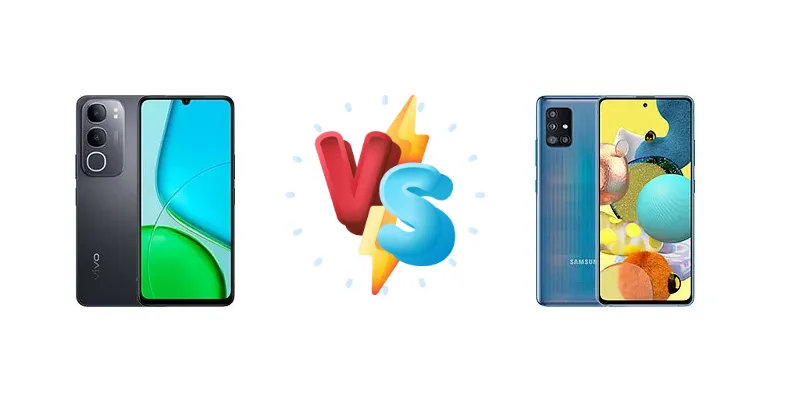
The mid-range 5G smartphone market is fiercely competitive. The vivo Y50 (China), powered by the Mediatek Dimensity 6300, and the Samsung Galaxy A51 5G UW, featuring the Qualcomm Snapdragon 765G, represent compelling options for users seeking affordable 5G connectivity. This comparison dissects their key differences, focusing on performance, charging speed, and overall value to determine which device best suits your needs.
🏆 Quick Verdict
For the average user prioritizing fast charging and potentially better sustained performance, the vivo Y50 (China) emerges as the winner. Its 44W charging significantly outperforms the A51 5G UW’s 15W, and the Dimensity 6300’s 6nm process offers a potential edge in thermal efficiency. However, Samsung’s brand recognition and software experience remain strong considerations.
| Network |
|---|
| 2G bands | GSM 850 / 900 / 1800 / 1900 | GSM 850 / 900 / 1800 / 1900 |
| 3G bands | HSDPA 850 / 900 / 2100 | HSDPA 850 / 900 / 1900 / 2100 |
| 4G bands | 1, 3, 5, 8, 28, 34, 38, 39, 40, 41 | 2, 4, 5, 13, 66 |
| 5G bands | 1, 3, 5, 8, 28, 38, 40, 41, 77, 78 SA/NSA | 260, 261 mmWave |
| Speed | HSPA, LTE | HSPA, LTE, 5G |
| Technology | GSM / HSPA / LTE / 5G | GSM / HSPA / LTE / 5G |
| Launch |
|---|
| Announced | 2025, July 21 | 2020, August 14 |
| Status | Available. Released 2025, July 21 | Available. Released 2020, August 14 |
| Body |
|---|
| Build | Glass front, plastic frame, plastic back | Glass front (Gorilla Glass 3), plastic back, aluminum frame |
| Dimensions | 167.3 x 77 x 8.2 mm (6.59 x 3.03 x 0.32 in) | 158.8 x 73.4 x 8.6 mm (6.25 x 2.89 x 0.34 in) |
| SIM | Nano-SIM + Nano-SIM | Nano-SIM (pre-installed) |
| Weight | 204 g (7.20 oz) | 188.8 g (6.67 oz) |
| Display |
|---|
| Protection | - | Corning Gorilla Glass 3 |
| Resolution | 720 x 1600 pixels, 20:9 ratio (~260 ppi density) | 1080 x 2400 pixels, 20:9 ratio (~405 ppi density) |
| Size | 6.74 inches, 109.7 cm2 (~85.1% screen-to-body ratio) | 6.5 inches, 102.0 cm2 (~87.5% screen-to-body ratio) |
| Type | IPS LCD, 90Hz, 570 nits (HBM) | Super AMOLED |
| Platform |
|---|
| CPU | Octa-core (2x2.4 GHz Cortex-A76 & 6x2.0 GHz Cortex-A55) | Octa-core (1x2.4 GHz Kryo 475 Prime & 1x2.2 GHz Kryo 475 Gold & 6x1.8 GHz Kryo 475 Silver) |
| Chipset | Mediatek Dimensity 6300 (6 nm) | Qualcomm SM7250 Snapdragon 765G 5G (7 nm) |
| GPU | Mali-G57 MC2 | Adreno 620 |
| OS | Android 15, OriginOS 5 | Android 10, One UI 2 |
| Memory |
|---|
| Card slot | microSDXC | microSDXC (uses shared SIM slot) |
| Internal | 128GB 4GB RAM, 128GB 6GB RAM, 256GB 8GB RAM, 256GB 12GB RAM | 128GB 6GB RAM |
| | - | UFS 2.1 |
| Main Camera |
|---|
| Features | LED flash, panorama | LED flash, panorama, HDR |
| Quad | - | 48 MP, f/2.0, 26mm (wide), 1/2.0", 0.8µm, PDAF
12 MP, f/2.2, 123˚ (ultrawide)
5 MP (macro)
Auxiliary lens |
| Single | 13 MP, f/2.2, (wide), PDAF
Auxiliary lens | 5 MP, AF |
| Video | 1080p@30fps | 4K@30fps, 1080p@30/120fps; gyro-EIS |
| Selfie camera |
|---|
| Features | - | HDR |
| Single | 5 MP, f/2.2, (wide) | 32 MP, f/2.2, 26mm (wide), 1/2.8", 0.8µm |
| Video | Yes | 4K@30fps, 1080p@30fps |
| Sound |
|---|
| 3.5mm jack | - | Yes |
| 35mm jack | Yes | Yes |
| Loudspeaker | Yes | Yes |
| Comms |
|---|
| Bluetooth | 5.4, A2DP, LE, aptX HD | 5.0, A2DP, LE |
| Infrared port | Yes | - |
| NFC | Yes | Yes |
| Positioning | GPS, GALILEO, GLONASS, BDS, QZSS | GPS, GLONASS, GALILEO, BDS |
| Radio | FM radio | FM radio, RDS, recording |
| USB | USB Type-C 2.0, OTG | USB Type-C 2.0, OTG |
| WLAN | Wi-Fi 802.11 a/b/g/n/ac, dual-band | Wi-Fi 802.11 a/b/g/n/ac, dual-band, Wi-Fi Direct |
| Features |
|---|
| Sensors | Fingerprint (side-mounted), accelerometer, proximity, compass | Fingerprint (under display, optical), accelerometer, gyro, proximity, compass |
| | - | ANT+ |
| Battery |
|---|
| Charging | 44W wired | 15W wired |
| Stand-by | - | Up to 672 h |
| Talk time | - | Up to 5 h |
| Type | 6000 mAh | Li-Po 4500 mAh |
| Misc |
|---|
| Colors | Platinum, Azure, Diamond Black | Prism Bricks Blue |
| Models | V2443A, V2443BA | SM-A516V |
| Price | About 140 EUR | About 470 EUR |
| SAR | - | 0.70 W/kg (head) 1.25 W/kg (body) |
| SAR EU | - | 0.59 W/kg (head) 1.32 W/kg (body) |
vivo Y50 (China)
- Significantly faster 44W charging
- Potentially better sustained performance due to 6nm Dimensity 6300
- Newer CPU architecture (Cortex-A76)
- Less brand recognition outside of China
- Software support may be less extensive than Samsung
Samsung Galaxy A51 5G UW
- Established Samsung brand and software ecosystem
- ‘UW’ designation suggests optimized Verizon 5G compatibility
- Generally good image processing from Snapdragon ISP
- Slow 15W charging
- Older 7nm Snapdragon 765G process
- Potentially more thermal throttling under sustained load
Display Comparison
Neither device’s display specifications are provided, so a direct comparison is limited. However, given the market segment, both likely utilize AMOLED panels. Samsung historically excels in display technology, potentially offering slightly better color accuracy and peak brightness on the A51 5G UW. The A51 5G UW’s ‘UW’ designation suggests optimization for Verizon’s mmWave network, which may not directly impact display quality but indicates a focus on network performance.
Camera Comparison
Without detailed camera specifications, a definitive comparison is difficult. However, the market positioning suggests both phones will feature multi-camera setups. The Snapdragon 765G’s ISP (Image Signal Processor) is generally well-regarded for its image processing capabilities, potentially offering slightly better dynamic range and noise reduction. The vivo Y50’s Dimensity 6300 also includes a capable ISP, but its performance is less widely documented. The absence of sensor size information makes it impossible to assess low-light performance accurately.
Performance
The core of the difference lies in the chipsets. The vivo Y50’s Mediatek Dimensity 6300 (6nm) and the Samsung Galaxy A51 5G UW’s Qualcomm Snapdragon 765G (7nm) represent different approaches to mid-range performance. While both are octa-core CPUs with similar peak clock speeds (2.4 GHz), the Dimensity 6300’s newer architecture (Cortex-A76 vs Kryo 475 Prime) and smaller 6nm process node suggest a potential advantage in both single-core and multi-core performance, as well as improved power efficiency. The Snapdragon 765G’s tri-cluster architecture (Prime, Gold, Silver) aims for efficiency by assigning tasks to appropriate cores, but the 7nm process is less efficient than 6nm. This translates to the Y50 potentially running cooler under sustained load, reducing throttling during extended gaming sessions.
Battery Life
The battery capacity of both devices is unknown. However, the charging speed is a clear differentiator. The vivo Y50’s 44W wired charging is significantly faster than the Samsung Galaxy A51 5G UW’s 15W charging. This means the Y50 can replenish its battery much more quickly, reducing downtime. Even if the A51 5G UW has a slightly larger battery capacity, the Y50’s faster charging will likely result in a more convenient user experience. A full charge on the Y50 could take under an hour, while the A51 5G UW will likely require over two hours.
Buying Guide
Buy the vivo Y50 (China) if you need rapid charging, potentially longer sustained gaming performance due to better thermal management, and are comfortable with a less globally recognized brand. Buy the Samsung Galaxy A51 5G UW if you prioritize Samsung’s established software ecosystem, wider carrier compatibility in the US (UW designation), and a more familiar user experience, even if it means sacrificing charging speed.
Frequently Asked Questions
❓ Will the Snapdragon 765G in the Galaxy A51 5G UW overheat during prolonged gaming sessions?
The Snapdragon 765G is a capable chip, but its 7nm process and tri-cluster architecture may lead to thermal throttling during extended gaming. While it won't necessarily overheat to the point of being unusable, performance may decrease over time as the phone heats up. The vivo Y50’s 6nm Dimensity 6300 is likely to manage heat more efficiently.
❓ How much faster is the 44W charging on the vivo Y50 compared to the 15W charging on the Samsung Galaxy A51 5G UW?
The 44W charging on the vivo Y50 is substantially faster. While exact charging times depend on battery capacity, the Y50 could potentially charge from 0-100% in under an hour, whereas the A51 5G UW will likely take over two hours. This difference is significant for users who frequently need to quickly top up their battery.
❓ Does the 'UW' designation on the Samsung Galaxy A51 5G mean it won't work on other carriers?
The 'UW' designation indicates optimization for Verizon’s Ultra Wideband (mmWave) 5G network. While it *will* work on other carriers, you may not experience the full 5G speeds available on Verizon. It’s primarily a benefit for Verizon customers in areas with mmWave coverage.