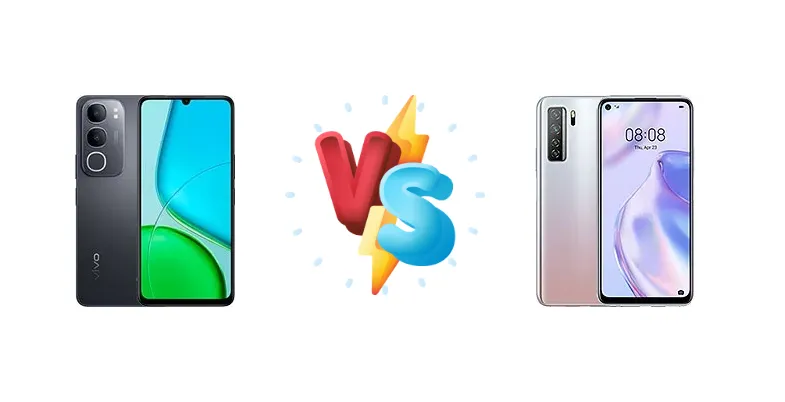
Both the vivo Y50 (China) and the Huawei nova 7 SE 5G Youth target the competitive mid-range 5G market, but they take slightly different approaches. The Y50 leverages the newer, 6nm Dimensity 6300, while the nova 7 SE 5G Youth opts for the established 7nm Dimensity 800U. This comparison dissects these chipsets and their implications for everyday use, focusing on performance, charging, and overall value.
🏆 Quick Verdict
For the average user prioritizing consistent performance and slightly faster charging, the vivo Y50 (China) emerges as the better choice. While the Huawei nova 7 SE 5G Youth offers reverse wireless charging, the Dimensity 6300’s more efficient 6nm process and comparable CPU performance provide a slight edge in sustained tasks.
| Network |
|---|
| 2G bands | GSM 850 / 900 / 1800 / 1900 | GSM 850 / 900 / 1800 / 1900 |
| 3G bands | HSDPA 850 / 900 / 2100 | HSDPA 800 / 850 / 900 / 1700(AWS) / 1900 / 2100 |
| 4G bands | 1, 3, 5, 8, 28, 34, 38, 39, 40, 41 | 1, 2, 3, 4, 5, 8, 18, 19, 26, 34, 38, 39, 40, 41 |
| 5G bands | 1, 3, 5, 8, 28, 38, 40, 41, 77, 78 SA/NSA | 1, 41, 77, 78 SA/NSA |
| Speed | HSPA, LTE | HSPA, LTE, 5G |
| Technology | GSM / HSPA / LTE / 5G | GSM / CDMA / HSPA / LTE / 5G |
| | - | CDMA 800 & TD-SCDMA |
| Launch |
|---|
| Announced | 2025, July 21 | 2020, October 16. Released 2020, October 16 |
| Status | Available. Released 2025, July 21 | Discontinued |
| Body |
|---|
| Build | Glass front, plastic frame, plastic back | - |
| Dimensions | 167.3 x 77 x 8.2 mm (6.59 x 3.03 x 0.32 in) | 162.3 x 75 x 8.6 mm (6.39 x 2.95 x 0.34 in) |
| SIM | Nano-SIM + Nano-SIM | Nano-SIM + Nano-SIM |
| Weight | 204 g (7.20 oz) | 189 g (6.67 oz) |
| Display |
|---|
| Resolution | 720 x 1600 pixels, 20:9 ratio (~260 ppi density) | 1080 x 2400 pixels, 20:9 ratio (~405 ppi density) |
| Size | 6.74 inches, 109.7 cm2 (~85.1% screen-to-body ratio) | 6.5 inches, 102.0 cm2 (~83.8% screen-to-body ratio) |
| Type | IPS LCD, 90Hz, 570 nits (HBM) | IPS LCD, HDR10 |
| Platform |
|---|
| CPU | Octa-core (2x2.4 GHz Cortex-A76 & 6x2.0 GHz Cortex-A55) | Octa-core (2x2.4 GHz Cortex-A76 & 6x2.0 GHz Cortex-A55) |
| Chipset | Mediatek Dimensity 6300 (6 nm) | Mediatek Dimensity 800U (7 nm) |
| GPU | Mali-G57 MC2 | Mali-G57 MC3 |
| OS | Android 15, OriginOS 5 | Android 10, EMUI 10.1, no Google Play Services |
| Memory |
|---|
| Card slot | microSDXC | No |
| Internal | 128GB 4GB RAM, 128GB 6GB RAM, 256GB 8GB RAM, 256GB 12GB RAM | 128GB 8GB RAM |
| Main Camera |
|---|
| Features | LED flash, panorama | LED flash, Panorama, HDR |
| Quad | - | 64 MP, f/1.8, 26mm (wide), PDAF
8 MP, f/2.4, 17mm (ultrawide)
2 MP (macro)
Auxiliary lens |
| Single | 13 MP, f/2.2, (wide), PDAF
Auxiliary lens | - |
| Video | 1080p@30fps | 4K@30fps, 1080p@30fps |
| Selfie camera |
|---|
| Features | - | HDR |
| Single | 5 MP, f/2.2, (wide) | 16 MP, f/2.0, (wide) |
| Video | Yes | 1080p@30fps |
| Sound |
|---|
| 3.5mm jack | - | Yes |
| 35mm jack | Yes | Yes |
| Loudspeaker | Yes | Yes |
| Comms |
|---|
| Bluetooth | 5.4, A2DP, LE, aptX HD | 5.1, A2DP, LE |
| Infrared port | Yes | - |
| NFC | Yes | No |
| Positioning | GPS, GALILEO, GLONASS, BDS, QZSS | GPS, GLONASS, GALILEO, BDS, QZSS |
| Radio | FM radio | No |
| USB | USB Type-C 2.0, OTG | USB Type-C 2.0, OTG |
| WLAN | Wi-Fi 802.11 a/b/g/n/ac, dual-band | Wi-Fi 802.11 a/b/g/n/ac, dual-band, Wi-Fi Direct |
| Features |
|---|
| Sensors | Fingerprint (side-mounted), accelerometer, proximity, compass | Fingerprint (side-mounted), accelerometer, proximity, compass |
| Battery |
|---|
| Charging | 44W wired | 40W wired, 70% in 30 min
5W reverse wired |
| Type | 6000 mAh | Li-Po 4000 mAh |
| Misc |
|---|
| Colors | Platinum, Azure, Diamond Black | Crush Green, Space Silver, Midnight Black, Purple |
| Models | V2443A, V2443BA | CND-AN00 |
| Price | About 140 EUR | About 290 EUR |
vivo Y50 (China)
- More efficient 6nm Dimensity 6300 chipset
- Faster 44W wired charging
- Potentially better sustained performance
- Lack of reverse wireless charging
- Camera specifications unknown
Huawei nova 7 SE 5G Youth
- Convenient 5W reverse wired charging
- Established Dimensity 800U chipset
- 70% charge in 30 minutes
- Less power-efficient 7nm process
- Slightly slower charging compared to vivo Y50
Display Comparison
Display specifications are not provided in the context data. However, given the price bracket, both devices likely feature LCD panels with FHD+ resolution. The absence of details like refresh rate or peak brightness makes a direct comparison impossible. Users should prioritize models with higher peak brightness for outdoor visibility and a higher refresh rate (90Hz or 120Hz) for smoother scrolling, if available.
Camera Comparison
Camera details are absent, making a detailed comparison impossible. However, both phones likely feature a multi-camera setup with a primary sensor. The image processing algorithms will differ between vivo and Huawei, resulting in distinct color science and image characteristics. Users should look for reviews with sample photos to assess which aesthetic they prefer. The absence of information regarding sensor size and OIS makes it difficult to determine which phone offers superior image quality.
Performance
The core of the difference lies in the chipsets. Both utilize an octa-core configuration with 2x2.4 GHz Cortex-A76 and 6x2.0 GHz Cortex-A55 cores, meaning CPU performance will be largely similar in burst tasks. However, the Huawei nova 7 SE 5G Youth’s Dimensity 800U, built on a 7nm process, is less power-efficient than the vivo Y50’s 6nm Dimensity 6300. This translates to potentially better thermal management and sustained performance on the Y50 during prolonged gaming or demanding applications. The GPU performance is also likely to be comparable, but the 6nm node gives the Y50 a slight advantage in efficiency.
Battery Life
Battery capacity is not specified. However, the charging speeds are a key differentiator. The vivo Y50 supports 44W wired charging, while the Huawei nova 7 SE 5G Youth offers 40W wired charging with a claimed 70% charge in 30 minutes, and 5W reverse wired charging. The 4W difference in charging speed is likely to be noticeable, with the Y50 potentially reaching full charge slightly faster. The inclusion of 5W reverse wired charging on the Huawei is a convenience feature for charging accessories, but its impact on daily use is limited.
Buying Guide
Buy the vivo Y50 (China) if you need a phone that balances performance with efficiency, offering a modern chipset for everyday tasks and moderate gaming. Buy the Huawei nova 7 SE 5G Youth if you value the convenience of reverse wireless charging and are comfortable with a slightly older, though still capable, chipset. Consider the Huawei's software ecosystem if that's a priority.
Frequently Asked Questions
❓ Will the Dimensity 6300 in the vivo Y50 handle demanding games like PUBG Mobile smoothly?
The Dimensity 6300, with its Cortex-A76 cores and Mali-G57 GPU, is capable of running PUBG Mobile at medium to high settings. However, sustained performance will depend on the phone's thermal management. The 6nm process should help mitigate throttling, but extended gaming sessions may still result in some frame drops.
❓ How useful is the 5W reverse wired charging on the Huawei nova 7 SE 5G Youth in real-world scenarios?
The 5W reverse wired charging is primarily useful for topping up accessories like wireless earbuds or smartwatches. It's not designed to quickly charge other phones, and the slow charging speed makes it impractical for anything beyond small devices. It's a convenience feature, not a core selling point.
❓ Does the Huawei nova 7 SE 5G Youth still have access to Google Mobile Services (GMS)?
This is a critical consideration. Due to ongoing restrictions, the Huawei nova 7 SE 5G Youth likely ships without GMS. It relies on Huawei Mobile Services (HMS) and the AppGallery. While HMS is improving, app availability and compatibility may be limited compared to GMS-equipped devices.