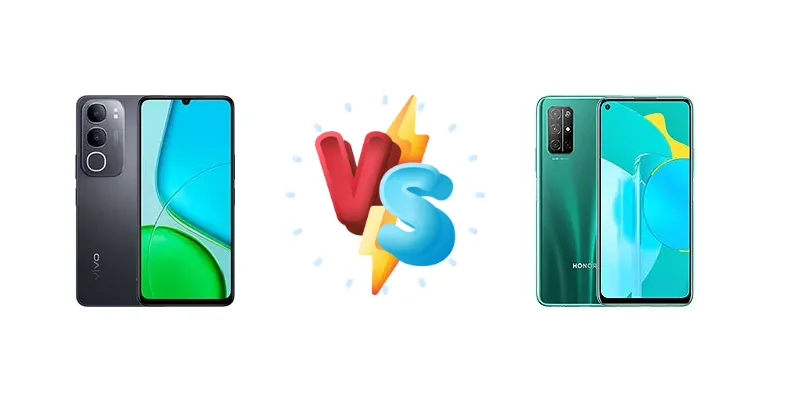
The vivo Y50 (China) and Honor 30S represent compelling options in the increasingly competitive mid-range 5G smartphone market. While both aim to deliver a balanced experience, they diverge significantly in their core processing power, with the Honor 30S leveraging Huawei’s Kirin 820 chipset against the MediaTek Dimensity 6300 found in the vivo Y50. This comparison will dissect these differences and determine which device offers the best value for your money.
🏆 Quick Verdict
For the average user prioritizing raw performance and sustained gaming, the Honor 30S is the clear winner. Its Kirin 820, built on a 7nm process, provides a noticeable advantage over the Dimensity 6300’s 6nm node in CPU and GPU capabilities. However, the vivo Y50 offers competitive charging and may appeal to those seeking a slightly more power-efficient option.
| Network |
|---|
| 2G bands | GSM 850 / 900 / 1800 / 1900 | GSM 850 / 900 / 1800 / 1900 |
| 3G bands | HSDPA 850 / 900 / 2100 | HSDPA 800 / 850 / 900 / 1700(AWS) / 1900 / 2100 |
| 4G bands | 1, 3, 5, 8, 28, 34, 38, 39, 40, 41 | 1, 2, 3, 4, 5, 6, 8, 18, 19, 26, 34, 38, 39, 40, 41 |
| 5G bands | 1, 3, 5, 8, 28, 38, 40, 41, 77, 78 SA/NSA | 1, 3, 41, 78, 79 SA/NSA |
| Speed | HSPA, LTE | HSPA, LTE, 5G |
| Technology | GSM / HSPA / LTE / 5G | GSM / CDMA / HSPA / LTE / 5G |
| | - | CDMA 800 & TD-SCDMA |
| Launch |
|---|
| Announced | 2025, July 21 | 2020, March 30. Released 2020, April 07 |
| Status | Available. Released 2025, July 21 | Discontinued |
| Body |
|---|
| Build | Glass front, plastic frame, plastic back | Glass front (Aluminosilicate glass), glass back, aluminum frame |
| Dimensions | 167.3 x 77 x 8.2 mm (6.59 x 3.03 x 0.32 in) | 162.3 x 75 x 8.6 mm (6.39 x 2.95 x 0.34 in) |
| SIM | Nano-SIM + Nano-SIM | Nano-SIM + Nano-SIM |
| Weight | 204 g (7.20 oz) | 190 g (6.70 oz) |
| Display |
|---|
| Protection | - | Aluminosilicate glass |
| Resolution | 720 x 1600 pixels, 20:9 ratio (~260 ppi density) | 1080 x 2400 pixels, 20:9 ratio (~405 ppi density) |
| Size | 6.74 inches, 109.7 cm2 (~85.1% screen-to-body ratio) | 6.5 inches, 102.0 cm2 (~83.8% screen-to-body ratio) |
| Type | IPS LCD, 90Hz, 570 nits (HBM) | IPS LCD, HDR10 |
| Platform |
|---|
| CPU | Octa-core (2x2.4 GHz Cortex-A76 & 6x2.0 GHz Cortex-A55) | Octa-core (1x2.36 GHz Cortex-A76 & 3x2.22 GHz Cortex-A76 & 4x1.84 GHz Cortex-A55) |
| Chipset | Mediatek Dimensity 6300 (6 nm) | Kirin 820 5G (7 nm) |
| GPU | Mali-G57 MC2 | Mali-G57 6 |
| OS | Android 15, OriginOS 5 | Android 10, Magic UI 3, no Google Play Services |
| Memory |
|---|
| Card slot | microSDXC | Nano Memory (uses shared SIM slot) |
| Internal | 128GB 4GB RAM, 128GB 6GB RAM, 256GB 8GB RAM, 256GB 12GB RAM | 128GB 6GB RAM, 128GB 8GB RAM, 256GB 8GB RAM |
| | - | UFS 2.1 |
| Main Camera |
|---|
| Features | LED flash, panorama | LED flash, HDR, panorama |
| Quad | - | 64 MP, f/1.8, 26mm (wide), 1/1.73", 0.8µm, PDAF
8 MP, f/2.4, 80mm (telephoto), AF, 3x optical zoom
8 MP, f/2.4, 17mm (ultrawide)
Auxiliary lens |
| Single | 13 MP, f/2.2, (wide), PDAF
Auxiliary lens | - |
| Video | 1080p@30fps | 4K@30fps, 1080p@30fps, 720p@960fps, gyro-EIS |
| Selfie camera |
|---|
| Features | - | HDR |
| Single | 5 MP, f/2.2, (wide) | 16 MP, f/2.0, (wide) |
| Video | Yes | 1080p@30fps |
| Sound |
|---|
| 3.5mm jack | - | Yes |
| 35mm jack | Yes | Yes |
| Loudspeaker | Yes | Yes |
| | - | 32-bit/192kHz audio |
| Comms |
|---|
| Bluetooth | 5.4, A2DP, LE, aptX HD | 5.1, A2DP, LE |
| Infrared port | Yes | - |
| NFC | Yes | No |
| Positioning | GPS, GALILEO, GLONASS, BDS, QZSS | GPS, GLONASS, BDS |
| Radio | FM radio | No |
| USB | USB Type-C 2.0, OTG | USB Type-C 2.0, OTG |
| WLAN | Wi-Fi 802.11 a/b/g/n/ac, dual-band | Wi-Fi 802.11 a/b/g/n/ac, dual-band, Wi-Fi Direct |
| Features |
|---|
| Sensors | Fingerprint (side-mounted), accelerometer, proximity, compass | Fingerprint (side-mounted), accelerometer, gyro, proximity, compass |
| Battery |
|---|
| Charging | 44W wired | 40W wired, 70% in 30 min |
| Type | 6000 mAh | Li-Po 4000 mAh |
| Misc |
|---|
| Colors | Platinum, Azure, Diamond Black | Black, Blue, Green, Gradient, Butterfly Feather Red |
| Models | V2443A, V2443BA | CDY-AN90, CDY-AN95, CDY-TN90 |
| Price | About 140 EUR | About 310 EUR |
vivo Y50 (China)
- Faster 44W wired charging
- Potentially better power efficiency with Dimensity 6300's 6nm process
- Competitive price point (likely)
- Less powerful processor compared to Kirin 820
- Potentially lower GPU performance for gaming
- Limited information on camera capabilities
Honor 30S
- More powerful Kirin 820 chipset for superior performance
- Better GPU performance for gaming and demanding tasks
- Integrated 5G modem within the Kirin 820
- Slower 40W wired charging
- Potentially lower battery efficiency due to 7nm process
- May be slightly more expensive
Display Comparison
Neither device’s display specifications are provided, so a direct comparison is limited. However, given the market positioning, both likely feature LCD panels with FHD+ resolution. The Honor 30S, being a slightly older model, may have marginally larger bezels. Color accuracy will likely be similar, tuned for vibrant visuals common in Chinese smartphones. Without specific data, it's reasonable to assume both offer adequate viewing experiences for everyday use.
Camera Comparison
Without detailed camera specifications, a precise comparison is difficult. However, both phones likely feature multi-camera setups geared towards general photography. The Honor 30S, given its slightly higher market positioning, may have a larger main sensor, potentially offering better low-light performance. Image processing styles will differ – Honor typically leans towards more saturated colors, while vivo often aims for a more natural look. The absence of information regarding OIS or sensor sizes makes a definitive judgment impossible, but the Kirin 820’s ISP likely offers more advanced image processing capabilities.
Performance
The core difference lies in the chipsets. The Honor 30S’s Kirin 820 (7nm) boasts a more complex CPU configuration – 1x2.36 GHz Cortex-A76, 3x2.22 GHz Cortex-A76, and 4x1.84 GHz Cortex-A55 – compared to the vivo Y50’s Dimensity 6300 (6nm) with 2x2.4 GHz Cortex-A76 & 6x2.0 GHz Cortex-A55. While the Dimensity 6300 benefits from a newer, more efficient 6nm process, the Kirin 820’s superior core count and higher clock speeds on its A76 cores translate to significantly better multi-core performance. This advantage extends to GPU performance, making the Honor 30S the better choice for gaming. The Honor 30S also benefits from 5G integration within the Kirin 820, while the Dimensity 6300's 5G capabilities depend on the modem used.
Battery Life
Battery capacity isn’t specified for either device. However, the charging speeds provide a clear differentiator. The vivo Y50’s 44W wired charging is faster than the Honor 30S’s 40W, with the latter claiming 70% charge in 30 minutes. This suggests the Y50 could achieve a full charge slightly faster. The 6nm process of the Dimensity 6300 may also contribute to slightly better power efficiency, potentially offsetting a smaller battery capacity. Real-world battery life will depend heavily on usage patterns, but the Y50’s faster charging is a significant convenience factor.
Buying Guide
Buy the vivo Y50 (China) if you need a reliable daily driver with fast 44W charging and prioritize power efficiency for extended battery life during typical usage. Buy the Honor 30S if you prefer a more powerful processor for demanding tasks like gaming, video editing, or multitasking, and are willing to trade a small amount of battery life for that performance boost.
Frequently Asked Questions
❓ Does the Dimensity 6300 in the vivo Y50 struggle with graphically intensive games like PUBG or Genshin Impact?
While the Dimensity 6300 is a capable chip, it will likely require lower graphics settings and frame rates to achieve a smooth experience in demanding games like PUBG or Genshin Impact. The Honor 30S’s Kirin 820 offers a significant performance advantage and can handle these games at higher settings.
❓ How does the 70% charge in 30 minutes claim for the Honor 30S translate to a full charge time?
Extrapolating from the 70% in 30 minutes claim, a full charge for the Honor 30S is estimated to take around 43-45 minutes. However, charging speed typically slows down as the battery approaches full capacity, so the actual time may be slightly longer.
❓ Is the difference in chipset performance noticeable for everyday tasks like browsing, social media, and video streaming?
For basic tasks, the difference between the Dimensity 6300 and Kirin 820 will be minimal. Both chips are more than capable of handling everyday usage smoothly. The performance gap becomes more apparent during multitasking, demanding apps, or gaming.