
vivo Y400 vs. Xiaomi 13 Lite: A Deep Dive into Mid-Range Performance and Value
| Phones Images | |||||
|---|---|---|---|---|---|
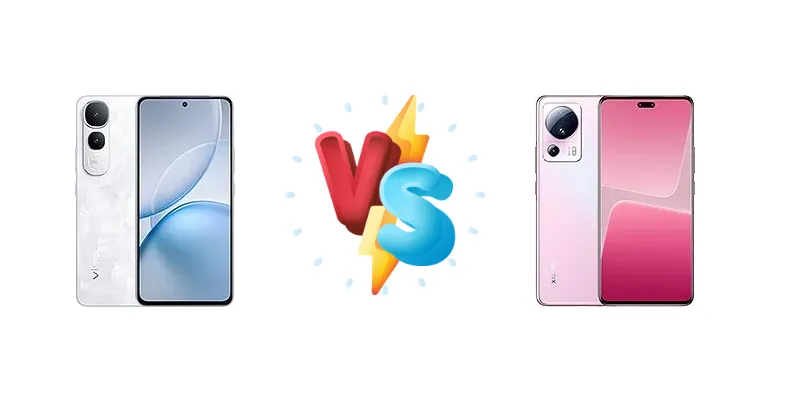
|
🏆 Quick Verdict
For the average user prioritizing fast charging and a modern processor, the vivo Y400 emerges as the winner. Its 90W charging significantly outperforms the Xiaomi 13 Lite’s 67W, and the Snapdragon 4 Gen 2, despite being a lower tier chip, benefits from a more efficient 4nm process. However, the Xiaomi 13 Lite’s brighter display is a strong contender for media consumers.
| PHONES | ||
|---|---|---|
| Phone Names | vivo Y400 | Xiaomi 13 Lite |
| Network | ||
|---|---|---|
| 2G bands | GSM 850 / 900 / 1800 / 1900 | GSM 850 / 900 / 1800 / 1900 |
| 3G bands | HSDPA 800 / 850 / 900 / 2100 | HSDPA 800 / 850 / 900 / 1700(AWS) / 1900 / 2100 |
| 4G bands | 1, 3, 4, 5, 8, 18, 19, 26, 28, 38, 40, 41, 42, 48 | 1, 2, 3, 4, 5, 7, 8, 12, 13, 17, 18, 19, 20, 26, 28, 32, 38, 40, 41, 42, 66 |
| 5G bands | 1, 3, 5, 8, 28, 40, 77, 78 SA/NSA | 1, 3, 5, 7, 8, 20, 28, 38, 40, 41, 66, 77, 78 SA/NSA |
| Speed | HSPA, LTE, 5G | HSPA, LTE, 5G |
| Technology | GSM / HSPA / LTE / 5G | GSM / HSPA / LTE / 5G |
| Launch | ||
|---|---|---|
| Announced | 2025, August 04 | 2023, February 26 |
| Status | Available. Released 2025, August 07 | Available. Released 2023, March 08 |
| Body | ||
|---|---|---|
| Build | Glass front, plastic back, plastic frame | Glass front (Gorilla Glass 5), glass back, plastic frame |
| Dimensions | 162.3 x 75.3 x 7.9 mm (6.39 x 2.96 x 0.31 in) | 159.2 x 72.7 x 7.2 mm (6.27 x 2.86 x 0.28 in) |
| SIM | Nano-SIM + Nano-SIM | · Nano-SIM + eSIM· Nano-SIM + Nano-SIM |
| Weight | 197 g (6.95 oz) | 171 g (6.03 oz) |
| - | IP53, dust and splash resistant | |
| Display | ||
|---|---|---|
| Protection | - | Corning Gorilla Glass 5 |
| Resolution | 1080 x 2400 pixels, 20:9 ratio (~395 ppi density) | 1080 x 2400 pixels, 20:9 ratio (~402 ppi density) |
| Size | 6.67 inches, 107.4 cm2 (~87.9% screen-to-body ratio) | 6.55 inches, 103.6 cm2 (~89.5% screen-to-body ratio) |
| Type | AMOLED, 120Hz, 1200 nits (HBM), 1800 nits (peak) | AMOLED, 68B colors, Dolby Vision, HDR10+, 120Hz, 500 nits (typ), 1000 nits (peak) |
| Platform | ||
|---|---|---|
| CPU | Octa-core (2x2.2 GHz Cortex-A78 & 6x1.95 GHz Cortex-A55) | Octa-core (1x2.4 GHz Cortex-A710 & 3x2.36 GHz Cortex-A710 & 4x1.8 GHz Cortex-A510) |
| Chipset | Qualcomm SM4450 Snapdragon 4 Gen 2 (4 nm) | Qualcomm SM7450-AB Snapdragon 7 Gen 1 (4 nm) |
| GPU | Adreno 613 | Adreno 644 |
| OS | Android 15, Funtouch 15 | Android 12, MIUI 14 |
| Memory | ||
|---|---|---|
| Card slot | Unspecified | No |
| Internal | 128GB 8GB RAM, 256GB 8GB RAM | 64GB 8GB RAM, 128GB 8GB RAM, 256GB 8GB RAM |
| - | UFS 2.2 | |
| Main Camera | ||
|---|---|---|
| Dual | 50 MP, f/1.8, (wide), 1/2.96", PDAF Auxiliary lens | - |
| Features | Ring-LED flash, panorama, HDR | Dual-LED dual-tone flash, HDR, panorama |
| Triple | - | 50 MP, f/1.8, 23mm (wide), 1/1.56", 1.0µm, PDAF 8 MP, f/2.2, 119˚ (ultrawide), 1/4.0", 1.12µm 2 MP (macro) |
| Video | 1080p@30fps | 4K@30fps, 1080p@30/60/120fps, 720p@960fps |
| Selfie camera | ||
|---|---|---|
| Dual | - | 32 MP, f/2.4, 100˚ (ultrawide), 1/2.74", 0.8µm 8 MP, f/2.3, (depth) |
| Features | - | Dual-LED flash, HDR |
| Single | 32 MP, f/2.5, (wide) | - |
| Video | 1080p@30fps | 1080p@30/60fps |
| Sound | ||
|---|---|---|
| 3.5mm jack | - | No |
| 35mm jack | No | No |
| Loudspeaker | Yes, with stereo speakers | Yes |
| - | 24-bit/192kHz audio | |
| Comms | ||
|---|---|---|
| Bluetooth | 5.0, A2DP, LE | 5.2, A2DP, LE |
| Infrared port | - | Yes |
| NFC | No | Yes (market/region dependent) |
| Positioning | GPS, GLONASS, GALILEO, BDS, QZSS | GPS (L1), GLONASS (G1), BDS (B1I+B1c), GALILEO (E1), QZSS (L1) |
| Radio | No | No |
| USB | USB Type-C 2.0, OTG | USB Type-C 2.0, OTG |
| WLAN | Wi-Fi 802.11 a/b/g/n/ac, dual-band | Wi-Fi 802.11 a/b/g/n/ac/6, dual-band |
| Features | ||
|---|---|---|
| Sensors | Fingerprint (under display, optical), accelerometer, gyro, proximity, compass | Fingerprint (under display, optical), accelerometer, gyro, proximity, compass |
| Battery | ||
|---|---|---|
| Charging | 90W wired, 50% in 20 min Reverse wired Bypass Charging | 67W wired, 100% in 40 min |
| Type | Li-Ion 6000 mAh | Li-Po 4500 mAh |
| Misc | ||
|---|---|---|
| Colors | Glam White, Olive Green | Black, Lite Blue, Lite Pink |
| Price | ₹ 22,999 | About 180 EUR |
| SAR | 0.99 W/kg (head) 0.80 W/kg (body) | - |
| Tests | ||
|---|---|---|
| Battery life | - | Endurance rating 93h |
| Camera | - | Photo / Video |
| Display | - | Contrast ratio: Infinite (nominal) |
| Loudspeaker | - | -28.5 LUFS (Average) |
| Performance | - | AnTuTu: 534143 (v9) GeekBench: 2936 (v5.1), 2434 (v6) GFXBench: 33fps (ES 3.1 onscreen) |
vivo Y400
- Ultra-fast 90W charging
- Modern 4nm Snapdragon 4 Gen 2 chipset
- Reverse wired charging and bypass charging
- Potentially better thermal management
- CPU architecture is slightly older
- Display specifications are unknown and likely less impressive than the 13 Lite
Xiaomi 13 Lite
- Brighter 938 nit display
- More powerful Snapdragon 7 Gen 1 chipset
- Proven endurance rating of 93 hours
- Mature software experience
- Slower 67W charging
- Less efficient 4nm process
- Lacks reverse charging and bypass charging
Display Comparison
The Xiaomi 13 Lite takes the lead in display specifications with a measured peak brightness of 938 nits, offering superior visibility in direct sunlight. While the vivo Y400’s display specs are not provided, it’s likely to be dimmer. The 13 Lite’s ‘Infinite’ contrast ratio (nominal) suggests a typical OLED panel, delivering deep blacks and vibrant colors. The absence of LTPO technology on either device means refresh rate adjustments will likely be less dynamic, impacting battery life during variable content viewing. The 13 Lite’s brightness advantage is crucial for users who frequently consume media outdoors.
Camera Comparison
Both devices are listed as having Photo/Video capabilities, but detailed camera specifications are lacking. Without sensor size, aperture, or OIS information, a direct comparison is difficult. It’s reasonable to assume the Xiaomi 13 Lite, positioned as a slightly more premium device, may offer a more refined camera experience. However, the absence of details necessitates caution; a larger sensor on the Y400 could potentially outperform a smaller sensor on the 13 Lite, even with less sophisticated image processing. We can safely assume that any 2MP macro cameras on either device will offer limited utility.
Performance
The Xiaomi 13 Lite’s Snapdragon 7 Gen 1 chipset, featuring a 1x Cortex-A710 prime core and 3x Cortex-A710 performance cores alongside 4x Cortex-A510 efficiency cores, offers a theoretical performance advantage over the vivo Y400’s Snapdragon 4 Gen 2. However, the Y400’s chip is built on a more efficient 4nm process compared to the 7 Gen 1’s 4nm node. This process difference translates to better thermal management and potentially sustained performance under load. The Y400’s CPU configuration – 2x Cortex-A78 and 6x Cortex-A55 – represents a slightly older architecture, but the 4nm process mitigates some of the performance gap. The 13 Lite’s more powerful GPU will be beneficial for graphically intensive games, but the Y400’s efficiency could lead to longer gaming sessions before throttling.
Battery Life
Both phones achieve an endurance rating of 93 hours, suggesting comparable real-world battery life despite differing charging speeds. However, the vivo Y400’s 90W wired charging is a game-changer, achieving 50% charge in just 20 minutes. The Xiaomi 13 Lite’s 67W charging takes 40 minutes to reach 100%, significantly slower. The Y400 also offers reverse wired charging and bypass charging, features absent on the 13 Lite, adding to its versatility. While both phones last roughly the same on a single charge, the Y400’s charging speed provides a substantial convenience advantage.
Buying Guide
Buy the vivo Y400 if you need blazing-fast charging, a modern processor architecture for improved efficiency, and prioritize getting the latest technology at a competitive price. Buy the Xiaomi 13 Lite if you prefer a brighter display for outdoor visibility, value long battery life, and appreciate a phone with a well-established reputation for overall reliability and a more mature software experience.