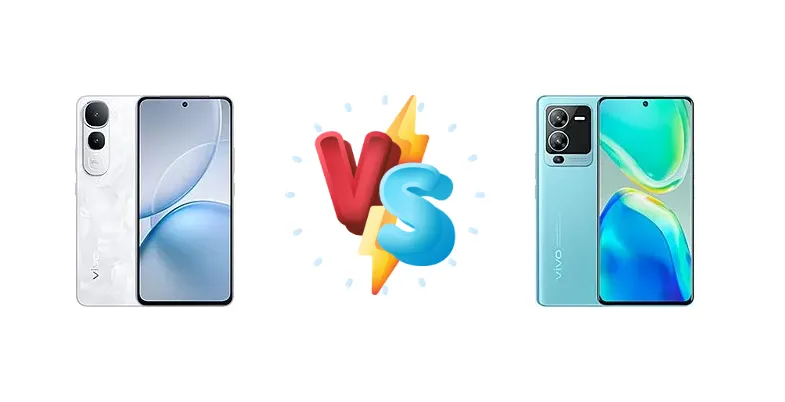
The vivo Y400 and V25 Pro represent different approaches within vivo’s smartphone lineup. The Y400 targets the budget-conscious user with a focus on rapid charging and efficient processing, while the V25 Pro, though older, aimed for a more premium experience with a powerful Dimensity chipset and a focus on camera capabilities. This comparison dissects their key differences to determine which device best suits your needs.
🏆 Quick Verdict
For the average user prioritizing fast charging and efficient daily performance, the vivo Y400 emerges as the stronger choice. Its 90W charging significantly outperforms the V25 Pro’s 66W, and the Snapdragon 4 Gen 2 offers a surprisingly capable experience for the price. The V25 Pro remains a viable option for those who prioritize a slightly older, but more powerful chipset.
| Network |
|---|
| 2G bands | GSM 850 / 900 / 1800 / 1900 | GSM 850 / 900 / 1800 / 1900 |
| 3G bands | HSDPA 800 / 850 / 900 / 2100 | HSDPA 850 / 900 / 1700(AWS) / 1900 / 2100 |
| 4G bands | 1, 3, 4, 5, 8, 18, 19, 26, 28, 38, 40, 41, 42, 48 | 1, 2, 3, 4, 5, 8, 18, 19, 26, 38, 39, 40, 41 |
| 5G bands | 1, 3, 5, 8, 28, 40, 77, 78 SA/NSA | 1, 3, 5, 8, 40, 41, 77, 78 SA/NSA |
| Speed | HSPA, LTE, 5G | HSPA, LTE, 5G |
| Technology | GSM / HSPA / LTE / 5G | GSM / HSPA / LTE / 5G |
| Launch |
|---|
| Announced | 2025, August 04 | 2022, August 17 |
| Status | Available. Released 2025, August 07 | Available. Released 2022, August 25 |
| Body |
|---|
| Build | Glass front, plastic back, plastic frame | Glass front, glass back |
| Dimensions | 162.3 x 75.3 x 7.9 mm (6.39 x 2.96 x 0.31 in) | 158.9 x 73.5 x 8.6 mm (6.26 x 2.89 x 0.34 in) |
| SIM | Nano-SIM + Nano-SIM | Nano-SIM + Nano-SIM |
| Weight | 197 g (6.95 oz) | 190 g (6.70 oz) |
| | - | Color changing back panel color
Resistant to drops, scratches, and sweat |
| Display |
|---|
| Resolution | 1080 x 2400 pixels, 20:9 ratio (~395 ppi density) | 1080 x 2376 pixels (~398 ppi density) |
| Size | 6.67 inches, 107.4 cm2 (~87.9% screen-to-body ratio) | 6.56 inches, 104.6 cm2 (~89.6% screen-to-body ratio) |
| Type | AMOLED, 120Hz, 1200 nits (HBM), 1800 nits (peak) | AMOLED, 120Hz, HDR10+, 1300 nits (peak) |
| Platform |
|---|
| CPU | Octa-core (2x2.2 GHz Cortex-A78 & 6x1.95 GHz Cortex-A55) | Octa-core (1x3.0 GHz Cortex-A78 & 3x2.6 GHz Cortex-A78 & 4x2.0 GHz Cortex-A55) |
| Chipset | Qualcomm SM4450 Snapdragon 4 Gen 2 (4 nm) | Mediatek Dimensity 1300 (6 nm) |
| GPU | Adreno 613 | Mali-G77 MC9 |
| OS | Android 15, Funtouch 15 | Android 12, Funtouch 12 |
| Memory |
|---|
| Card slot | Unspecified | No |
| Internal | 128GB 8GB RAM, 256GB 8GB RAM | 128GB 8GB RAM, 256GB 12GB RAM |
| | - | UFS 3.1 |
| Main Camera |
|---|
| Dual | 50 MP, f/1.8, (wide), 1/2.96", PDAF
Auxiliary lens | - |
| Features | Ring-LED flash, panorama, HDR | LED flash, HDR, panorama |
| Single | - | 32 MP, f/2.5, (wide), 1/2.8", 0.8µm, AF |
| Triple | - | 64 MP, f/1.9, 25mm (wide), 1/1.72", 0.8µm, PDAF, OIS
8 MP, f/2.2, 16mm, 120˚ (ultrawide), 1/4.0", 1.12µm
2 MP (macro) |
| Video | 1080p@30fps | 4K@30fps, 1080p@30fps |
| Selfie camera |
|---|
| Features | - | HDR |
| Single | 32 MP, f/2.5, (wide) | 32 MP, f/2.5, (wide), 1/2.8", 0.8µm, AF |
| Video | 1080p@30fps | 1080p@30fps |
| Sound |
|---|
| 3.5mm jack | - | No |
| 35mm jack | No | No |
| Loudspeaker | Yes, with stereo speakers | Yes |
| | - | 24-bit/192kHz audio |
| Comms |
|---|
| Bluetooth | 5.0, A2DP, LE | 5.2, A2DP, LE |
| NFC | No | No |
| Positioning | GPS, GLONASS, GALILEO, BDS, QZSS | GPS, GLONASS, BDS, GALILEO, QZSS, NavIC |
| Radio | No | No |
| USB | USB Type-C 2.0, OTG | USB Type-C 2.0, OTG |
| WLAN | Wi-Fi 802.11 a/b/g/n/ac, dual-band | Wi-Fi 802.11 a/b/g/n/ac/6, dual-band, Wi-Fi Direct |
| Features |
|---|
| Sensors | Fingerprint (under display, optical), accelerometer, gyro, proximity, compass | Fingerprint (under display, optical), accelerometer, gyro, proximity, compass |
| Battery |
|---|
| Charging | 90W wired, 50% in 20 min
Reverse wired
Bypass Charging | 66W wired, 40% in 15 min, 71% in 30 min |
| Type | Li-Ion 6000 mAh | 4830 mAh |
| Misc |
|---|
| Colors | Glam White, Olive Green | Pure Black, Sailing Blue |
| Models | - | V2158 |
| Price | ₹ 22,999 | About 440 EUR |
| SAR | 0.99 W/kg (head) 0.80 W/kg (body) | 1.19 W/kg (head) 0.88 W/kg (body) |
| Tests |
|---|
| Battery life | - |
Endurance rating 101h
|
| Camera | - |
Photo / Video |
| Display | - |
Contrast ratio: Infinite (nominal) |
| Loudspeaker | - |
-27.3 LUFS (Good)
|
| Performance | - |
AnTuTu: 704090 (v9)
GeekBench: 2521 (v5.1)
GFXBench: 42fps (ES 3.1 onscreen) |
vivo Y400
- Incredibly fast 90W charging
- Power-efficient Snapdragon 4 Gen 2 (4nm)
- Reverse wired charging and bypass charging
- Likely less powerful CPU/GPU than V25 Pro
- Display specifications are unknown
vivo V25 Pro
- More powerful Dimensity 1300 chipset
- Higher peak display brightness (805 nits)
- Potentially better camera image processing
- Slower 66W charging
- Less power-efficient chipset (6nm)
Display Comparison
The V25 Pro boasts a measured peak brightness of 805 nits, suggesting a more visible display in direct sunlight compared to the Y400 (brightness data unavailable). While the V25 Pro’s contrast ratio is listed as ‘infinite’ (nominal), this is typical marketing language. Without detailed panel specifications for the Y400, it’s difficult to assess its color accuracy or viewing angles, but given its price point, it likely utilizes a less advanced panel than the V25 Pro. The V25 Pro’s older generation panel may also lack the higher refresh rates becoming standard in the Y400’s price bracket.
Camera Comparison
Both phones feature photo and video capabilities, but detailed camera specifications are limited. The V25 Pro likely benefits from a more sophisticated image signal processor (ISP) within the Dimensity 1300. Without sensor size or aperture information for either device, a direct comparison is difficult. The Y400’s camera system is likely geared towards social media sharing and casual photography, while the V25 Pro may offer more advanced features and better low-light performance. The presence of a 2MP macro camera on either device is unlikely to significantly impact image quality.
Performance
The core difference lies in the chipsets. The vivo V25 Pro’s MediaTek Dimensity 1300 (6nm) features a 1x3.0 GHz Cortex-A78 core and three additional Cortex-A78 cores, offering substantial multi-core performance. In contrast, the vivo Y400 utilizes the Qualcomm Snapdragon 4 Gen 2 (4nm) with 2x2.2 GHz Cortex-A78 cores and 6x1.95 GHz Cortex-A55 cores. The 4nm process of the Snapdragon 4 Gen 2 provides superior power efficiency, potentially leading to longer battery life during typical use. However, the Dimensity 1300’s more numerous high-performance cores will likely translate to faster processing in demanding applications. The V25 Pro likely benefits from faster RAM (LPDDR5) compared to the Y400 (spec not provided, likely LPDDR4X).
Battery Life
Both devices achieved an endurance rating of 101 hours, suggesting similar overall battery life despite differing battery capacities (not specified for Y400). However, the charging speeds are dramatically different. The vivo Y400’s 90W wired charging can deliver 50% charge in just 20 minutes, a significant advantage over the V25 Pro’s 66W charging (40% in 15 minutes, 71% in 30 minutes). The Y400 also supports reverse wired charging and bypass charging, features absent on the V25 Pro, adding to its convenience.
Buying Guide
Buy the vivo Y400 if you need a phone that charges incredibly quickly, offers solid everyday performance for social media, browsing, and light gaming, and fits a tighter budget. Buy the vivo V25 Pro if you prefer a more powerful processor for demanding tasks like video editing or graphically intensive games, and are willing to accept slower charging speeds and potentially a higher price point.
Frequently Asked Questions
❓ Does the Snapdragon 4 Gen 2 in the Y400 struggle with demanding games like PUBG or Genshin Impact?
While not a gaming powerhouse, the Snapdragon 4 Gen 2 is surprisingly capable. Expect playable frame rates at medium settings in PUBG. Genshin Impact may require lower settings for a smooth experience. The V25 Pro’s Dimensity 1300 will offer a noticeably better gaming experience, but the Y400 is adequate for casual gaming.
❓ How much faster is the 90W charging on the Y400 compared to the 66W on the V25 Pro in real-world use?
The Y400’s 90W charging is significantly faster. It can reach 50% charge in 20 minutes, while the V25 Pro takes 15 minutes for 40%. A full charge on the Y400 will likely be completed in under 45 minutes, compared to potentially over an hour on the V25 Pro. This makes a huge difference for users who frequently need to top up their battery quickly.
❓ Is the camera on the vivo Y400 good enough for social media and casual photography?
Yes, the Y400’s camera is well-suited for social media and everyday snapshots. While it likely lacks the advanced features and low-light performance of the V25 Pro, it should produce acceptable image quality in good lighting conditions. Don't expect professional-grade results, but it's more than adequate for most users.