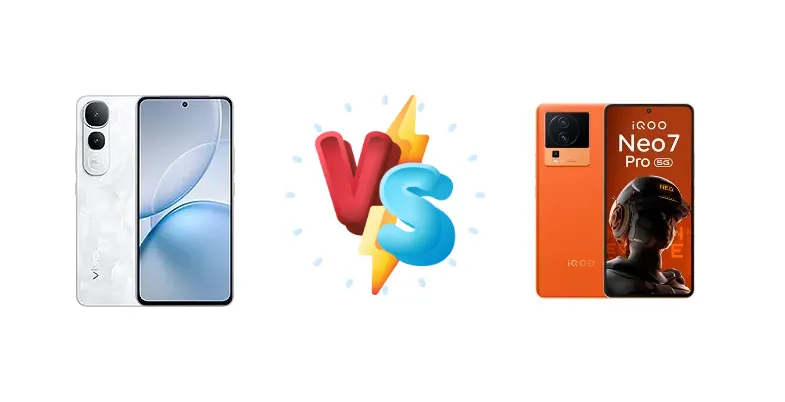
vivo offers a diverse smartphone lineup, and the Y400 and iQOO Neo 7 Pro represent distinct approaches. The Y400 focuses on delivering a solid experience at a more accessible price point, while the iQOO Neo 7 Pro aims for near-flagship performance with a focus on gaming. This comparison dissects their key differences to help you determine which vivo phone best suits your needs.
🏆 Quick Verdict
For the average user prioritizing value and efficient daily performance, the vivo Y400 is the stronger choice. However, the iQOO Neo 7 Pro’s Snapdragon 8+ Gen 1 provides a significant performance leap for demanding users and gamers, justifying its higher price tag.
| Network |
|---|
| 2G bands | GSM 850 / 900 / 1800 / 1900 | GSM 850 / 900 / 1800 / 1900 |
| 3G bands | HSDPA 800 / 850 / 900 / 2100 | HSDPA 800 / 850 / 900 / 1700(AWS) / 1900 / 2100 |
| 4G bands | 1, 3, 4, 5, 8, 18, 19, 26, 28, 38, 40, 41, 42, 48 | 1, 2, 3, 4, 5, 8, 28, 34, 38, 39, 40, 41 |
| 5G bands | 1, 3, 5, 8, 28, 40, 77, 78 SA/NSA | 1, 3, 5, 8, 28, 40, 77, 78 SA/NSA |
| Speed | HSPA, LTE, 5G | HSPA, LTE, 5G |
| Technology | GSM / HSPA / LTE / 5G | GSM / HSPA / LTE / 5G |
| Launch |
|---|
| Announced | 2025, August 04 | 2023, July 04 |
| Status | Available. Released 2025, August 07 | Available. Released 2023, July 15 |
| Body |
|---|
| Build | Glass front, plastic back, plastic frame | Glass front, plastic frame, glass or leather back |
| Dimensions | 162.3 x 75.3 x 7.9 mm (6.39 x 2.96 x 0.31 in) | 164.8 x 76.9 x 8.5 mm or 8.9 mm |
| SIM | Nano-SIM + Nano-SIM | Nano-SIM + Nano-SIM |
| Weight | 197 g (6.95 oz) | 197 g or 202 g (6.95 oz) |
| Display |
|---|
| Resolution | 1080 x 2400 pixels, 20:9 ratio (~395 ppi density) | 1080 x 2400 pixels, 20:9 ratio (~388 ppi density) |
| Size | 6.67 inches, 107.4 cm2 (~87.9% screen-to-body ratio) | 6.78 inches, 111.0 cm2 (~87.6% screen-to-body ratio) |
| Type | AMOLED, 120Hz, 1200 nits (HBM), 1800 nits (peak) | AMOLED, 1B colors, 120Hz, HDR10+, 1300 nits (peak) |
| Platform |
|---|
| CPU | Octa-core (2x2.2 GHz Cortex-A78 & 6x1.95 GHz Cortex-A55) | Octa-core (1x3.19 GHz Cortex-X2 & 3x2.75 GHz Cortex-A710 & 4x2.0 GHz Cortex-A510) |
| Chipset | Qualcomm SM4450 Snapdragon 4 Gen 2 (4 nm) | Qualcomm SM8475 Snapdragon 8+ Gen 1 (4 nm) |
| GPU | Adreno 613 | Adreno 730 |
| OS | Android 15, Funtouch 15 | Android 13, Funtouch 13 |
| Memory |
|---|
| Card slot | Unspecified | No |
| Internal | 128GB 8GB RAM, 256GB 8GB RAM | 128GB 8GB RAM, 256GB 12GB RAM |
| Main Camera |
|---|
| Dual | 50 MP, f/1.8, (wide), 1/2.96", PDAF
Auxiliary lens | - |
| Features | Ring-LED flash, panorama, HDR | LED flash, HDR, panorama |
| Triple | - | 50 MP, f/1.9, 24mm (wide), 1/1.57", 1.0µm, PDAF, OIS
8 MP, f/2.2, 16mm (ultrawide), 1/4.0", 1.12µm
2 MP (macro) |
| Video | 1080p@30fps | 4K@30fps, 1080p@30fps |
| Selfie camera |
|---|
| Features | - | HDR |
| Single | 32 MP, f/2.5, (wide) | 16 MP, f/2.5, (wide), 1/3.1", 1.0µm |
| Video | 1080p@30fps | 1080p@30fps |
| Sound |
|---|
| 35mm jack | No | No |
| Loudspeaker | Yes, with stereo speakers | Yes, with stereo speakers |
| Comms |
|---|
| Bluetooth | 5.0, A2DP, LE | 5.3, A2DP, LE, aptX HD, aptX Adaptive |
| Infrared port | - | Yes |
| NFC | No | No |
| Positioning | GPS, GLONASS, GALILEO, BDS, QZSS | GPS, GLONASS, GALILEO, BDS, QZSS, NavIC |
| Radio | No | No |
| USB | USB Type-C 2.0, OTG | USB Type-C 2.0, OTG |
| WLAN | Wi-Fi 802.11 a/b/g/n/ac, dual-band | Wi-Fi 802.11 a/b/g/n/ac/6, dual-band, Wi-Fi Direct |
| Features |
|---|
| Sensors | Fingerprint (under display, optical), accelerometer, gyro, proximity, compass | Fingerprint (under display, optical), accelerometer, gyro, proximity, compass |
| Battery |
|---|
| Charging | 90W wired, 50% in 20 min
Reverse wired
Bypass Charging | 120W wired, 50% in 8 min |
| Type | Li-Ion 6000 mAh | 5000 mAh |
| Misc |
|---|
| Colors | Glam White, Olive Green | Fearless Flame, Dark Storm |
| Models | - | I2217 |
| Price | ₹ 22,999 | About 380 EUR |
| SAR | 0.99 W/kg (head) 0.80 W/kg (body) | - |
vivo Y400
- More affordable price point
- Efficient Snapdragon 4 Gen 2 processor
- 90W fast charging with bypass charging
- Significantly less powerful than the iQOO Neo 7 Pro
- Likely a less advanced display panel
vivo iQOO Neo 7 Pro
- Flagship-level Snapdragon 8+ Gen 1 performance
- 120W ultra-fast charging
- Superior camera capabilities (likely)
- Higher price tag
- Potentially higher power consumption
Display Comparison
While display specifications are missing for the Y400, the iQOO Neo 7 Pro is expected to feature a high refresh rate AMOLED panel, common for the iQOO brand. The Y400’s display will likely be an LCD panel to keep costs down. The iQOO Neo 7 Pro’s panel will benefit from the Snapdragon 8+ Gen 1’s superior image signal processor (ISP) for more vibrant colors and accurate image processing. The absence of LTPO technology in the Y400 suggests a less adaptive refresh rate, potentially impacting battery life compared to the iQOO Neo 7 Pro if it includes this feature.
Camera Comparison
Camera details for the Y400 are unavailable, but it’s reasonable to expect a more modest camera setup focused on everyday photography. The iQOO Neo 7 Pro, given its positioning, likely features a more sophisticated camera system with a larger sensor and optical image stabilization (OIS). The Snapdragon 8+ Gen 1’s ISP provides superior image processing capabilities, resulting in better dynamic range, noise reduction, and overall image quality, especially in low-light conditions. While megapixel counts aren’t everything, the iQOO Neo 7 Pro’s processing power will likely extract more detail from its sensor.
Performance
The core difference lies in the chipsets. The iQOO Neo 7 Pro’s Snapdragon 8+ Gen 1 (4nm) is a flagship-level processor featuring a Cortex-X2 prime core clocked at 3.19 GHz, significantly outperforming the vivo Y400’s Snapdragon 4 Gen 2 (4nm). The Snapdragon 4 Gen 2 utilizes Cortex-A78 cores, offering a step up from previous 4-series chips, but it cannot match the raw power of the 8+ Gen 1’s architecture. This translates to faster app loading, smoother multitasking, and a far superior gaming experience on the iQOO Neo 7 Pro. The 4nm process node in both chips contributes to improved efficiency, but the 8+ Gen 1’s more advanced architecture still demands more power under load. The iQOO Neo 7 Pro will likely feature faster LPDDR5x RAM, further enhancing performance.
Battery Life
The iQOO Neo 7 Pro’s 120W wired charging is a standout feature, capable of charging to 50% in just 8 minutes. The vivo Y400’s 90W charging is still fast, reaching 50% in 20 minutes, but the iQOO Neo 7 Pro offers a significantly quicker top-up. While battery capacity isn’t specified for either device, the iQOO Neo 7 Pro’s more efficient chipset and potentially larger battery (based on iQOO’s history) could translate to longer real-world usage despite the higher power draw.
Buying Guide
Buy the vivo Y400 if you need a reliable smartphone for everyday tasks, social media, and light gaming, prioritizing battery life and affordability. Buy the vivo iQOO Neo 7 Pro if you demand maximum performance for gaming, content creation, or multitasking, and are willing to pay a premium for the Snapdragon 8+ Gen 1 and its associated benefits.
Frequently Asked Questions
❓ Will the Snapdragon 4 Gen 2 in the vivo Y400 struggle with demanding games like Genshin Impact?
While the Snapdragon 4 Gen 2 is a capable chip, Genshin Impact and other graphically intensive games will likely require significant graphics settings reductions to achieve playable frame rates on the vivo Y400. The iQOO Neo 7 Pro’s Snapdragon 8+ Gen 1 is far better equipped to handle these titles at higher settings.
❓ How much faster is the 120W charging on the iQOO Neo 7 Pro compared to the 90W charging on the vivo Y400 in real-world use?
The iQOO Neo 7 Pro’s 120W charging can add approximately 50% charge in just 8 minutes, while the Y400 takes 20 minutes for the same. This difference is particularly noticeable for users who frequently need to quickly top up their battery throughout the day.
❓ Does the iQOO Neo 7 Pro experience significant thermal throttling during extended gaming sessions?
The Snapdragon 8+ Gen 1 is known for being relatively efficient, but it can still generate heat under sustained load. iQOO typically implements robust cooling solutions in their Neo series, mitigating throttling. However, expect some performance reduction after prolonged gaming, though less severe than with older Snapdragon 8 Gen 1 devices.