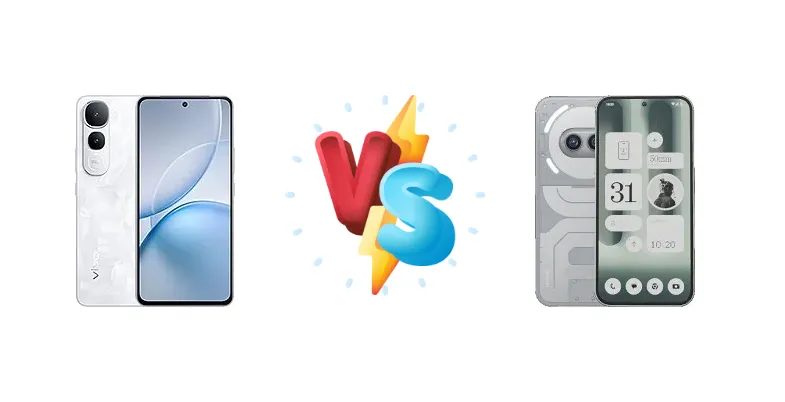
The sub-$300 smartphone market is fiercely competitive. The vivo Y400 and Nothing Phone (2a) Plus both aim to deliver a compelling experience, but they take different approaches. The Y400 prioritizes rapid charging and a cost-optimized Snapdragon chipset, while the Nothing Phone (2a) Plus focuses on a brighter display and a more powerful, albeit less efficient, Mediatek Dimensity processor. This comparison will dissect their strengths and weaknesses to help you choose the right device.
🏆 Quick Verdict
For the average user prioritizing all-day battery life and a vibrant display, the Nothing Phone (2a) Plus emerges as the stronger contender. Its 16:34 active use score and 1097 nits peak brightness provide a superior user experience. However, the vivo Y400’s 90W charging is a significant advantage for those who value speed above all else.
| Network |
|---|
| 2G bands | GSM 850 / 900 / 1800 / 1900 | GSM 850 / 900 / 1800 / 1900 |
| 3G bands | HSDPA 800 / 850 / 900 / 2100 | HSDPA 800 / 850 / 900 / 1700(AWS) / 1900 / 2100 |
| 4G bands | 1, 3, 4, 5, 8, 18, 19, 26, 28, 38, 40, 41, 42, 48 | 1, 3, 4, 5, 7, 8, 18, 19, 20, 26, 28, 38, 39, 40, 41, 42, 66 |
| 5G bands | 1, 3, 5, 8, 28, 40, 77, 78 SA/NSA | 1, 3, 5, 7, 8, 20, 28, 38, 40, 41, 66, 77, 78 SA/NSA |
| Speed | HSPA, LTE, 5G | HSPA, LTE, 5G |
| Technology | GSM / HSPA / LTE / 5G | GSM / HSPA / LTE / 5G |
| Launch |
|---|
| Announced | 2025, August 04 | 2024, July 31 |
| Status | Available. Released 2025, August 07 | Available. Released 2024, August 03 |
| Body |
|---|
| Build | Glass front, plastic back, plastic frame | Glass front (Gorilla Glass 5), plastic frame, plastic back |
| Dimensions | 162.3 x 75.3 x 7.9 mm (6.39 x 2.96 x 0.31 in) | 161.7 x 76.3 x 8.5 mm (6.37 x 3.00 x 0.33 in) |
| SIM | Nano-SIM + Nano-SIM | Nano-SIM + Nano-SIM |
| Weight | 197 g (6.95 oz) | 190 g (6.70 oz) |
| Display |
|---|
| Protection | - | Corning Gorilla Glass 5 |
| Resolution | 1080 x 2400 pixels, 20:9 ratio (~395 ppi density) | 1080 x 2412 pixels, 20:9 ratio (~395 ppi density) |
| Size | 6.67 inches, 107.4 cm2 (~87.9% screen-to-body ratio) | 6.7 inches, 107.5 cm2 (~87.1% screen-to-body ratio) |
| Type | AMOLED, 120Hz, 1200 nits (HBM), 1800 nits (peak) | AMOLED, 1B colors, 120Hz, 2160Hz PWM, HDR10+, 700 nits (typ), 1100 nits (HBM), 1300 nits (peak) |
| Platform |
|---|
| CPU | Octa-core (2x2.2 GHz Cortex-A78 & 6x1.95 GHz Cortex-A55) | Octa-core (2x3.0 GHz Cortex-A715 & 6x 2.0 GHz Cortex-A510) |
| Chipset | Qualcomm SM4450 Snapdragon 4 Gen 2 (4 nm) | Mediatek Dimensity 7350 Pro (4 nm) |
| GPU | Adreno 613 | Mali-G610 MC4 |
| OS | Android 15, Funtouch 15 | Android 14, up to 3 major Android upgrades, Nothing OS 3.0 |
| Memory |
|---|
| Card slot | Unspecified | No |
| Internal | 128GB 8GB RAM, 256GB 8GB RAM | 256GB 8GB RAM, 256GB 12GB RAM |
| Main Camera |
|---|
| Dual | 50 MP, f/1.8, (wide), 1/2.96", PDAF
Auxiliary lens | 50 MP, f/1.9, 24mm (wide), 1/1.57", 1.0µm, PDAF, OIS
50 MP, f/2.2, 114˚ (ultrawide), 1/2.76", 0.64µm |
| Features | Ring-LED flash, panorama, HDR | LED flash, panorama, HDR |
| Video | 1080p@30fps | 4K@30fps, 1080p@60/120fps, gyro-EIS |
| Selfie camera |
|---|
| Features | - | HDR |
| Single | 32 MP, f/2.5, (wide) | 50 MP, f/2.2, (wide), 1/2.76" |
| Video | 1080p@30fps | 4K@30fps |
| Sound |
|---|
| 35mm jack | No | No |
| Loudspeaker | Yes, with stereo speakers | Yes, with stereo speakers |
| Comms |
|---|
| Bluetooth | 5.0, A2DP, LE | 5.3, A2DP, LE |
| NFC | No | Yes, 360˚ |
| Positioning | GPS, GLONASS, GALILEO, BDS, QZSS | GPS, GALILEO, GLONASS, BDS, QZSS |
| Radio | No | No |
| USB | USB Type-C 2.0, OTG | USB Type-C 2.0, OTG |
| WLAN | Wi-Fi 802.11 a/b/g/n/ac, dual-band | Wi-Fi 802.11 a/b/g/n/ac/6, dual-band, Wi-Fi Direct |
| Features |
|---|
| Sensors | Fingerprint (under display, optical), accelerometer, gyro, proximity, compass | Fingerprint (under display, optical), accelerometer, gyro, proximity, compass |
| Battery |
|---|
| Charging | 90W wired, 50% in 20 min
Reverse wired
Bypass Charging | 50W wired, 50% in 21 min, 100% in 56 min |
| Type | Li-Ion 6000 mAh | 5000 mAh |
| Misc |
|---|
| Colors | Glam White, Olive Green | Black, Grey |
| Models | - | A142P |
| Price | ₹ 22,999 | € 269.90 / ₹ 22,599 |
| SAR | 0.99 W/kg (head) 0.80 W/kg (body) | - |
vivo Y400
- Ultra-fast 90W charging
- Cost-effective Snapdragon 4 Gen 2 chipset
- Bypass charging allows use while charging
- Battery life data unavailable, potentially lower than competitor
- Display brightness likely lower than Nothing Phone (2a) Plus
Nothing Phone (2a) Plus
- Excellent battery life (16:34h active use)
- Bright and vibrant 1097 nits display
- More powerful Mediatek Dimensity 7350 Pro processor
- Slower 50W charging compared to vivo Y400
- Image processing style may not appeal to all users
Display Comparison
The Nothing Phone (2a) Plus boasts a significantly brighter display, reaching a measured 1097 nits, compared to an unspecified brightness for the vivo Y400. This translates to better visibility outdoors and a more vibrant viewing experience. While the Y400’s panel technology isn’t detailed, the Nothing Phone (2a) Plus likely utilizes a higher-quality panel given its brightness capabilities. Bezels are expected to be similar in this price bracket, but the Nothing Phone (2a)'s design language may offer a more premium aesthetic. Color accuracy is unknown for both, but the Nothing Phone (2a) Plus’s brighter panel will generally appear more vivid.
Camera Comparison
Without detailed camera specifications beyond the main sensors, a direct comparison is difficult. However, the Nothing Phone (2a) Plus’s image processing is known for its natural color reproduction, while vivo typically leans towards more saturated, vibrant images. The absence of details regarding OIS or lens apertures on either device suggests a focus on computational photography rather than optical stabilization. The usefulness of a 2MP macro camera on either phone is questionable, as image quality is typically limited. The larger sensor size (if any) will be the key differentiator, but this information is currently unavailable.
Performance
The Nothing Phone (2a) Plus’s Mediatek Dimensity 7350 Pro, with its 2x3.0 GHz Cortex-A715 cores, offers a clear CPU performance advantage over the vivo Y400’s Qualcomm Snapdragon 4 Gen 2 (2x2.2 GHz Cortex-A78). The Dimensity 7350 Pro’s newer architecture and higher clock speeds will result in faster app loading times and smoother multitasking. However, both chipsets are fabricated on a 4nm process, suggesting comparable efficiency. The Snapdragon 4 Gen 2 is optimized for cost-effectiveness, while the Dimensity 7350 Pro aims for a balance of power and efficiency. RAM speed is not specified for either device, but LPDDR5x would be expected in this segment, potentially giving the Nothing Phone (2a) Plus a slight edge if equipped.
Battery Life
The Nothing Phone (2a) Plus’s active use score of 16:34h demonstrates superior battery endurance compared to the vivo Y400, which lacks this data. While the Y400 compensates with 90W wired charging (50% in 20 minutes), the Nothing Phone (2a) Plus’s 50W charging (50% in 21 minutes, 100% in 56 minutes) is still respectable. The Y400’s bypass charging feature allows for charging while the phone is in use, a useful addition. However, the Nothing Phone (2a) Plus’s longer battery life reduces the need for frequent charging, making it more convenient for many users.
Buying Guide
Buy the vivo Y400 if you absolutely need the fastest possible charging speeds and are willing to trade some sustained performance for it. It’s ideal for users who frequently find themselves needing a quick power boost. Buy the Nothing Phone (2a) Plus if you prioritize a brighter, more usable display in all lighting conditions, and longer battery life during typical daily use. It’s the better choice for media consumption and general productivity.
Frequently Asked Questions
❓ Does the Mediatek Dimensity 7350 Pro in the Nothing Phone (2a) Plus tend to overheat during prolonged gaming sessions?
The Dimensity 7350 Pro is a relatively efficient chip, and the Nothing Phone (2a) Plus’s thermal design should be adequate for most gaming scenarios. While some throttling is possible during extended, graphically intensive games, it’s unlikely to be a major issue. The 4nm process helps mitigate heat generation.
❓ How does the 90W charging on the vivo Y400 impact battery health over the long term?
While 90W charging is incredibly fast, it can potentially accelerate battery degradation over time compared to slower charging speeds. However, vivo likely incorporates battery management software to mitigate this effect, such as optimized charging curves and temperature control. The convenience of rapid charging may outweigh the potential long-term impact for many users.
❓ Is the reverse wired charging feature on the vivo Y400 useful for topping up accessories like earbuds?
Yes, the reverse wired charging feature is a convenient addition. While the charging speed will be limited, it allows you to use the vivo Y400 as a power bank for accessories like wireless earbuds or smartwatches in a pinch, eliminating the need to carry separate chargers.