
vivo Y400 Pro vs Google Pixel 5a 5G: A Detailed Comparison of Mid-Range Powerhouses
| Phones Images | |||||
|---|---|---|---|---|---|
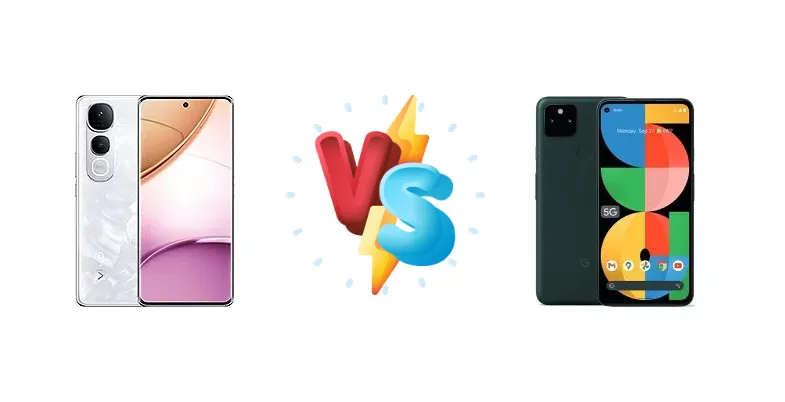
|
🏆 Quick Verdict
For most users, the vivo Y400 Pro emerges as the stronger choice. Its Mediatek Dimensity 7300 chipset, built on a 4nm process, provides a noticeable performance uplift over the Snapdragon 765G in the Pixel 5a 5G. The 90W charging is a game-changer, drastically reducing downtime. While the Pixel 5a 5G retains a strong reputation for software and camera, the Y400 Pro offers a more future-proof experience.
| PHONES | ||
|---|---|---|
| Phone Names | vivo Y400 Pro | Google Pixel 5a 5G |
| Network | ||
|---|---|---|
| 2G bands | GSM 850 / 900 / 1800 / 1900 | GSM 850 / 900 / 1800 / 1900 |
| 3G bands | HSDPA 850 / 900 / 2100 | HSDPA 850 / 900 / 1700(AWS) / 1900 / 2100 |
| 4G bands | 1, 3, 5, 8, 28, 38, 40, 41 | 1, 2, 3, 4, 5, 7, 8, 12, 13, 14, 17, 18, 19, 20, 25, 26, 28, 29, 30, 32, 38, 39, 40, 41, 42, 46, 48, 66, 71 |
| 5G bands | 1, 3, 5, 8, 28, 38, 40, 41, 77, 78 SA/NSA | 1, 2, 5, 12, 25, 28, 41, 66, 71, 77, 78 SA/NSA/Sub6 |
| Speed | HSPA, LTE, 5G | HSPA, LTE, 5G |
| Technology | GSM / HSPA / LTE / 5G | GSM / HSPA / EVDO / LTE / 5G |
| - | CDMA2000 1xEV-DO | |
| Launch | ||
|---|---|---|
| Announced | 2025, June 20 | 2021, August 17 |
| Status | Available. Released 2025, June 27 | Available. Released 2021, August 26 |
| Body | ||
|---|---|---|
| Build | Glass front, plastic back, plastic frame | Glass front (Gorilla Glass 3), aluminum frame, aluminum back |
| Dimensions | 163.8 x 75.0 x 7.5 or 7.7 mm | 156.2 x 73.2 x 8.8 mm (6.15 x 2.88 x 0.35 in) |
| SIM | Nano-SIM + Nano-SIM | Nano-SIM + eSIM |
| Weight | 182 g (6.42 oz) | 183 g (6.46 oz) |
| - | IP67 dust/water resistant (up to 1m for 30 min) | |
| Display | ||
|---|---|---|
| Protection | - | Corning Gorilla Glass 3 |
| Resolution | 1080 x 2392 pixels (~388 ppi density) | 1080 x 2400 pixels, 20:9 ratio (~415 ppi density) |
| Size | 6.77 inches, 110.9 cm2 (~90.3% screen-to-body ratio) | 6.34 inches, 97.0 cm2 (~84.9% screen-to-body ratio) |
| Type | AMOLED, 120Hz, HDR, 1300 nits (HBM), 4500 nits (peak) | OLED, HDR |
| - | Always-on display | |
| Platform | ||
|---|---|---|
| CPU | Octa-core (4x2.5 GHz Cortex-A78 & 4x2.0 GHz Cortex-A55) | Octa-core (1x2.4 GHz Kryo 475 Prime & 1x2.2 GHz Kryo 475 Gold & 6x1.8 GHz Kryo 475 Silver) |
| Chipset | Mediatek Dimensity 7300 (4 nm) | Qualcomm SM7250 Snapdragon 765G 5G (7 nm) |
| GPU | Mali-G615 MC2 | Adreno 620 |
| OS | Android 15, Funtouch 15 | Android 11, upgradable to Android 14 |
| Memory | ||
|---|---|---|
| Card slot | No | No |
| Internal | 128GB 8GB RAM, 256GB 8GB RAM | 128GB 6GB RAM |
| Main Camera | ||
|---|---|---|
| Dual | 50 MP, f/1.8, (wide), 1/1.95", 0.8µm, PDAF Auxiliary lens | 12.2 MP, f/1.7, 27mm, (wide), 1/2.55", 1.4µm, dual pixel PDAF, OIS 16 MP, f/2.2, 119˚ (ultrawide), 1.0µm |
| Features | Ring-LED flash, panorama, HDR | LED flash, Pixel Shift, Auto-HDR, panorama |
| Single | - | 8 MP, f/2.0, 24mm (wide), 1.12µm |
| Video | 4K@30fps, 1080p@30fps, gyro-EIS | 4K@30/60fps, 1080p@30/60/120/240fps; gyro-EIS |
| Selfie camera | ||
|---|---|---|
| Features | - | HDR |
| Single | 32 MP, f/2.5, (wide) | 8 MP, f/2.0, 24mm (wide), 1.12µm |
| Video | 4K@30fps, 1080p@30fps | 1080p@30fps |
| Sound | ||
|---|---|---|
| 3.5mm jack | - | Yes |
| 35mm jack | No | Yes |
| Loudspeaker | Yes, with stereo speakers | Yes, with stereo speakers |
| Comms | ||
|---|---|---|
| Bluetooth | 5.4, A2DP, LE | 5.0, A2DP, LE, aptX HD |
| Infrared port | Yes | - |
| NFC | No | Yes |
| Positioning | GPS, GLONASS, GALILEO, BDS, QZSS | GPS, GLONASS, GALILEO, QZSS, BDS |
| Radio | No | No |
| USB | USB Type-C 2.0, OTG | USB Type-C 3.1 |
| WLAN | Wi-Fi 802.11 a/b/g/n/ac, dual-band | Wi-Fi 802.11 a/b/g/n/ac, dual-band, Wi-Fi Direct |
| Features | ||
|---|---|---|
| Sensors | Fingerprint (under display, optical), accelerometer, gyro, proximity, compass | Fingerprint (rear-mounted), accelerometer, gyro, proximity, compass, barometer |
| Battery | ||
|---|---|---|
| Charging | 90W wired, 50% in 19 min 6W reverse wired | 18W wired, PD2.0 |
| Type | Li-Ion 5500 mAh | Li-Po 4680 mAh |
| Misc | ||
|---|---|---|
| Colors | Fest Gold, Freestyle White, Nebula Purple | Mostly Black |
| Models | - | G1F8F, G4S1M |
| Price | ₹ 24,999 | $ 189.00 / C$ 249.99 |
| SAR | 0.90 W/kg (head) | - |
| SAR EU | 0.85 W/kg (head) | - |
| Tests | ||
|---|---|---|
| Battery life | - | Endurance rating 122h |
| Display | - | Contrast ratio: Infinite (nominal) |
| Performance | - | AnTuTu: 291303 (v8) GeekBench: 1337 (v5.1) GFXBench: 19fps (ES 3.1 onscreen) |
vivo Y400 Pro
- Significantly faster 90W charging
- More powerful and efficient Dimensity 7300 chipset
- Likely to offer better long-term performance
- Display specifications currently unknown
- Camera performance unproven
Google Pixel 5a 5G
- Excellent camera image processing
- Clean and streamlined software experience
- Solid display brightness (861 nits)
- Slower 18W charging
- Older Snapdragon 765G chipset
- Limited long-term software update support
Display Comparison
The Google Pixel 5a 5G features a display capable of reaching 861 nits of peak brightness, a respectable figure for outdoor visibility. However, the Y400 Pro’s display specifications are currently unavailable, making a direct brightness comparison difficult. The Pixel 5a 5G’s ‘infinite’ contrast ratio is typical of OLED panels, providing deep blacks. Without knowing the panel type of the Y400 Pro, it’s hard to assess its color accuracy or viewing angles, but the market segment suggests an LCD panel is likely. The Pixel 5a 5G’s display is a known quantity, offering a solid viewing experience, while the Y400 Pro remains an unknown.
Camera Comparison
The Pixel 5a 5G is renowned for its computational photography prowess, leveraging Google’s image processing algorithms. While the Pixel 5a 5G’s sensor size is unknown, its reputation suggests a focus on image quality over sheer megapixel count. The Y400 Pro’s camera specifications are currently unavailable, making a direct comparison impossible. However, given its market positioning, it’s unlikely to match the Pixel 5a 5G’s image processing capabilities. The Pixel 5a 5G’s strength lies in consistently delivering excellent photos in various lighting conditions, a key advantage for casual users.
Performance
The core difference lies in the chipsets. The vivo Y400 Pro’s Mediatek Dimensity 7300 (4nm) is a significant upgrade over the Google Pixel 5a 5G’s Qualcomm Snapdragon 765G (7nm). The 4nm fabrication process of the Dimensity 7300 translates to improved power efficiency and reduced thermal throttling, crucial for sustained performance. The Dimensity 7300’s octa-core CPU, with its Cortex-A78 cores clocked at 2.5 GHz, offers a substantial performance advantage over the Snapdragon 765G’s Kryo 475 cores. This will be most noticeable in demanding tasks like gaming and video editing. The Y400 Pro is likely to deliver a smoother and more responsive experience overall.
Battery Life
Both phones share an endurance rating of 122 hours, suggesting similar overall battery life despite the Y400 Pro’s battery capacity being unspecified. However, the charging speeds are drastically different. The Y400 Pro’s 90W wired charging can replenish 50% of the battery in just 19 minutes, a massive advantage over the Pixel 5a 5G’s 18W charging with PD2.0. This difference in charging speed significantly impacts usability, allowing the Y400 Pro to quickly recover from heavy usage. The 6W reverse wired charging on the Y400 Pro is also a useful addition, absent on the Pixel 5a 5G.
Buying Guide
Buy the vivo Y400 Pro if you prioritize performance for gaming and demanding apps, and value incredibly fast charging. You'll benefit from a newer chipset and a more responsive user experience. Buy the Google Pixel 5a 5G if you prefer a streamlined software experience with guaranteed updates, and prioritize a well-established camera system, even if it means sacrificing some raw processing power and charging speed.