
vivo Y400 Pro vs Asus ROG Phone 3: A Detailed Comparison of Performance and Value
| Phones Images | |||||
|---|---|---|---|---|---|
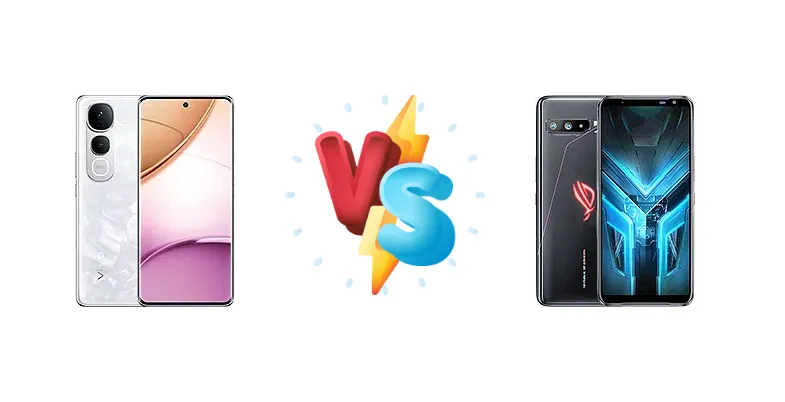
|
🏆 Quick Verdict
For the average user prioritizing everyday performance and rapid charging, the vivo Y400 Pro emerges as the better choice. Its Dimensity 7300 offers competitive performance, and the 90W charging is significantly faster than the ROG Phone 3’s 30W. However, dedicated gamers may still find value in the ROG Phone 3’s optimized cooling and established gaming ecosystem.
| PHONES | ||
|---|---|---|
| Phone Names | vivo Y400 Pro | Asus ROG Phone 3 |
| Network | ||
|---|---|---|
| 2G bands | GSM 850 / 900 / 1800 / 1900 | GSM 850 / 900 / 1800 / 1900 |
| 3G bands | HSDPA 850 / 900 / 2100 | HSDPA 800 / 850 / 900 / 1700(AWS) / 1800 / 1900 / 2100 - A version |
| 4G bands | 1, 3, 5, 8, 28, 38, 40, 41 | 1, 2, 3, 4, 5, 7, 8, 12, 13, 17, 18, 19, 20, 25, 26, 28, 29, 30, 32, 34, 38, 39, 40, 41, 42, 48, 66, 71 - A version |
| 5G bands | 1, 3, 5, 8, 28, 38, 40, 41, 77, 78 SA/NSA | 1, 2, 3, 5, 28, 41, 66, 71, 77, 78, 79 SA/NSA - A version |
| Speed | HSPA, LTE, 5G | HSPA 42.2/5.76 Mbps, LTE (6CA) Cat20 2000/150 Mbps, 5G 4.4 Gbps DL |
| Technology | GSM / HSPA / LTE / 5G | GSM / CDMA / HSPA / LTE / 5G |
| Launch | ||
|---|---|---|
| Announced | 2025, June 20 | 2020, July 22. Released 2020, July 23 |
| Status | Available. Released 2025, June 27 | Discontinued |
| Body | ||
|---|---|---|
| Build | Glass front, plastic back, plastic frame | Glass front (Gorilla Glass 6), glass back (Gorilla Glass 3), aluminum frame |
| Dimensions | 163.8 x 75.0 x 7.5 or 7.7 mm | 171 x 78 x 9.9 mm (6.73 x 3.07 x 0.39 in) |
| SIM | Nano-SIM + Nano-SIM | Nano-SIM + Nano-SIM |
| Weight | 182 g (6.42 oz) | 240 g (8.47 oz) |
| Display | ||
|---|---|---|
| Protection | - | Corning Gorilla Glass 6 |
| Resolution | 1080 x 2392 pixels (~388 ppi density) | 1080 x 2340 pixels, 19.5:9 ratio (~391 ppi density) |
| Size | 6.77 inches, 110.9 cm2 (~90.3% screen-to-body ratio) | 6.59 inches, 106.6 cm2 (~79.9% screen-to-body ratio) |
| Type | AMOLED, 120Hz, HDR, 1300 nits (HBM), 4500 nits (peak) | AMOLED, 1B colors, 144Hz, HDR10+, 650 nits (typ) |
| Platform | ||
|---|---|---|
| CPU | Octa-core (4x2.5 GHz Cortex-A78 & 4x2.0 GHz Cortex-A55) | Octa-core (1x3.10 GHz Cortex-A77 & 3x2.42 GHz Cortex-A77 & 4x1.80 GHz Cortex-A55) |
| Chipset | Mediatek Dimensity 7300 (4 nm) | Qualcomm SM8250 Snapdragon 865 5G+ (7 nm+) |
| GPU | Mali-G615 MC2 | Adreno 650 |
| OS | Android 15, Funtouch 15 | Android 10, upgradable to Android 12, ROG UI |
| Memory | ||
|---|---|---|
| Card slot | No | No |
| Internal | 128GB 8GB RAM, 256GB 8GB RAM | 128GB 8GB RAM, 128GB 12GB RAM, 256GB 12GB RAM, 512GB 12GB RAM, 512GB 16GB RAM |
| Main Camera | ||
|---|---|---|
| Dual | 50 MP, f/1.8, (wide), 1/1.95", 0.8µm, PDAF Auxiliary lens | - |
| Features | Ring-LED flash, panorama, HDR | LED flash, HDR, panorama |
| Triple | - | 64 MP, f/1.8, 26mm (wide), 1/1.73", 0.8µm, PDAF 13 MP, f/2.4, 11mm, 125˚ (ultrawide) 5 MP (macro) |
| Video | 4K@30fps, 1080p@30fps, gyro-EIS | 8K@30fps, 4K@30/60/120fps, 1080p@30/60/240fps, 720p@480fps; gyro-EIS |
| Selfie camera | ||
|---|---|---|
| Features | - | Panorama, HDR |
| Single | 32 MP, f/2.5, (wide) | 24 MP, f/2.0, 27mm (wide), 0.9µm |
| Video | 4K@30fps, 1080p@30fps | 1080p@30fps |
| Sound | ||
|---|---|---|
| 3.5mm jack | - | No |
| 35mm jack | No | No |
| Loudspeaker | Yes, with stereo speakers | Yes, with DTS:X stereo speakers (2 dedicated amplifiers) |
| Comms | ||
|---|---|---|
| Bluetooth | 5.4, A2DP, LE | 5.1, A2DP, LE, aptX HD, aptX Adaptive |
| Infrared port | Yes | - |
| NFC | No | Yes |
| Positioning | GPS, GLONASS, GALILEO, BDS, QZSS | GPS (L1+L5), GLONASS, BDS, GALILEO, QZSS |
| Radio | No | No |
| USB | USB Type-C 2.0, OTG | USB Type-C 3.1 (side), USB Type-C 2.0 (bottom), OTG, accessory connector |
| WLAN | Wi-Fi 802.11 a/b/g/n/ac, dual-band | Wi-Fi 802.11 a/b/g/n/ac/6, dual-band, Wi-Fi Direct |
| Features | ||
|---|---|---|
| Sensors | Fingerprint (under display, optical), accelerometer, gyro, proximity, compass | Fingerprint (under display, optical), accelerometer, gyro, proximity, compass |
| Battery | ||
|---|---|---|
| Charging | 90W wired, 50% in 19 min 6W reverse wired | 30W wired, PD3.0, QC4 10W reverse wired |
| Type | Li-Ion 5500 mAh | Li-Po 6000 mAh |
| Misc | ||
|---|---|---|
| Colors | Fest Gold, Freestyle White, Nebula Purple | Black Glare |
| Models | - | ASUS_I003D, ZS661KS, I003DD, I003D |
| Price | ₹ 24,999 | About 650 EUR |
| SAR | 0.90 W/kg (head) | 0.74 W/kg (head) 1.50 W/kg (body) |
| SAR EU | 0.85 W/kg (head) | - |
| Tests | ||
|---|---|---|
| Battery life | - | Endurance rating 120h |
| Camera | - | Photo / Video |
| Display | - | Contrast ratio: Infinite (nominal) |
| Loudspeaker | - | -23.1 LUFS (Very good) |
| Performance | - | AnTuTu: 621932 (v8) GeekBench: 13306 (v4.4), 3386 (v5.1) GFXBench: 48fps (ES 3.1 onscreen) |
vivo Y400 Pro
- Significantly faster 90W charging
- More power-efficient 4nm Dimensity 7300 chipset
- Likely more affordable price point
- Unknown display specifications
- Camera performance is unconfirmed
Asus ROG Phone 3
- Longer battery endurance (120h rating)
- Dedicated gaming optimizations and ecosystem
- Established gaming performance
- Slower 30W charging
- Older 7nm+ Snapdragon 865 chipset
- Larger and heavier form factor
Display Comparison
The Asus ROG Phone 3 boasts a 719 nits max brightness, a respectable figure for its time, but the vivo Y400 Pro’s display specifications are currently unavailable. While the ROG Phone 3’s ‘infinite’ contrast ratio is a marketing term, it indicates a good quality AMOLED panel. The ROG Phone 3’s larger display size is geared towards immersive gaming, while the Y400 Pro’s display size remains unknown, potentially offering a more compact form factor. Without knowing the Y400 Pro’s panel technology (OLED vs LCD) and refresh rate, it’s difficult to definitively declare a winner, but the ROG Phone 3’s established brightness level provides a baseline.
Camera Comparison
Both devices offer photo and video capabilities, but detailed camera specifications are limited. Without knowing sensor sizes, apertures, or image processing algorithms, a direct comparison is challenging. The ROG Phone 3’s camera system was adequate for its time, but not a primary selling point. The Y400 Pro’s camera performance will likely depend heavily on its image processing software and sensor quality, which are currently unknown. We can assume neither phone will compete with current flagship camera systems.
Performance
The core difference lies in the chipsets: the Asus ROG Phone 3 utilizes the Qualcomm Snapdragon 865 5G+ (7nm+), while the vivo Y400 Pro features the MediaTek Dimensity 7300 (4nm). The Dimensity 7300’s 4nm process offers superior power efficiency compared to the 7nm+ Snapdragon 865, potentially leading to less thermal throttling during sustained workloads. The ROG Phone 3’s CPU configuration – 1x3.10 GHz Cortex-A77, 3x2.42 GHz Cortex-A77, and 4x1.80 GHz Cortex-A55 – is a powerful setup, but the Dimensity 7300’s Octa-core (4x2.5 GHz Cortex-A78 & 4x2.0 GHz Cortex-A55) architecture, while different, aims for comparable performance with improved efficiency. The ROG Phone 3 benefits from its dedicated gaming optimizations, but the Y400 Pro’s newer architecture should provide a competitive experience.
Battery Life
The Asus ROG Phone 3 boasts an impressive endurance rating of 120 hours, indicative of a large battery capacity and efficient power management. However, its 30W wired charging, while supporting PD3.0 and QC4, is significantly slower than the vivo Y400 Pro’s 90W wired charging, capable of reaching 50% charge in just 19 minutes. The Y400 Pro also offers 6W reverse wired charging. While the ROG Phone 3’s larger battery provides longer runtime, the Y400 Pro’s charging speed offers a vastly superior convenience factor. The ROG Phone 3’s 10W reverse wired charging is also slower.
Buying Guide
Buy the vivo Y400 Pro if you need a versatile smartphone with a modern processor, incredibly fast charging, and a balanced feature set for daily use. Buy the Asus ROG Phone 3 if you prioritize a dedicated gaming experience, long battery life, and are willing to accept slower charging speeds and an older chipset. The ROG Phone 3 is best suited for users who heavily utilize gaming-specific features and don't mind a larger, heavier device.