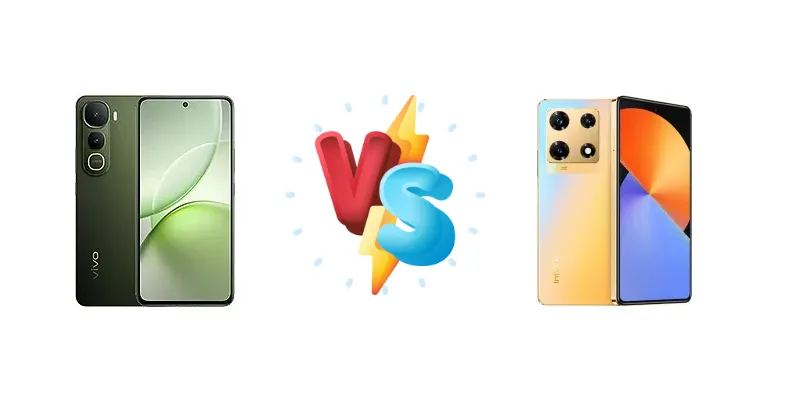
The sub-$200 smartphone market is fiercely competitive. The vivo Y400 4G and Infinix Note 30 Pro both aim to deliver a compelling experience without breaking the bank, but they take different approaches. The Y400 4G relies on Qualcomm’s Snapdragon 685, prioritizing efficiency, while the Note 30 Pro leverages MediaTek’s Helio G99 for a performance boost. This comparison dives deep into the specifics to determine which device offers the best value.
🏆 Quick Verdict
For the average user prioritizing all-around usability and faster charging, the Infinix Note 30 Pro emerges as the winner. Its 68W charging, coupled with wireless charging capabilities, and the slightly more powerful Helio G99 chipset, provide a more versatile experience. However, the vivo Y400 4G remains a solid choice for those seeking a dependable device with a focus on Qualcomm’s established efficiency.
| Network |
|---|
| 2G bands | GSM 850 / 900 / 1800 / 1900 | GSM 850 / 900 / 1800 / 1900 |
| 3G bands | HSDPA 850 / 900 / 2100 | HSDPA 850 / 900 / 1700(AWS) / 1900 / 2100 |
| 4G bands | 1, 3, 5, 7, 8, 20, 28, 38, 40, 41 | 1, 2, 3, 4, 5, 7, 8, 12, 17, 20, 28, 38, 40, 41, 66 |
| Speed | HSPA, LTE | HSPA, LTE |
| Technology | GSM / HSPA / LTE | GSM / HSPA / LTE |
| Launch |
|---|
| Announced | 2025, July 28 | 2023, May 22 |
| Status | Available. Released 2025, July 28 | Available. Released 2023, May 22 |
| Body |
|---|
| Build | Glass front, plastic back, plastic frame | Glass front, plastic frame, glass back |
| Dimensions | 162.3 x 75.3 x 7.9 mm (6.39 x 2.96 x 0.31 in) | 162.7 x 76 x 8.2 mm (6.41 x 2.99 x 0.32 in) |
| SIM | Nano-SIM + Nano-SIM | Nano-SIM + Nano-SIM |
| Weight | 196 g or 198 g (6.91 oz) | 203 g (7.16 oz) |
| | - | IP53 |
| Display |
|---|
| Resolution | 1080 x 2400 pixels, 20:9 ratio (~395 ppi density) | 1080 x 2400 pixels, 20:9 ratio (~395 ppi density) |
| Size | 6.67 inches, 107.4 cm2 (~87.9% screen-to-body ratio) | 6.67 inches, 107.4 cm2 (~86.9% screen-to-body ratio) |
| Type | AMOLED, 120Hz, 1200 nits (HBM), 1800 nits (peak) | AMOLED, 1B colors, 120Hz, 900 nits (peak) |
| | - | * the display diagonal size and resolution is unconfirmed |
| Platform |
|---|
| CPU | Octa-core (4x2.8 GHz Cortex-A73 & 4x1.9 GHz Cortex-A53) | Octa-core (2x2.2 GHz Cortex-A76 & 6x2.0 GHz Cortex-A55) |
| Chipset | Qualcomm SM6225 Snapdragon 685 (6 nm) | Mediatek Helio G99 (6 nm) |
| GPU | Adreno 610 | Mali-G57 MC2 |
| OS | Android 15, Funtouch 15 | Android 13, XOS 13 |
| Memory |
|---|
| Card slot | No | microSDXC (dedicated slot) |
| Internal | 128GB 8GB RAM, 256GB 8GB RAM | 256GB 8GB RAM |
| Main Camera |
|---|
| Dual | 50 MP, f/1.8, (wide), 1/2.96", PDAF
Auxiliary lens | - |
| Features | Ring-LED flash, panorama, HDR | Quad-LED flash, HDR, panorama |
| Triple | - | 108 MP, (wide), 1/1.67", PDAF
2 MP (macro)
Auxiliary lens |
| Video | 1080p@30fps | 1440p@30fps, 1080p@30fps |
| Selfie camera |
|---|
| Features | - | LED flash, HDR |
| Single | 8 MP, f/2.1, (wide) | 32 MP, f/2.0, (wide), 1/2.8" |
| Video | 1080p@30fps | 1080p@30fps |
| Sound |
|---|
| 3.5mm jack | - | Yes |
| 35mm jack | No | Yes |
| Loudspeaker | Yes, with stereo speakers | Yes, with dual speakers |
| | - | Sound by JBL
24-bit/192kHz audio |
| Comms |
|---|
| Bluetooth | 5.0, A2DP, LE | Yes |
| NFC | Yes (market/region dependent) | Yes (market/region dependent) |
| Positioning | GPS, GLONASS, GALILEO, BDS, QZSS | GPS |
| Radio | No | FM radio |
| USB | USB Type-C 2.0, OTG | USB Type-C 2.0, OTG |
| WLAN | Wi-Fi 802.11 a/b/g/n/ac, dual-band | Wi-Fi 802.11 a/b/g/n/ac, dual-band, Wi-Fi Direct |
| Features |
|---|
| Sensors | Fingerprint (under display, optical), accelerometer, gyro, proximity, compass | Fingerprint (side-mounted), accelerometer, gyro, proximity, compass |
| Battery |
|---|
| Charging | 44W wired
Reverse wired | 68W wired, PD3.0, 80% in 30 min
15W wireless
Reverse wireless |
| Type | Si/C Li-Ion 6000 mAh | 5000 mAh |
| Misc |
|---|
| Colors | Purple Twilight, Tropical Green (Dynamic Green), Pearl White | Magic Black, Variable Gold |
| Models | I2502 | X678B |
| Price | About 200 EUR | - |
vivo Y400 4G
- Qualcomm Snapdragon 685 offers good efficiency.
- Reliable brand reputation with vivo.
- 44W fast charging is still respectable.
- Slower charging compared to the Infinix Note 30 Pro.
- Less powerful processor for demanding tasks.
Infinix Note 30 Pro
- 68W fast charging with 80% in 30 minutes.
- 15W wireless charging and reverse wireless charging.
- MediaTek Helio G99 provides better performance.
- MediaTek chipsets sometimes have less consistent software updates.
- Infinix brand recognition is lower than vivo.
Display Comparison
Neither device boasts a flagship-level display, but both utilize 6nm chipsets which help with thermal management. Specific display specs (resolution, panel type, refresh rate) are missing, but given the price point, we can assume both are FHD+ LCD panels. The focus here shifts to charging and processing power. The absence of high refresh rates on either device suggests a focus on battery life rather than visual fluidity.
Camera Comparison
Without detailed camera specifications, a direct comparison is difficult. However, it’s safe to assume both phones feature a multi-camera setup with a primary sensor and supporting lenses. Given the market segment, image processing will likely prioritize social media-friendly results over absolute accuracy. The absence of information regarding OIS or sensor size suggests neither phone will excel in low-light photography. The usefulness of any included 2MP macro lens is questionable on both devices.
Performance
The core difference lies in the chipsets. The Infinix Note 30 Pro’s MediaTek Helio G99, with its 2x2.2 GHz Cortex-A76 cores, offers a performance edge over the vivo Y400 4G’s Qualcomm Snapdragon 685 (4x2.8 GHz Cortex-A73). While the Snapdragon 685 has higher clocked cores, the Helio G99’s newer architecture and more efficient core configuration generally translate to better sustained performance in tasks like gaming and multitasking. The Snapdragon 685’s strength is its 6nm process, potentially leading to slightly better thermal efficiency under prolonged load. Both devices likely pair their chipsets with similar amounts of RAM, but the Note 30 Pro’s GPU is likely more capable for graphics-intensive tasks.
Battery Life
The Infinix Note 30 Pro significantly pulls ahead in the charging department with its 68W wired charging, capable of reaching 80% charge in just 30 minutes. This is a substantial advantage over the vivo Y400 4G’s 44W charging. Furthermore, the Note 30 Pro adds 15W wireless charging and reverse wireless charging, offering greater convenience. While battery capacity isn’t specified, the faster charging and wireless options of the Note 30 Pro mitigate any potential disadvantage from a slightly smaller battery size.
Buying Guide
Buy the vivo Y400 4G if you need a reliable daily driver with a proven chipset and prioritize long-term software support from a well-established brand. Buy the Infinix Note 30 Pro if you prefer faster charging speeds, the convenience of wireless charging, and a slightly more powerful processor for demanding apps and light gaming.
Frequently Asked Questions
❓ Does the MediaTek Helio G99 in the Infinix Note 30 Pro tend to overheat during prolonged gaming sessions?
The Helio G99 is generally well-managed in terms of thermals, especially in devices like the Note 30 Pro that likely incorporate adequate cooling solutions. While it may get warm during extended gaming, it's unlikely to experience significant throttling due to the 6nm process node and MediaTek's thermal management features. However, sustained peak performance will inevitably generate heat.
❓ Is the 44W charging on the vivo Y400 4G sufficient for a full charge overnight, or is it noticeably slower compared to the Infinix Note 30 Pro?
44W charging is adequate for overnight charging, but it's demonstrably slower than the 68W charging on the Infinix Note 30 Pro. While the Y400 4G will likely reach a full charge overnight, the Note 30 Pro can achieve an 80% charge in just 30 minutes, offering significantly more flexibility for users who need a quick power boost.
❓ Does either phone support VoLTE or VoWiFi for improved call quality?
Given the target market, both phones *likely* support VoLTE (Voice over LTE) for improved call quality on 4G networks. VoWiFi (Voice over Wi-Fi) support is less certain and would depend on carrier compatibility. Checking the specific carrier compatibility list for each phone is recommended.