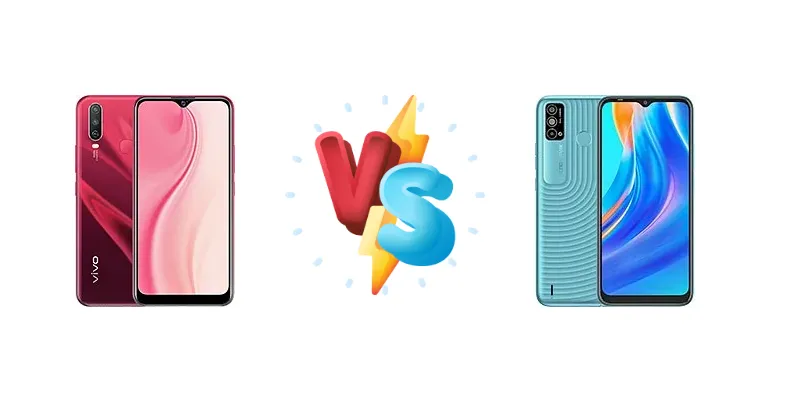
The vivo Y3s and Tecno Spark Go 2021 represent the extreme end of the budget smartphone spectrum. Both aim to deliver essential smartphone functionality at the lowest possible price point, but they take different approaches to achieving this. The Y3s leverages a more complex, octa-core processor, while the Spark Go 2021 opts for a simpler quad-core design. This comparison will dissect these choices and determine which device offers the best value for users prioritizing affordability.
🏆 Quick Verdict
For users needing a slightly more responsive experience for multitasking and light gaming, the vivo Y3s is the better choice, thanks to its Mediatek Helio P35 chipset. However, the Tecno Spark Go 2021 remains a viable option for those with extremely basic needs and a tighter budget, offering functional smartphone access at a minimal cost.
| Network |
|---|
| 2G bands | GSM 850 / 900 / 1800 / 1900 | GSM 850 / 900 / 1800 / 1900 |
| 3G bands | HSDPA 850 / 900 / 2100 | HSDPA 900 / 2100 |
| 4G bands | 1, 3, 5, 8, 34, 38, 39, 40, 41 | LTE |
| Speed | HSPA 42.2/5.76 Mbps, LTE (2CA) Cat6 300/50 Mbps | HSPA 42.2/5.76 Mbps, LTE Cat4 150/50 Mbps |
| Technology | GSM / CDMA / HSPA / LTE | GSM / HSPA / LTE |
| | CDMA 800 & TD-SCDMA | - |
| Launch |
|---|
| Announced | 2020, September 21. Released 2020, October 26 | 2021, July 01 |
| Status | Discontinued | Available. Released 2021, July 07 |
| Body |
|---|
| Build | Glass front, plastic back, plastic frame | - |
| Dimensions | 159.4 x 76.8 x 8.9 mm (6.28 x 3.02 x 0.35 in) | 165.6 x 76.3 x 9.1 mm (6.52 x 3.00 x 0.36 in) |
| SIM | Nano-SIM + Nano-SIM | Nano-SIM + Nano-SIM |
| Weight | 190.5 g (6.74 oz) | 193 g (6.81 oz) |
| Display |
|---|
| Resolution | 720 x 1544 pixels, 19.3:9 ratio (~268 ppi density) | 720 x 1600 pixels, 20:9 ratio (~269 ppi density) |
| Size | 6.35 inches, 99.6 cm2 (~81.4% screen-to-body ratio) | 6.52 inches, 102.6 cm2 (~81.2% screen-to-body ratio) |
| Type | IPS LCD | IPS LCD, 480 nits |
| Platform |
|---|
| CPU | Octa-core (4x2.3 GHz Cortex-A53 & 4x1.8 GHz Cortex-A53) | Quad-core 1.8 GHz |
| Chipset | Mediatek MT6765 Helio P35 (12 nm) | - |
| GPU | PowerVR GE8320 | - |
| OS | Android 9.0 (Pie), Funtouch 9 | Android 10 (Go edition), HiOS 6.2 |
| Memory |
|---|
| Card slot | microSDXC (dedicated slot) | microSDXC (dedicated slot) |
| Internal | 32GB 3GB RAM, 64GB 4GB RAM, 128GB 4GB RAM | 32GB 2GB RAM |
| | eMMC 5.1 | eMMC 5.1 |
| Main Camera |
|---|
| Dual | 13 MP, f/2.2, PDAF
Auxiliary lens | 13 MP, f/1.8, AF
Auxiliary lens |
| Features | LED flash, HDR, panorama | Dual-LED flash, panorama, HDR |
| Single | - | 8 MP, f/2.0 |
| Video | 1080p@30fps, 720p@120fps | 1080p@30fps |
| Selfie camera |
|---|
| Features | - | LED flash |
| Single | 8 MP, f/1.8 | 8 MP, f/2.0 |
| Video | 1080p@30fps | - |
| Sound |
|---|
| 3.5mm jack | Yes | Yes |
| 35mm jack | Yes | Yes |
| Loudspeaker | Yes | Yes |
| Comms |
|---|
| Bluetooth | 5.0, A2DP, LE | 4.2, A2DP |
| NFC | No | No |
| Positioning | GPS, GLONASS, GALILEO, BDS | GPS |
| Radio | FM radio | FM radio |
| USB | microUSB 2.0, OTG | microUSB 2.0, OTG |
| WLAN | Wi-Fi 802.11 b/g/n, Wi-Fi Direct | Wi-Fi 802.11 b/g/n |
| Features |
|---|
| Sensors | Fingerprint (rear-mounted), accelerometer, proximity, compass | Fingerprint (rear-mounted), accelerometer, proximity |
| Battery |
|---|
| Charging | 10W wired | - |
| Type | 5000 mAh | 5000 mAh |
| Misc |
|---|
| Colors | Dark Blue, Light Blue, Red | Maldives Blue, Horizon Orange, Galaxy Blue |
| Models | V1901A, V1901T | - |
| Price | About 150 EUR | About 80 EUR |
vivo Y3s
- Octa-core processor offers better multitasking.
- More responsive user experience.
- 10W charging is a standard convenience.
- Likely higher price point than the Tecno Spark Go 2021.
- Still limited by older processor architecture.
Tecno Spark Go 2021
- Extremely affordable.
- Suitable for basic communication tasks.
- Potentially longer standby time due to simpler processor.
- Slow performance with multiple apps.
- Limited gaming capabilities.
- May struggle with modern app requirements.
Display Comparison
Neither device boasts a standout display. Given the context data focuses on processing power, we can infer both likely utilize basic LCD panels. The absence of specifications like resolution or refresh rate suggests both are targeting the lowest possible bill of materials. Bezels are likely substantial on both, maximizing screen real estate within a compact form factor. Color accuracy is unlikely to be a priority at this price point, with both likely covering a limited portion of the sRGB color gamut.
Camera Comparison
Without detailed camera specifications, it's safe to assume both devices feature basic camera setups geared towards casual photography. The market segment suggests both will likely include a primary camera and potentially a depth sensor. Any claims of 'AI' camera features are likely software enhancements rather than hardware improvements. Image quality will be heavily reliant on software processing and will likely struggle in low-light conditions. The absence of OIS (Optical Image Stabilization) on either device means image stabilization will be purely digital, resulting in softer images and potential for motion blur.
Performance
The core difference lies in the chipset. The vivo Y3s’ Mediatek Helio P35 is an octa-core processor built on a 12nm process, featuring a cluster of four Cortex-A53 cores clocked at 2.3 GHz and another four at 1.8 GHz. This architecture allows for a degree of parallel processing, improving multitasking and responsiveness compared to the Tecno Spark Go 2021’s quad-core 1.8 GHz CPU. While the Cortex-A53 cores are relatively old, the eight cores of the Helio P35 provide a significant advantage over the four cores in the Spark Go 2021, especially when running multiple apps or moderately demanding applications. The 12nm process node of the Helio P35, while not cutting-edge, is more efficient than what is likely used in the Spark Go 2021, potentially leading to slightly better battery life under load.
Battery Life
Both devices likely feature batteries in the 3000-4000 mAh range, typical for this price bracket. However, the Helio P35 in the vivo Y3s, being built on a 12nm process, *may* offer slightly better power efficiency than the Tecno Spark Go 2021’s processor. The vivo Y3s supports 10W wired charging, which is standard for this segment. The Tecno Spark Go 2021’s charging speed is unknown, but is likely similar or slightly slower. Real-world battery life will depend heavily on usage patterns, but both devices should comfortably last a full day with light use.
Buying Guide
Buy the vivo Y3s if you need a phone capable of handling more than just calls and texts – light social media browsing, occasional gaming, and smoother app switching will benefit from the Helio P35. Buy the Tecno Spark Go 2021 if you primarily need a device for calls, messaging, and very basic tasks, and are prioritizing the absolute lowest possible price point. This phone is ideal for first-time smartphone users or as a reliable backup device.
Frequently Asked Questions
❓ Will the vivo Y3s handle popular social media apps like Facebook and WhatsApp smoothly?
Yes, the Helio P35 processor in the vivo Y3s should provide a reasonably smooth experience with Facebook and WhatsApp, even with multiple chats and occasional image/video loading. It's a significant step up from the quad-core processor in the Tecno Spark Go 2021 for these types of tasks.
❓ Is the Tecno Spark Go 2021 suitable for playing mobile games?
The Tecno Spark Go 2021 is not ideal for gaming. Its quad-core processor will struggle with most modern mobile games, resulting in low frame rates and lag. It may be able to handle very simple, older games, but don't expect a good gaming experience.
❓ How much storage do these phones typically offer, and can it be expanded?
While not specified, both phones likely ship with 32GB of internal storage, which is standard for this price range. Crucially, both devices almost certainly support microSD card expansion, allowing users to add more storage for photos, videos, and apps. This is essential given the limited internal storage.
❓ What version of Android do these phones run?
Given their target market, both devices likely run a lightweight version of Android, potentially Android Go Edition. This version is optimized for devices with limited RAM and storage, providing a smoother experience on lower-end hardware. Expect a simplified user interface and streamlined apps.