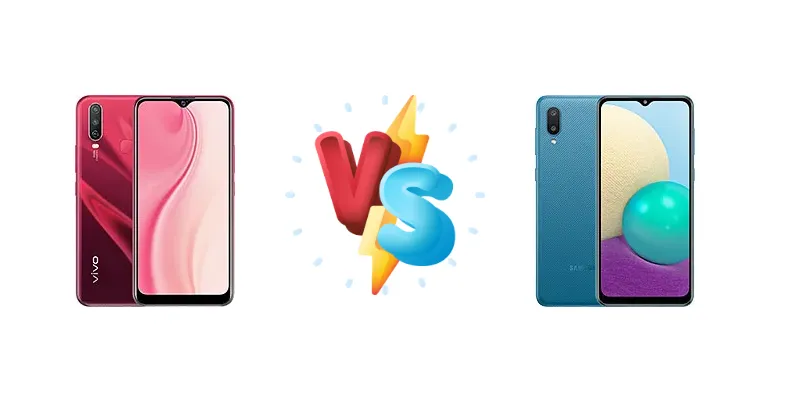
The sub-$200 smartphone market is fiercely competitive. Both the vivo Y3s and Samsung Galaxy A02 aim to deliver essential smartphone functionality at an incredibly low price point. However, significant differences in their underlying hardware mean one offers a noticeably smoother experience than the other, despite similar price tags. This comparison dissects those differences to help you make the right choice.
🏆 Quick Verdict
For most users, the vivo Y3s is the better buy. Its Mediatek Helio P35 chipset, built on a 12nm process, provides a substantial performance advantage over the Samsung Galaxy A02’s older, 28nm MT6739W. While both phones are limited, the Y3s offers a more responsive experience for everyday tasks, justifying its slight price premium.
| Network |
|---|
| 2G bands | GSM 850 / 900 / 1800 / 1900 | GSM 850 / 900 / 1800 / 1900 |
| 3G bands | HSDPA 850 / 900 / 2100 | HSDPA 850 / 900 / 2100 |
| 4G bands | 1, 3, 5, 8, 34, 38, 39, 40, 41 | 1, 3, 5, 7, 8, 20, 28, 38, 40, 41 |
| Speed | HSPA 42.2/5.76 Mbps, LTE (2CA) Cat6 300/50 Mbps | HSPA 42.2/5.76 Mbps, LTE Cat4 150/50 Mbps |
| Technology | GSM / CDMA / HSPA / LTE | GSM / HSPA / LTE |
| | CDMA 800 & TD-SCDMA | - |
| Launch |
|---|
| Announced | 2020, September 21. Released 2020, October 26 | 2021, January 27 |
| Status | Discontinued | Available. Released 2021, January 27 |
| Body |
|---|
| Build | Glass front, plastic back, plastic frame | Glass front, plastic back, plastic frame |
| Dimensions | 159.4 x 76.8 x 8.9 mm (6.28 x 3.02 x 0.35 in) | 164 x 75.9 x 9.1 mm (6.46 x 2.99 x 0.36 in) |
| SIM | Nano-SIM + Nano-SIM | · Nano-SIM· Nano-SIM + Nano-SIM |
| Weight | 190.5 g (6.74 oz) | 206 g (7.27 oz) |
| Display |
|---|
| Resolution | 720 x 1544 pixels, 19.3:9 ratio (~268 ppi density) | 720 x 1600 pixels, 20:9 ratio (~270 ppi density) |
| Size | 6.35 inches, 99.6 cm2 (~81.4% screen-to-body ratio) | 6.5 inches, 102.0 cm2 (~81.9% screen-to-body ratio) |
| Type | IPS LCD | PLS LCD |
| Platform |
|---|
| CPU | Octa-core (4x2.3 GHz Cortex-A53 & 4x1.8 GHz Cortex-A53) | Quad-core 1.5 GHz Cortex-A53 |
| Chipset | Mediatek MT6765 Helio P35 (12 nm) | Mediatek MT6739W (28 nm) |
| GPU | PowerVR GE8320 | PowerVR GE8100 |
| OS | Android 9.0 (Pie), Funtouch 9 | Android 10, upgradable to Android 11, One UI Core 3.1 |
| Memory |
|---|
| Card slot | microSDXC (dedicated slot) | microSDXC (dedicated slot) |
| Internal | 32GB 3GB RAM, 64GB 4GB RAM, 128GB 4GB RAM | 32GB 2GB RAM, 32GB 3GB RAM, 32GB 4GB RAM, 64GB 3GB RAM |
| | eMMC 5.1 | eMMC 5.1 |
| Main Camera |
|---|
| Dual | 13 MP, f/2.2, PDAF
Auxiliary lens | 13 MP, f/1.9, (wide), AF
2 MP (macro) |
| Features | LED flash, HDR, panorama | LED flash |
| Video | 1080p@30fps, 720p@120fps | 1080p@30fps |
| Selfie camera |
|---|
| Single | 8 MP, f/1.8 | 5 MP, f/2.0 |
| Video | 1080p@30fps | - |
| Sound |
|---|
| 3.5mm jack | Yes | Yes |
| 35mm jack | Yes | Yes |
| Loudspeaker | Yes | Yes |
| Comms |
|---|
| Bluetooth | 5.0, A2DP, LE | 5.1, A2DP, LE |
| NFC | No | No |
| Positioning | GPS, GLONASS, GALILEO, BDS | GPS, GLONASS |
| Radio | FM radio | FM radio |
| USB | microUSB 2.0, OTG | microUSB 2.0 |
| WLAN | Wi-Fi 802.11 b/g/n, Wi-Fi Direct | Wi-Fi 802.11 b/g/n, Wi-Fi Direct |
| Features |
|---|
| Sensors | Fingerprint (rear-mounted), accelerometer, proximity, compass | Accelerometer |
| | - | Virtual proximity sensing |
| Battery |
|---|
| Charging | 10W wired | - |
| Type | 5000 mAh | Li-Po 5000 mAh |
| Misc |
|---|
| Colors | Dark Blue, Light Blue, Red | Black, Blue |
| Models | V1901A, V1901T | SM-A022F, SM-A022F/DS, SM-A022M, SM-A022M/DS, SM-A022G, SM-A022G/DS |
| Price | About 150 EUR | € 97.46 |
| SAR EU | - | 0.65 W/kg (head) 1.71 W/kg (body) |
| Pricing |
|---|
| 32GB 2GB RAM | - | $ 149.99 |
| 32GB 3GB RAM | - | $ 129.99 |
| 64GB 3GB RAM | - | $ 199.99 |
| RENEWED | - | £ 113.00 |
vivo Y3s
- Significantly faster processor (Helio P35)
- More efficient 12nm process
- Smoother multitasking and app loading
- Potentially better image processing speed
- Charging speed is slow (10W)
- Display details are unknown
Samsung Galaxy A02
- Lower starting price (depending on configuration)
- Multiple RAM/storage options
- Widely available brand
- Android Go Edition may offer a lighter experience
- Outdated and slow processor (MT6739W)
- Inefficient 28nm process
- Struggles with multitasking and demanding apps
- Poor gaming performance
Display Comparison
Neither device boasts a standout display. Both are likely to feature LCD panels, typical for this price bracket. However, details like resolution and brightness are missing. The focus here is on internal specs. The more powerful processor in the Y3s will contribute to smoother scrolling and animations, indirectly improving the perceived display experience. We can assume both will have similar color accuracy, leaning towards the budget-friendly side.
Camera Comparison
Both phones likely feature basic camera setups. Details are sparse, but the A02’s available configurations (32GB/2GB, 32GB/3GB, 64GB/3GB) don’t specify camera sensor details. It’s safe to assume both rely heavily on software processing to enhance image quality. The presence of a 2MP macro camera on the A02 is largely a marketing gimmick; its image quality will be limited. Without specific sensor size or aperture information, it’s difficult to definitively declare a winner, but the Y3s’ more powerful processor could potentially handle image processing slightly faster.
Performance
This is where the Y3s truly shines. The Mediatek Helio P35 is a significant upgrade over the MT6739W. The P35’s octa-core configuration (4x2.3 GHz Cortex-A53 & 4x1.8 GHz Cortex-A53) versus the A02’s quad-core 1.5 GHz Cortex-A53 translates to faster app launches, smoother multitasking, and a more responsive overall experience. Crucially, the P35 is fabricated on a 12nm process, offering better power efficiency and thermal management compared to the A02’s older 28nm process. This means less throttling under sustained load. The A02 will struggle with even moderately demanding apps.
Battery Life
Battery capacity is not specified for either device. However, the Helio P35’s 12nm process in the Y3s offers a power efficiency advantage. While the A02 might have a slightly larger battery, the less efficient MT6739W will likely drain it faster under similar usage. Both phones feature 10W wired charging, meaning slow charging speeds – expect several hours to reach a full charge from empty.
Buying Guide
Buy the vivo Y3s if you prioritize a smoother, more responsive user experience, even for basic tasks like browsing and social media. The Helio P35 chipset will handle multitasking and app loading times more efficiently. Buy the Samsung Galaxy A02 if you absolutely need the lowest possible price and are willing to accept significant performance limitations. The A02’s varying RAM/storage configurations offer some flexibility, but the core performance remains a bottleneck.
Frequently Asked Questions
❓ Will the Samsung Galaxy A02 struggle with popular apps like Facebook or WhatsApp?
Yes, the MT6739W processor in the A02 is quite limited. While it can run these apps, you may experience noticeable lag, slow loading times, and difficulty multitasking. The vivo Y3s, with its Helio P35, will handle these apps much more smoothly.
❓ Is the 2MP macro camera on the Samsung Galaxy A02 worth considering?
Not really. 2MP macro cameras on budget phones typically produce low-resolution, soft images with limited detail. It's more of a marketing feature than a genuinely useful camera component. Don't base your purchase decision on this camera.
❓ Can either of these phones handle basic mobile gaming?
The vivo Y3s is the better choice for gaming, but temper your expectations. The Helio P35 can handle less demanding games at low settings. The Samsung Galaxy A02’s MT6739W will struggle even with simple games, experiencing significant frame rate drops and lag.
❓ Does the Samsung Galaxy A02 benefit from running Android Go Edition?
The Galaxy A02 *can* run Android Go Edition, but it's not a guarantee. It depends on the specific model and region. If it does, it can help mitigate some of the performance limitations of the MT6739W by using lighter versions of Google apps. However, it won't completely transform the experience.