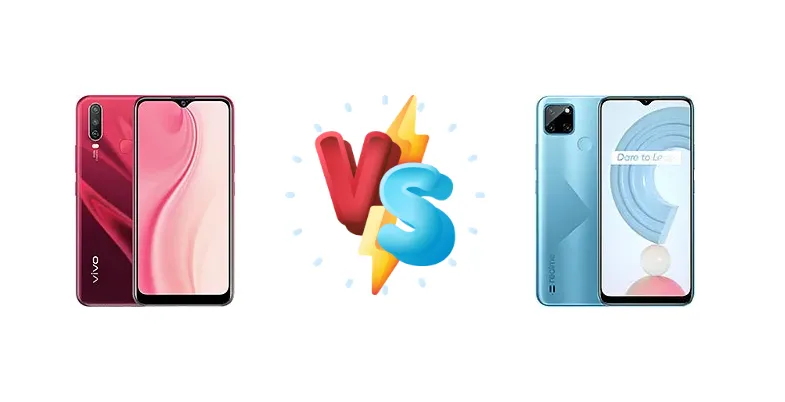
The sub-$150 smartphone market is fiercely competitive. Both the vivo Y3s and Realme C21Y aim to deliver essential smartphone functionality at an accessible price point. However, they take different approaches to achieving this, primarily diverging in their chipset choices and feature sets. This comparison will dissect those differences to determine which device offers the best value.
🏆 Quick Verdict
For the average user prioritizing overall performance and a useful feature like reverse charging, the Realme C21Y is the better choice. While the vivo Y3s is a capable device, the Unisoc T610 in the C21Y provides a noticeable performance uplift, especially in multi-tasking, and the reverse charging adds versatility.
| Network |
|---|
| 2G bands | GSM 850 / 900 / 1800 / 1900 | GSM 850 / 900 / 1800 / 1900 |
| 3G bands | HSDPA 850 / 900 / 2100 | HSDPA 850 / 900 / 2100 |
| 4G bands | 1, 3, 5, 8, 34, 38, 39, 40, 41 | 1, 3, 5, 8, 38, 40, 41 |
| Speed | HSPA 42.2/5.76 Mbps, LTE (2CA) Cat6 300/50 Mbps | HSPA, LTE |
| Technology | GSM / CDMA / HSPA / LTE | GSM / HSPA / LTE |
| | CDMA 800 & TD-SCDMA | - |
| Launch |
|---|
| Announced | 2020, September 21. Released 2020, October 26 | 2021, June 21 |
| Status | Discontinued | Available. Released 2021, July 02 |
| Body |
|---|
| Build | Glass front, plastic back, plastic frame | Glass front, plastic back, plastic frame |
| Dimensions | 159.4 x 76.8 x 8.9 mm (6.28 x 3.02 x 0.35 in) | 164.5 x 76 x 9.1 mm (6.48 x 2.99 x 0.36 in) |
| SIM | Nano-SIM + Nano-SIM | Nano-SIM + Nano-SIM |
| Weight | 190.5 g (6.74 oz) | 200 g (7.05 oz) |
| Display |
|---|
| Resolution | 720 x 1544 pixels, 19.3:9 ratio (~268 ppi density) | 720 x 1600 pixels, 20:9 ratio (~270 ppi density) |
| Size | 6.35 inches, 99.6 cm2 (~81.4% screen-to-body ratio) | 6.5 inches, 102.0 cm2 (~81.6% screen-to-body ratio) |
| Type | IPS LCD | IPS LCD, 400 nits (typ) |
| Platform |
|---|
| CPU | Octa-core (4x2.3 GHz Cortex-A53 & 4x1.8 GHz Cortex-A53) | Octa-core (2x1.8 GHz Cortex-A75 & 6x1.8 GHz Cortex-A55) |
| Chipset | Mediatek MT6765 Helio P35 (12 nm) | Unisoc T610 (12 nm) |
| GPU | PowerVR GE8320 | Mali-G52 MP2 |
| OS | Android 9.0 (Pie), Funtouch 9 | Android 10/ Android 11 |
| Memory |
|---|
| Card slot | microSDXC (dedicated slot) | microSDXC (dedicated slot) |
| Internal | 32GB 3GB RAM, 64GB 4GB RAM, 128GB 4GB RAM | 32GB 3GB RAM, 64GB 4GB RAM |
| | eMMC 5.1 | eMMC 5.1 |
| Main Camera |
|---|
| Dual | 13 MP, f/2.2, PDAF
Auxiliary lens | 13 MP, f/2.2, 26mm (wide), 1/3.06", 1.12µm, PDAF
2 MP (macro)
Auxiliary lens |
| Features | LED flash, HDR, panorama | LED flash, HDR, panorama |
| Single | - | 5 MP, f/2.2, (wide), 1/5.0", 1.12µm |
| Video | 1080p@30fps, 720p@120fps | 1080p@30fps |
| Selfie camera |
|---|
| Features | - | HDR, panorama |
| Single | 8 MP, f/1.8 | 5 MP, f/2.2, (wide), 1/5.0", 1.12µm |
| Video | 1080p@30fps | 1080p@30fps |
| Sound |
|---|
| 3.5mm jack | Yes | Yes |
| 35mm jack | Yes | Yes |
| Loudspeaker | Yes | Yes |
| Comms |
|---|
| Bluetooth | 5.0, A2DP, LE | 5.0, A2DP, LE |
| NFC | No | No |
| Positioning | GPS, GLONASS, GALILEO, BDS | GPS, GLONASS, BDS |
| Radio | FM radio | Unspecified |
| USB | microUSB 2.0, OTG | microUSB 2.0, OTG |
| WLAN | Wi-Fi 802.11 b/g/n, Wi-Fi Direct | Wi-Fi 802.11 b/g/n |
| Features |
|---|
| Sensors | Fingerprint (rear-mounted), accelerometer, proximity, compass | Fingerprint (rear-mounted), accelerometer, proximity, compass |
| Battery |
|---|
| Charging | 10W wired | Reverse wired |
| Type | 5000 mAh | 5000 mAh |
| Misc |
|---|
| Colors | Dark Blue, Light Blue, Red | Cross Black, Cross Blue |
| Models | V1901A, V1901T | RMX3261, RMX3263 |
| Price | About 150 EUR | About 130 EUR |
vivo Y3s
- Simple and easy to use interface
- Reliable for basic tasks
- Potentially lower price point
- Older, less powerful chipset
- Limited feature set
- Slower performance in demanding apps
Realme C21Y
- More powerful Unisoc T610 chipset
- Reverse wired charging capability
- Better multitasking performance
- May be slightly more expensive
- Unisoc chipset may have less software support
- Camera performance likely similar to vivo Y3s
Display Comparison
Neither device boasts a standout display. Both likely utilize LCD panels, common in this price bracket. Detailed display specs (resolution, brightness) are unavailable, but we can infer that both will offer adequate, but not exceptional, viewing experiences. The focus here is on functionality over fidelity.
Camera Comparison
Camera details are sparse for both devices. Given the price point, expect basic camera performance. The absence of details suggests neither phone will excel in photography. Focusing on the chipsets, the Unisoc T610's ISP (Image Signal Processor) *may* offer slightly better image processing capabilities, but this is speculative without further data. The presence of a 2MP macro lens on both is largely a marketing tactic, offering limited real-world benefit.
Performance
The core difference lies in the chipsets. The vivo Y3s uses the Mediatek Helio P35, an older 12nm chip with a CPU configuration of 4x2.3 GHz Cortex-A53 and 4x1.8 GHz Cortex-A53 cores. The Realme C21Y, however, features the Unisoc T610, also a 12nm chip, but with a more modern CPU arrangement: 2x1.8 GHz Cortex-A75 and 6x1.8 GHz Cortex-A55 cores. The Cortex-A75 cores in the T610 represent a significant architectural improvement over the A53 cores in the P35, offering better single-core performance and improved efficiency. This translates to snappier app launches and smoother multitasking on the C21Y. While both are octa-core, the architectural differences give the Unisoc T610 a clear advantage.
Battery Life
Both phones likely feature similar battery capacities (around 5000mAh is typical for this segment). However, the Realme C21Y distinguishes itself with reverse wired charging. This allows the C21Y to act as a power bank for other devices, a valuable feature for users who frequently travel or rely on multiple gadgets. The vivo Y3s is limited to 10W wired charging, while the C21Y's charging speed is unspecified, but the inclusion of reverse charging suggests a more robust power management system.
Buying Guide
Buy the vivo Y3s if you need a simple, reliable smartphone for basic tasks like calls, messaging, and light social media use, and are comfortable with a more basic feature set. Buy the Realme C21Y if you prefer a phone that can handle more demanding apps, occasional gaming, and offers the convenience of using it as a power bank for other devices.
Frequently Asked Questions
❓ Will the Realme C21Y handle popular games like PUBG Mobile or Call of Duty?
While the Unisoc T610 is an improvement over the Helio P35, don't expect flagship-level gaming performance. PUBG Mobile and Call of Duty will likely be playable at lower settings and frame rates. The C21Y will offer a more stable gaming experience than the Y3s, but demanding titles will still push its limits.
❓ How much faster is the Unisoc T610 in the Realme C21Y compared to the Helio P35 in the vivo Y3s in everyday use?
The difference will be most noticeable when multitasking or opening multiple apps. The Cortex-A75 cores in the T610 provide a significant boost in single-core performance, resulting in snappier app launches and smoother transitions. Basic tasks like browsing and social media will feel similar on both, but the C21Y will handle heavier workloads more efficiently.
❓ What is the practical benefit of reverse charging on the Realme C21Y?
Reverse charging allows you to use the Realme C21Y as a power bank for other devices, such as wireless earbuds, smartwatches, or even another smartphone. This is particularly useful when you're traveling and don't have access to a power outlet. It's a convenient feature for keeping your smaller gadgets topped up.