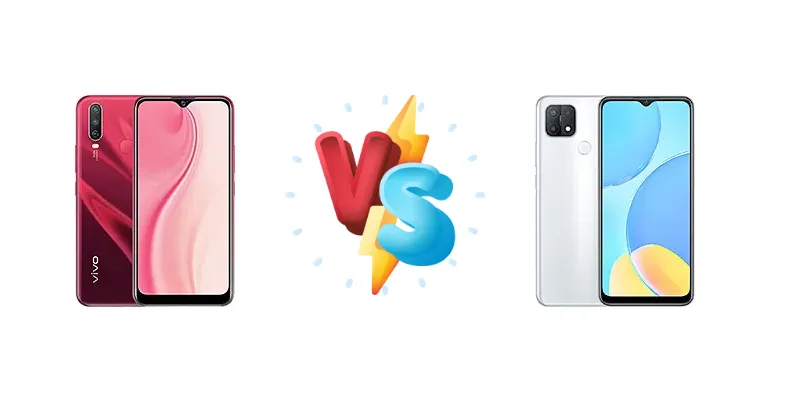
The vivo Y3s and Oppo A15s represent the extreme end of the smartphone price spectrum. Both devices rely on the Mediatek Helio P35 chipset, targeting users prioritizing affordability over cutting-edge features. This comparison dissects the subtle differences between these two models to determine which offers the best value for the budget-conscious consumer.
🏆 Quick Verdict
For the average user, the Oppo A15s edges out the vivo Y3s. While both share the same Helio P35 chipset and 10W charging, the slightly higher CPU clock speed (2.35GHz vs 2.3GHz) in the A15s, though minimal, combined with potentially better software optimization, provides a marginally smoother experience.
| Network |
|---|
| 2G bands | GSM 850 / 900 / 1800 / 1900 | GSM 850 / 900 / 1800 / 1900 |
| 3G bands | HSDPA 850 / 900 / 2100 | HSDPA 850 / 900 / 2100 |
| 4G bands | 1, 3, 5, 8, 34, 38, 39, 40, 41 | 1, 3, 5, 8, 38, 40, 41 |
| Speed | HSPA 42.2/5.76 Mbps, LTE (2CA) Cat6 300/50 Mbps | HSPA, LTE |
| Technology | GSM / CDMA / HSPA / LTE | GSM / HSPA / LTE |
| | CDMA 800 & TD-SCDMA | - |
| Launch |
|---|
| Announced | 2020, September 21. Released 2020, October 26 | 2020, December 18. Released 2020, December 18 |
| Status | Discontinued | Discontinued |
| Body |
|---|
| Build | Glass front, plastic back, plastic frame | Glass front, plastic back, plastic frame |
| Dimensions | 159.4 x 76.8 x 8.9 mm (6.28 x 3.02 x 0.35 in) | 164 x 75.4 x 7.9 mm (6.46 x 2.97 x 0.31 in) |
| SIM | Nano-SIM + Nano-SIM | Nano-SIM + Nano-SIM |
| Weight | 190.5 g (6.74 oz) | 177 g (6.24 oz) |
| Display |
|---|
| Resolution | 720 x 1544 pixels, 19.3:9 ratio (~268 ppi density) | 720 x 1600 pixels, 20:9 ratio (~269 ppi density) |
| Size | 6.35 inches, 99.6 cm2 (~81.4% screen-to-body ratio) | 6.52 inches, 102.6 cm2 (~83.0% screen-to-body ratio) |
| Type | IPS LCD | IPS LCD, 480 nits (typ) |
| Platform |
|---|
| CPU | Octa-core (4x2.3 GHz Cortex-A53 & 4x1.8 GHz Cortex-A53) | Octa-core (4x2.35 GHz Cortex-A53 & 4x1.8 GHz Cortex-A53) |
| Chipset | Mediatek MT6765 Helio P35 (12 nm) | Mediatek MT6765 Helio P35 (12 nm) |
| GPU | PowerVR GE8320 | PowerVR GE8320 |
| OS | Android 9.0 (Pie), Funtouch 9 | Android 10, ColorOS 7.2 |
| Memory |
|---|
| Card slot | microSDXC (dedicated slot) | microSDXC |
| Internal | 32GB 3GB RAM, 64GB 4GB RAM, 128GB 4GB RAM | 64GB 4GB RAM, 128GB 4GB RAM |
| | eMMC 5.1 | eMMC 5.1 |
| Main Camera |
|---|
| Dual | 13 MP, f/2.2, PDAF
Auxiliary lens | - |
| Features | LED flash, HDR, panorama | LED flash, HDR, panorama |
| Triple | - | 13 MP, f/2.2, (wide), 1/3.1", 1.12µm, PDAF
2 MP (macro)
Auxiliary lens |
| Video | 1080p@30fps, 720p@120fps | 1080p@30fps |
| Selfie camera |
|---|
| Features | - | HDR |
| Single | 8 MP, f/1.8 | 8 MP, f/2.0, (wide) |
| Video | 1080p@30fps | 1080p@30fps |
| Sound |
|---|
| 3.5mm jack | Yes | Yes |
| 35mm jack | Yes | Yes |
| Loudspeaker | Yes | Yes |
| Comms |
|---|
| Bluetooth | 5.0, A2DP, LE | 5.0, A2DP, LE, aptX |
| NFC | No | No |
| Positioning | GPS, GLONASS, GALILEO, BDS | GPS, GLONASS, GALILEO, BDS |
| Radio | FM radio | FM radio |
| USB | microUSB 2.0, OTG | microUSB 2.0, OTG |
| WLAN | Wi-Fi 802.11 b/g/n, Wi-Fi Direct | Wi-Fi 802.11 b/g/n, Wi-Fi Direct |
| Features |
|---|
| Sensors | Fingerprint (rear-mounted), accelerometer, proximity, compass | Fingerprint (rear-mounted), accelerometer, proximity |
| Battery |
|---|
| Charging | 10W wired | 10W wired |
| Type | 5000 mAh | Li-Po 4230 mAh |
| Misc |
|---|
| Colors | Dark Blue, Light Blue, Red | Dynamic Black, Fancy White |
| Models | V1901A, V1901T | CPH2179 |
| Price | About 150 EUR | About 130 EUR |
vivo Y3s
- Potentially lower price point.
- Established brand presence in some markets.
- Simple and straightforward user interface.
- Slightly lower CPU clock speed (2.3 GHz vs 2.35 GHz).
- May receive fewer software updates.
- Potentially less optimized software experience.
Oppo A15s
- Marginally faster CPU clock speed (2.35 GHz).
- Oppo’s ColorOS offers potential software optimizations.
- Sleek design aesthetic (subjective).
- May be slightly more expensive.
- ColorOS can be perceived as bloated by some users.
- Similar camera performance to the vivo Y3s.
Display Comparison
Both the vivo Y3s and Oppo A15s likely feature similar LCD panels, given their price point. Specifics like resolution and brightness are not provided, but we can assume they are optimized for power efficiency rather than visual fidelity. The absence of high refresh rates or advanced panel technologies like LTPO is expected. Bezels are likely to be substantial on both devices, maximizing screen real estate within a compact form factor. Color accuracy will likely be standard for this segment, prioritizing saturation over precise color reproduction.
Camera Comparison
Camera performance is expected to be similar on both devices, with both likely featuring a primary sensor paired with basic auxiliary lenses. Details on sensor size and aperture are unavailable, but given the price point, we can anticipate modest image quality, particularly in low-light conditions. The inclusion of a 2MP macro camera on either device is largely a marketing tactic, offering limited practical benefit due to the low resolution and fixed focus. Image processing will likely focus on enhancing colors and contrast rather than delivering natural-looking photos.
Performance
The core of both devices is the Mediatek MT6765 Helio P35 (12 nm). The CPU configuration is identical – an octa-core setup with four Cortex-A53 cores clocked at 2.3 GHz and another four at 1.8 GHz. However, the Oppo A15s boasts a slightly higher peak CPU clock speed of 2.35 GHz on the faster cores. This 50MHz difference is unlikely to be noticeable in most everyday tasks, but could translate to marginally faster app loading times or smoother multitasking. Both phones will likely be paired with 3GB or 4GB of RAM, impacting multitasking capabilities. Thermal management will be passive, relying on the phone’s chassis to dissipate heat, meaning sustained performance under heavy load will be limited.
Battery Life
Both the vivo Y3s and Oppo A15s utilize 10W wired charging, indicating a focus on cost savings over rapid charging speeds. Battery capacity is not specified, but typical capacities for phones in this segment range from 4000mAh to 5000mAh. A full charge from 0-100% is expected to take approximately 2.5 to 3.5 hours. Real-world battery life will depend heavily on usage patterns, but both devices should comfortably last a full day with moderate use, prioritizing power-efficient components and software optimizations.
Buying Guide
Buy the vivo Y3s if you prioritize a brand with a strong track record in emerging markets and are seeking the absolute lowest possible price. Buy the Oppo A15s if you prefer a slightly more refined user experience, potentially benefiting from Oppo’s ColorOS software optimizations, and a marginally faster CPU clock speed, even if the difference is subtle.
Frequently Asked Questions
❓ Will the Helio P35 struggle with popular apps like WhatsApp and Facebook?
The Helio P35 is a basic chipset, but it's sufficient for running lightweight apps like WhatsApp and Facebook. Expect some lag when multitasking or using more demanding features within these apps. Optimizing app usage and limiting background processes will improve performance.
❓ Can either of these phones play PUBG Mobile, and if so, at what settings?
PUBG Mobile is playable on both devices, but only at the lowest graphics settings and frame rates. Expect significant frame drops and stuttering, even on the lowest settings. These phones are not designed for demanding gaming experiences.
❓ How does the software experience differ between vivo’s Funtouch OS and Oppo’s ColorOS?
Funtouch OS is known for its customization options, while ColorOS aims for a cleaner, more streamlined experience. ColorOS often includes additional features and optimizations, but can also be perceived as more bloated. Both are based on Android, but offer distinct user interfaces.
❓ Are these phones suitable for elderly users or those new to smartphones?
Yes, both the vivo Y3s and Oppo A15s are suitable for elderly users or those new to smartphones. Their simple interfaces, large displays, and affordable price points make them accessible options. Consider enabling accessibility features like larger fonts and simplified menus.