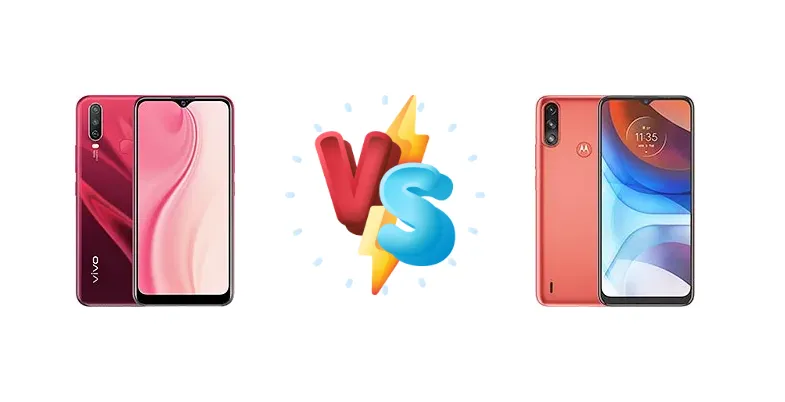
The sub-$150 smartphone market is fiercely competitive. Both the vivo Y3s and Motorola Moto E7i Power aim to deliver essential smartphone functionality at an incredibly accessible price point. However, they take different approaches to achieving this, primarily through contrasting chipset choices – Mediatek’s Helio P35 versus Unisoc’s SC9863A. This comparison dissects these differences to determine which device offers the best value for budget-conscious consumers.
🏆 Quick Verdict
For most users, the vivo Y3s emerges as the better choice. While both phones offer 10W charging and similar price points, the Helio P35’s more efficient 12nm process and Cortex-A53 architecture provide a noticeable performance edge over the older, 28nm Unisoc SC9863A, making it better suited for everyday tasks and light multitasking.
| Network |
|---|
| 2G bands | GSM 850 / 900 / 1800 / 1900 | GSM 850 / 900 / 1800 / 1900 |
| 3G bands | HSDPA 850 / 900 / 2100 | HSDPA 850 / 900 / 1700(AWS) / 1900 / 2100 |
| 4G bands | 1, 3, 5, 8, 34, 38, 39, 40, 41 | LTE |
| Speed | HSPA 42.2/5.76 Mbps, LTE (2CA) Cat6 300/50 Mbps | HSPA, LTE |
| Technology | GSM / CDMA / HSPA / LTE | GSM / HSPA / LTE |
| | CDMA 800 & TD-SCDMA | - |
| Launch |
|---|
| Announced | 2020, September 21. Released 2020, October 26 | 2021, February 23 |
| Status | Discontinued | Available. Released 2021, March 15 |
| Body |
|---|
| Build | Glass front, plastic back, plastic frame | Glass front, plastic back, plastic frame |
| Dimensions | 159.4 x 76.8 x 8.9 mm (6.28 x 3.02 x 0.35 in) | 165.1 x 75.9 x 9.2 mm (6.5 x 2.99 x 0.36 in) |
| SIM | Nano-SIM + Nano-SIM | Nano-SIM + Nano-SIM |
| Weight | 190.5 g (6.74 oz) | 200 g (7.05 oz) |
| | - | Water-repellent design |
| Display |
|---|
| Resolution | 720 x 1544 pixels, 19.3:9 ratio (~268 ppi density) | 720 x 1600 pixels, 20:9 ratio (~270 ppi density) |
| Size | 6.35 inches, 99.6 cm2 (~81.4% screen-to-body ratio) | 6.51 inches, 102.3 cm2 (~81.7% screen-to-body ratio) |
| Type | IPS LCD | IPS LCD, 380 nits (typ) |
| Platform |
|---|
| CPU | Octa-core (4x2.3 GHz Cortex-A53 & 4x1.8 GHz Cortex-A53) | Octa-core (4x1.6 GHz Cortex-A55 & 4x1.2 GHz Cortex-A55) |
| Chipset | Mediatek MT6765 Helio P35 (12 nm) | Unisoc SC9863A (28 nm) |
| GPU | PowerVR GE8320 | IMG8322 |
| OS | Android 9.0 (Pie), Funtouch 9 | Android 10 (Go edition) |
| Memory |
|---|
| Card slot | microSDXC (dedicated slot) | microSDXC (uses shared SIM slot) |
| Internal | 32GB 3GB RAM, 64GB 4GB RAM, 128GB 4GB RAM | 32GB 2GB RAM |
| | eMMC 5.1 | eMMC 5.1 |
| Main Camera |
|---|
| Dual | 13 MP, f/2.2, PDAF
Auxiliary lens | 13 MP, f/2.0, 26mm (wide), 1/3.1", 1.12µm, PDAF
2 MP (macro) |
| Features | LED flash, HDR, panorama | LED flash, HDR, panorama |
| Video | 1080p@30fps, 720p@120fps | 1080p@30fps |
| Selfie camera |
|---|
| Features | - | HDR |
| Single | 8 MP, f/1.8 | 5 MP, f/2.2, 27mm (wide), 1.12µm |
| Video | 1080p@30fps | 1080p@30fps |
| Sound |
|---|
| 3.5mm jack | Yes | Yes |
| 35mm jack | Yes | Yes |
| Loudspeaker | Yes | Yes |
| Comms |
|---|
| Bluetooth | 5.0, A2DP, LE | 4.2, A2DP |
| NFC | No | No |
| Positioning | GPS, GLONASS, GALILEO, BDS | GPS, GLONASS, GALILEO |
| Radio | FM radio | Unspecified |
| USB | microUSB 2.0, OTG | USB Type-C 2.0 |
| WLAN | Wi-Fi 802.11 b/g/n, Wi-Fi Direct | Wi-Fi 802.11 b/g/n |
| Features |
|---|
| Sensors | Fingerprint (rear-mounted), accelerometer, proximity, compass | Fingerprint (rear-mounted), accelerometer, proximity |
| Battery |
|---|
| Charging | 10W wired | 10W wired |
| Type | 5000 mAh | Li-Ion 5000 mAh |
| Misc |
|---|
| Colors | Dark Blue, Light Blue, Red | Tahiti Blue, Coral Red |
| Models | V1901A, V1901T | XT2097-13 |
| Price | About 150 EUR | About 120 EUR |
vivo Y3s
- More powerful and efficient Helio P35 chipset
- Slightly better performance for multitasking
- More modern CPU architecture (Cortex-A53)
- May have slightly shorter battery life under heavy load
- Basic camera system
Motorola Moto E7i Power
- Potentially longer battery life for basic usage
- Affordable price point
- Simple and easy-to-use interface
- Significantly slower Unisoc SC9863A chipset
- Older 28nm process leads to more heat and throttling
- Less responsive user experience
Display Comparison
Neither device boasts a standout display. Both likely feature basic IPS LCD panels with resolutions around 720p+. However, display quality isn't the focus at this price point. The lack of detailed specifications prevents a direct comparison of brightness or color accuracy. The key difference lies in the processing power needed to drive the display, which ties back to the chipset – the Helio P35 has a slight advantage here due to its more modern GPU.
Camera Comparison
Both phones likely feature basic camera setups, with the Motorola Moto E7i Power featuring a 13MP main sensor and the vivo Y3s featuring a 13MP main sensor. Given the price bracket, image quality will be heavily reliant on software processing. The aperture sizes are likely similar, and neither phone offers Optical Image Stabilization (OIS). The real-world difference in image quality will be minimal, and any 2MP macro or depth sensors included on either device are unlikely to significantly impact the overall experience.
Performance
This is where the core difference lies. The vivo Y3s’ Mediatek Helio P35, built on a 12nm process, features an octa-core CPU with a split configuration of 4x2.3 GHz Cortex-A53 and 4x1.8 GHz Cortex-A53 cores. This is a more modern architecture than the Motorola Moto E7i Power’s Unisoc SC9863A, which uses a 28nm process and an octa-core setup of 4x1.6 GHz Cortex-A55 and 4x1.2 GHz Cortex-A55 cores. The 12nm process of the Helio P35 is significantly more efficient, leading to less heat generation and potentially better sustained performance. While both are octa-core, the Cortex-A53 cores in the Y3s are generally faster per clock cycle than the A55 cores in the E7i Power, despite the lower clock speeds. The Unisoc chip's older 28nm node will likely result in more throttling under sustained load.
Battery Life
The Motorola Moto E7i Power’s name suggests a focus on battery life, and its larger battery capacity (4000mAh vs the Y3s’ 4030mAh) combined with the less power-hungry Unisoc chipset *could* translate to longer screen-on time. However, the Helio P35’s efficiency gains might offset this difference. Both phones are limited to 10W wired charging, meaning 0-100% charge times will be relatively slow – likely exceeding 2.5 hours. The difference in battery life will be most noticeable during demanding tasks, where the Y3s’ more efficient chipset will consume less power.
Buying Guide
Buy the vivo Y3s if you prioritize smoother app performance and a slightly more responsive user experience, even if it means potentially sacrificing a small amount of theoretical battery life. Buy the Motorola Moto E7i Power if your absolute top priority is maximizing screen-on time and you primarily use your phone for very basic tasks like calls, texts, and light social media browsing, and are willing to accept slower performance.
Frequently Asked Questions
❓ Will the Unisoc SC9863A in the Moto E7i Power struggle with popular apps like Facebook or WhatsApp?
Yes, the Unisoc SC9863A is a significantly less powerful chipset than the Helio P35. While it can handle basic apps like Facebook and WhatsApp, you may experience noticeable lag and slowdowns, especially when multitasking or using the apps for extended periods. The older architecture and 28nm process limit its ability to efficiently handle modern app demands.
❓ Is the 10W charging on either phone fast enough for daily use?
No, 10W charging is quite slow by today's standards. Expect a full charge to take over 2.5 hours. Neither phone prioritizes fast charging, focusing instead on affordability. If quick top-ups are important to you, these phones are not ideal choices.
❓ Does the vivo Y3s support any form of fast charging, even with a third-party charger?
No, the vivo Y3s is limited to 10W charging. While using a charger with a higher wattage *might* slightly reduce charging time, the phone itself doesn't support any fast charging protocols. It will only draw 10W of power.
❓ Which phone is better for playing casual games like Candy Crush or Subway Surfers?
The vivo Y3s is the better choice for casual gaming. The Helio P35’s GPU provides a smoother experience, even with simple games. The Unisoc SC9863A may struggle to maintain a consistent frame rate, leading to occasional stuttering.