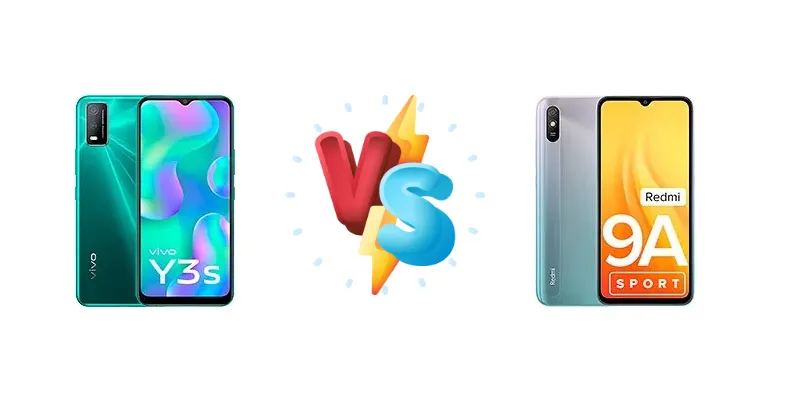
The sub-$150 smartphone market is fiercely competitive. Both the vivo Y3s (2021) and the Xiaomi Redmi 9A Sport aim to deliver essential smartphone functionality at an incredibly affordable price. This comparison dives deep into their core components – specifically the Mediatek Helio P35 and Helio G25 chipsets – to determine which device offers the best experience for everyday tasks and light gaming.
🏆 Quick Verdict
For the average user prioritizing slightly smoother performance in demanding apps, the vivo Y3s (2021) emerges as the better choice. Its Helio P35, with its higher clocked Cortex-A53 cores, provides a noticeable edge over the Redmi 9A Sport’s Helio G25, despite both phones sharing similar RAM and storage configurations.
| Network |
|---|
| 2G bands | GSM 850 / 900 / 1800 / 1900 | GSM 850 / 900 / 1800 / 1900 |
| 3G bands | HSDPA 850 / 900 / 2100 | HSDPA 850 / 900 / 2100 |
| 4G bands | 1, 3, 5, 8, 40 | 1, 3, 5, 8, 40, 41 |
| Speed | HSPA, LTE | HSPA, LTE |
| Technology | GSM / HSPA / LTE | GSM / HSPA / LTE |
| Launch |
|---|
| Announced | 2021, October 18 | 2021, September 28 |
| Status | Available. Released 2021, October 18 | Available. Released 2021, September 28 |
| Body |
|---|
| Build | Glass front, plastic back, plastic frame | - |
| Dimensions | 164.4 x 76.3 x 8.4 mm (6.47 x 3.00 x 0.33 in) | 164.9 x 77.1 x 9 mm (6.49 x 3.04 x 0.35 in) |
| SIM | Nano-SIM + Nano-SIM | Nano-SIM + Nano-SIM |
| Weight | 190 g (6.70 oz) | 194 g (6.84 oz) |
| | - | Water-repellent coating |
| Display |
|---|
| Resolution | 720 x 1600 pixels, 20:9 ratio (~270 ppi density) | 720 x 1600 pixels, 20:9 ratio (~269 ppi density) |
| Size | 6.51 inches, 102.3 cm2 (~81.6% screen-to-body ratio) | 6.53 inches, 102.9 cm2 (~81.0% screen-to-body ratio) |
| Type | IPS LCD | IPS LCD, 400 nits (typ) |
| Platform |
|---|
| CPU | Octa-core (4x2.3 GHz Cortex-A53 & 4x1.8 GHz Cortex-A53) | Octa-core (4x2.0 GHz Cortex-A53 & 4x1.5 GHz Cortex-A53) |
| Chipset | Mediatek MT6765 Helio P35 (12 nm) | Mediatek MT6762G Helio G25 (12 nm) |
| GPU | PowerVR GE8320 | PowerVR GE8320 |
| OS | Android 11 (Go edition), Funtouch 11 | Android 10, MIUI 12 |
| Memory |
|---|
| Card slot | microSDXC (dedicated slot) | microSDXC (dedicated slot) |
| Internal | 32GB 2GB RAM | 32GB 2GB RAM, 32GB 3GB RAM |
| | eMMC 5.1 | eMMC 5.1 |
| Main Camera |
|---|
| Features | LED flash, HDR, panorama | LED flash, HDR |
| Single | 13 MP, f/2.2, 27mm (wide), AF | 13 MP, f/2.2, 28mm (wide), 1.0µm, PDAF |
| Video | 1080p@30fps | 1080p@30/60fps |
| Selfie camera |
|---|
| Features | - | HDR |
| Single | 5 MP, f/1.8 | 5 MP, f/2.2, (wide), 1.12µm |
| Video | Unspecified | 1080p@30fps |
| Sound |
|---|
| 3.5mm jack | Yes | Yes |
| 35mm jack | Yes | Yes |
| Loudspeaker | Yes | Yes |
| Comms |
|---|
| Bluetooth | 5.0, A2DP, LE | 5.0, A2DP, LE |
| NFC | No | No |
| Positioning | GPS, GLONASS, GALILEO, BDS | GPS, GLONASS, BDS |
| Radio | FM radio | FM radio |
| USB | microUSB 2.0, OTG | microUSB 2.0, OTG |
| WLAN | Wi-Fi 802.11 b/g/n, Wi-Fi Direct | Wi-Fi 802.11 a/b/g/n, Wi-Fi Direct |
| Features |
|---|
| Sensors | Accelerometer, proximity, compass | Accelerometer, proximity |
| Battery |
|---|
| Charging | 10W wired
5W reverse wired | 10W wired |
| Type | 5000 mAh | Li-Po 5000 mAh |
| Misc |
|---|
| Colors | Starry Blue, Pearl White, Mint Green | Carbon Black, Coral Green, Metallic Blue |
| Models | V2044 | - |
| Price | About 110 EUR | About 100 EUR |
vivo Y3s (2021)
- Slightly faster CPU performance with Helio P35
- Potentially better app responsiveness
- May offer marginally better battery life due to chipset efficiency
- 10W charging is slow
- Camera performance likely limited
Xiaomi Redmi 9A Sport
- Potentially lower price point
- Helio G25 offers some gaming optimizations (though limited)
- 10W charging is standard for the price
- Slower CPU performance compared to the vivo Y3s
- May exhibit more lag when multitasking
Display Comparison
Neither device boasts a standout display. Both likely utilize standard IPS LCD panels, given their price bracket. The focus here isn't on visual fidelity, but rather basic usability. Without specific display specs, it's safe to assume both offer adequate viewing angles and color reproduction for everyday tasks. Bezels are likely to be substantial on both, maximizing screen real estate within a compact form factor.
Camera Comparison
Camera performance on both devices will be modest. Without detailed sensor information, it's reasonable to expect a primary camera around 13MP on both, supplemented by basic depth or macro sensors. Image quality will be heavily reliant on software processing, and low-light performance will likely be poor. The aperture size is a critical factor, but absent that data, it's difficult to definitively say which phone captures better images. The Redmi 9A Sport may benefit from slight image processing tweaks geared towards gaming content, but this is speculative.
Performance
The core difference lies in the chipsets. The vivo Y3s (2021) features the Mediatek Helio P35, an octa-core processor with four cores clocked at 2.3 GHz and four at 1.8 GHz. The Redmi 9A Sport utilizes the Helio G25, also octa-core, but with a slightly lower peak clock speed of 2.0 GHz on its faster cores and 1.5 GHz on the slower ones. While both use the Cortex-A53 architecture, the higher clock speeds of the P35 translate to faster single-core performance, impacting app launch times and general responsiveness. The 'G' in Helio G25 suggests some gaming optimizations, but the difference is unlikely to be substantial given the overall hardware limitations. Both are paired with similar RAM configurations, meaning the CPU is the primary bottleneck.
Battery Life
Both phones feature 10W wired charging, indicating similar charging speeds – expect around 2.5 to 3 hours for a full charge. Battery capacity is not specified, but both likely house batteries in the 4000-5000 mAh range, sufficient for a full day of light use. The slightly more efficient Helio P35 in the vivo Y3s (2021) *could* translate to marginally longer battery life, but the difference will be minimal under typical usage scenarios.
Buying Guide
Buy the vivo Y3s (2021) if you frequently switch between apps, occasionally play less-demanding mobile games, or value a slightly more responsive user interface. Buy the Xiaomi Redmi 9A Sport if your primary needs are basic communication – calls, texts, and light social media – and you prioritize a potentially lower price point, accepting a trade-off in overall processing power.
Frequently Asked Questions
❓ Will the Redmi 9A Sport struggle with popular apps like WhatsApp and Facebook?
While the Redmi 9A Sport can run these apps, the Helio G25's lower processing power may result in slower loading times and occasional lag, especially when multitasking. The vivo Y3s (2021) with its Helio P35 will offer a smoother experience.
❓ Is either phone suitable for playing demanding games like PUBG Mobile or Call of Duty Mobile?
Neither phone is ideal for demanding games. While you might be able to run them at the lowest settings, expect significant frame rate drops and a generally poor gaming experience. The Helio G25 in the Redmi 9A Sport has some gaming optimizations, but it's not enough to make these games truly playable.
❓ How long will it take to fully charge either phone from 0%?
With both phones supporting only 10W charging, a full charge from 0% will likely take between 2.5 and 3 hours. This is a standard charging speed for phones in this price range.
❓ Does the vivo Y3s (2021) offer reverse charging capabilities?
Yes, the vivo Y3s (2021) supports 5W reverse wired charging, allowing you to use it as a power bank to charge other devices, albeit at a very slow rate. The Redmi 9A Sport does not appear to offer this feature.