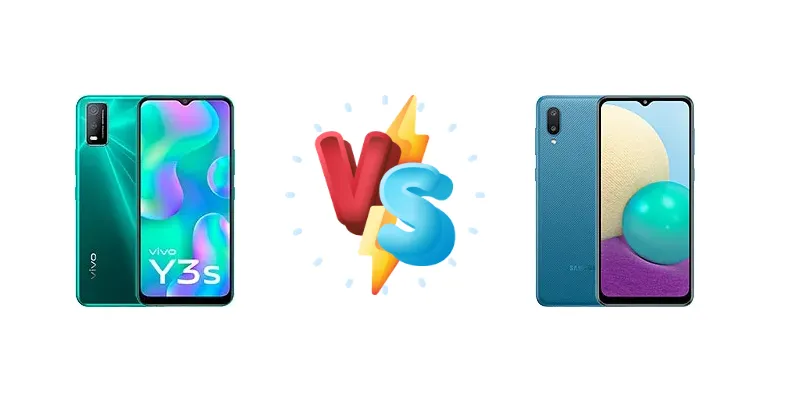
The sub-$200 smartphone market is fiercely competitive, and the vivo Y3s (2021) and Samsung Galaxy A02 represent two of the most popular options. While both aim to deliver essential smartphone functionality at an incredibly low price, they take different approaches to achieving this. This comparison dissects their core components to reveal which device offers the best experience for the money.
🏆 Quick Verdict
For most users, the vivo Y3s (2021) emerges as the better choice. Its Mediatek Helio P35 chipset, built on a more efficient 12nm process, provides a noticeable performance advantage over the Samsung Galaxy A02’s older 28nm MT6739W, translating to smoother multitasking and app loading. While neither phone excels in any single area, the Y3s offers a more responsive experience.
| Network |
|---|
| 2G bands | GSM 850 / 900 / 1800 / 1900 | GSM 850 / 900 / 1800 / 1900 |
| 3G bands | HSDPA 850 / 900 / 2100 | HSDPA 850 / 900 / 2100 |
| 4G bands | 1, 3, 5, 8, 40 | 1, 3, 5, 7, 8, 20, 28, 38, 40, 41 |
| Speed | HSPA, LTE | HSPA 42.2/5.76 Mbps, LTE Cat4 150/50 Mbps |
| Technology | GSM / HSPA / LTE | GSM / HSPA / LTE |
| Launch |
|---|
| Announced | 2021, October 18 | 2021, January 27 |
| Status | Available. Released 2021, October 18 | Available. Released 2021, January 27 |
| Body |
|---|
| Build | Glass front, plastic back, plastic frame | Glass front, plastic back, plastic frame |
| Dimensions | 164.4 x 76.3 x 8.4 mm (6.47 x 3.00 x 0.33 in) | 164 x 75.9 x 9.1 mm (6.46 x 2.99 x 0.36 in) |
| SIM | Nano-SIM + Nano-SIM | · Nano-SIM· Nano-SIM + Nano-SIM |
| Weight | 190 g (6.70 oz) | 206 g (7.27 oz) |
| Display |
|---|
| Resolution | 720 x 1600 pixels, 20:9 ratio (~270 ppi density) | 720 x 1600 pixels, 20:9 ratio (~270 ppi density) |
| Size | 6.51 inches, 102.3 cm2 (~81.6% screen-to-body ratio) | 6.5 inches, 102.0 cm2 (~81.9% screen-to-body ratio) |
| Type | IPS LCD | PLS LCD |
| Platform |
|---|
| CPU | Octa-core (4x2.3 GHz Cortex-A53 & 4x1.8 GHz Cortex-A53) | Quad-core 1.5 GHz Cortex-A53 |
| Chipset | Mediatek MT6765 Helio P35 (12 nm) | Mediatek MT6739W (28 nm) |
| GPU | PowerVR GE8320 | PowerVR GE8100 |
| OS | Android 11 (Go edition), Funtouch 11 | Android 10, upgradable to Android 11, One UI Core 3.1 |
| Memory |
|---|
| Card slot | microSDXC (dedicated slot) | microSDXC (dedicated slot) |
| Internal | 32GB 2GB RAM | 32GB 2GB RAM, 32GB 3GB RAM, 32GB 4GB RAM, 64GB 3GB RAM |
| | eMMC 5.1 | eMMC 5.1 |
| Main Camera |
|---|
| Dual | - | 13 MP, f/1.9, (wide), AF
2 MP (macro) |
| Features | LED flash, HDR, panorama | LED flash |
| Single | 13 MP, f/2.2, 27mm (wide), AF | - |
| Video | 1080p@30fps | 1080p@30fps |
| Selfie camera |
|---|
| Single | 5 MP, f/1.8 | 5 MP, f/2.0 |
| Video | Unspecified | - |
| Sound |
|---|
| 3.5mm jack | Yes | Yes |
| 35mm jack | Yes | Yes |
| Loudspeaker | Yes | Yes |
| Comms |
|---|
| Bluetooth | 5.0, A2DP, LE | 5.1, A2DP, LE |
| NFC | No | No |
| Positioning | GPS, GLONASS, GALILEO, BDS | GPS, GLONASS |
| Radio | FM radio | FM radio |
| USB | microUSB 2.0, OTG | microUSB 2.0 |
| WLAN | Wi-Fi 802.11 b/g/n, Wi-Fi Direct | Wi-Fi 802.11 b/g/n, Wi-Fi Direct |
| Features |
|---|
| Sensors | Accelerometer, proximity, compass | Accelerometer |
| | - | Virtual proximity sensing |
| Battery |
|---|
| Charging | 10W wired
5W reverse wired | - |
| Type | 5000 mAh | Li-Po 5000 mAh |
| Misc |
|---|
| Colors | Starry Blue, Pearl White, Mint Green | Black, Blue |
| Models | V2044 | SM-A022F, SM-A022F/DS, SM-A022M, SM-A022M/DS, SM-A022G, SM-A022G/DS |
| Price | About 110 EUR | € 97.46 |
| SAR EU | - | 0.65 W/kg (head) 1.71 W/kg (body) |
| Pricing |
|---|
| 32GB 2GB RAM | - | $ 149.99 |
| 32GB 3GB RAM | - | $ 129.99 |
| 64GB 3GB RAM | - | $ 199.99 |
| RENEWED | - | £ 113.00 |
vivo Y3s (2021)
- More powerful Helio P35 chipset
- More efficient 12nm process
- Reverse wired charging capability
- Potentially smoother multitasking
- Limited information on display quality
- Basic camera system
Samsung Galaxy A02
- Lower starting price (depending on configuration)
- Multiple RAM/storage options
- Familiar Samsung One UI (potentially)
- Wide availability
- Significantly weaker MT6739W chipset
- Less efficient 28nm process
- Slower overall performance
- No reverse charging
Display Comparison
Neither device boasts a standout display. Both are likely utilizing LCD panels, a common cost-saving measure in this segment. However, specifics like resolution and brightness are not provided. The Galaxy A02’s price variations suggest a potential for slightly larger storage options, which could indirectly impact media consumption. The lack of information on PWM dimming rates makes it difficult to assess potential eye strain for sensitive users.
Camera Comparison
Camera performance on both devices is expected to be basic. Details are scarce, but it’s safe to assume both rely on budget sensors. The Galaxy A02’s price tiers suggest some configuration variations, but the core camera hardware is unlikely to differ dramatically. The prevalence of 2MP macro and depth sensors on phones in this price range is largely marketing fluff; image quality from these sensors is typically poor. Without specific sensor size or aperture information, it’s difficult to definitively declare a winner, but the Y3s’ more powerful processor *could* offer slightly better image processing capabilities.
Performance
The performance gap is the most significant differentiator. The vivo Y3s (2021) utilizes the Mediatek Helio P35, an octa-core processor built on a 12nm FinFET process. This contrasts sharply with the Samsung Galaxy A02’s Mediatek MT6739W, a quad-core processor fabricated on a much older and less efficient 28nm process. The 12nm node of the Helio P35 translates to better power efficiency and, crucially, higher sustained performance. The Y3s’ eight Cortex-A53 cores (four at 2.3 GHz and four at 1.8 GHz) will handle multitasking and app launches more effectively than the A02’s four 1.5 GHz Cortex-A53 cores. This difference will be particularly noticeable when switching between apps or running multiple applications simultaneously.
Battery Life
Battery capacity isn’t specified for either device, but both likely house batteries in the 4000-5000 mAh range, typical for this segment. The vivo Y3s (2021) offers 10W wired charging and 5W reverse wired charging, a feature absent on the Galaxy A02. While 10W isn’t fast by modern standards, it’s still preferable to slower charging options. The Helio P35’s superior power efficiency should also contribute to slightly longer battery life on the Y3s, offsetting any potential capacity differences.
Buying Guide
Buy the vivo Y3s (2021) if you prioritize a more fluid user experience and slightly better performance for everyday tasks like social media and web browsing. Buy the Samsung Galaxy A02 if you are strictly focused on the absolute lowest price point and are willing to accept compromises in performance and responsiveness. The A02’s varying RAM/storage configurations offer some flexibility, but the core chipset remains a significant limitation.
Frequently Asked Questions
❓ Will the Samsung Galaxy A02 struggle with popular apps like Facebook or WhatsApp?
The MT6739W chipset in the Galaxy A02 is quite limited. While it can run basic apps like Facebook and WhatsApp, you may experience noticeable lag, slow loading times, and occasional stuttering, especially with multiple apps open. The vivo Y3s (2021) will provide a smoother experience with these apps due to its more powerful processor.
❓ Is the 5W reverse charging on the vivo Y3s (2021) actually useful?
While 5W reverse charging is slow, it can be a lifesaver in a pinch. It allows you to top up accessories like wireless earbuds or a smartwatch using your phone as a power bank. It's not a replacement for a dedicated power bank, but it's a convenient feature to have, and the Galaxy A02 lacks this capability entirely.
❓ Does either phone support widevine L1 for HD streaming on Netflix or Prime Video?
It's highly unlikely that either phone supports Widevine L1. Phones in this price range typically ship with Widevine L3, limiting streaming resolution to SD quality. Checking specific firmware versions would be required to confirm, but don't expect HD streaming on either device.