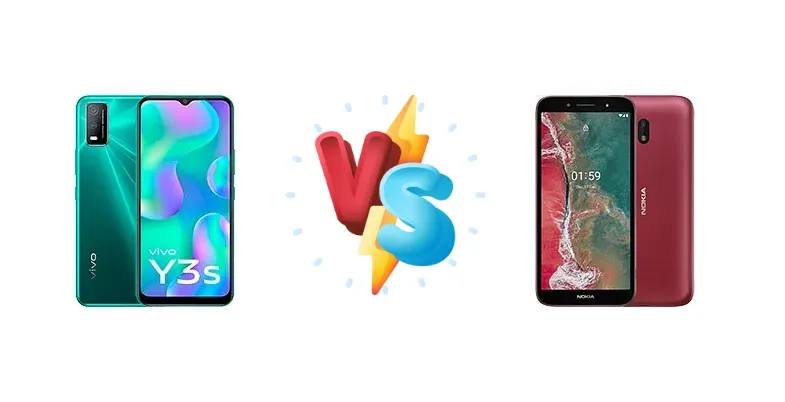
The ultra-budget smartphone segment is fiercely competitive. Both the vivo Y3s (2021) and the Nokia C1 Plus aim to deliver basic smartphone functionality at the lowest possible price point. However, a significant disparity in processing power separates these two devices, making the choice less about features and more about prioritizing a usable experience.
🏆 Quick Verdict
For the average user, the vivo Y3s (2021) is the clear winner. Its Mediatek Helio P35 chipset provides a substantially more responsive experience than the Nokia C1 Plus’s quad-core processor, making it better suited for multitasking and app usage. While both are entry-level, the Y3s offers a more future-proofed platform.
| Network |
|---|
| 2G bands | GSM 850 / 900 / 1800 / 1900 | GSM 850 / 900 / 1800 / 1900 |
| 3G bands | HSDPA 850 / 900 / 2100 | HSDPA 850 / 900 / 2100 - International, APAC |
| 4G bands | 1, 3, 5, 8, 40 | 1, 3, 7, 8, 20, 28 - International |
| Speed | HSPA, LTE | HSPA 21.1/5.76 Mbps, LTE Cat4 150/50 Mbps |
| Technology | GSM / HSPA / LTE | GSM / HSPA / LTE |
| | - | 1, 3, 8, 20, 28, 38, 40, 41 - Saudi Arabia |
| Launch |
|---|
| Announced | 2021, October 18 | 2020, December 15. Released 2021, January 29 |
| Status | Available. Released 2021, October 18 | Discontinued |
| Body |
|---|
| Build | Glass front, plastic back, plastic frame | Glass front, plastic back, plastic frame |
| Dimensions | 164.4 x 76.3 x 8.4 mm (6.47 x 3.00 x 0.33 in) | 149.1 x 71.2 x 8.8 mm (5.87 x 2.80 x 0.35 in) |
| SIM | Nano-SIM + Nano-SIM | · Nano-SIM· Nano-SIM + Nano-SIM |
| Weight | 190 g (6.70 oz) | 146 g (5.15 oz) |
| Display |
|---|
| Resolution | 720 x 1600 pixels, 20:9 ratio (~270 ppi density) | 720 x 1440 pixels, 18:9 ratio (~295 ppi density) |
| Size | 6.51 inches, 102.3 cm2 (~81.6% screen-to-body ratio) | 5.45 inches, 76.7 cm2 (~72.2% screen-to-body ratio) |
| Type | IPS LCD | IPS LCD |
| Platform |
|---|
| CPU | Octa-core (4x2.3 GHz Cortex-A53 & 4x1.8 GHz Cortex-A53) | Quad-core 1.4 GHz |
| Chipset | Mediatek MT6765 Helio P35 (12 nm) | - |
| GPU | PowerVR GE8320 | - |
| OS | Android 11 (Go edition), Funtouch 11 | Android 10 (Go edition) |
| Memory |
|---|
| Card slot | microSDXC (dedicated slot) | microSDXC (dedicated slot) |
| Internal | 32GB 2GB RAM | 16GB 1GB RAM |
| | eMMC 5.1 | eMMC 5.1 |
| Main Camera |
|---|
| Features | LED flash, HDR, panorama | LED flash, HDR |
| Single | 13 MP, f/2.2, 27mm (wide), AF | 5 MP |
| Video | 1080p@30fps | 720p@30fps |
| Selfie camera |
|---|
| Features | - | LED flash, HDR |
| Single | 5 MP, f/1.8 | 5 MP |
| Video | Unspecified | 720p@30fps |
| Sound |
|---|
| 3.5mm jack | Yes | Yes |
| 35mm jack | Yes | Yes |
| Loudspeaker | Yes | Yes |
| Comms |
|---|
| Bluetooth | 5.0, A2DP, LE | 4.2, A2DP, LE |
| NFC | No | No |
| Positioning | GPS, GLONASS, GALILEO, BDS | GPS |
| Radio | FM radio | FM radio |
| USB | microUSB 2.0, OTG | microUSB 2.0 |
| WLAN | Wi-Fi 802.11 b/g/n, Wi-Fi Direct | Wi-Fi 802.11 b/g/n |
| Features |
|---|
| Sensors | Accelerometer, proximity, compass | Accelerometer, proximity |
| Battery |
|---|
| Charging | 10W wired
5W reverse wired | - |
| Type | 5000 mAh | Li-Ion 2500 mAh, removable |
| Misc |
|---|
| Colors | Starry Blue, Pearl White, Mint Green | Blue, Red |
| Models | V2044 | TA-1312 |
| Price | About 110 EUR | About 70 EUR |
vivo Y3s (2021)
- Significantly faster processor (Helio P35)
- 10W charging with 5W reverse charging
- More responsive user experience
- Better multitasking capabilities
- May have a less streamlined software experience (depending on vivo’s Funtouch OS)
- Potentially shorter software support compared to Nokia
Nokia C1 Plus
- Simple and clean Android Go Edition software
- Potentially longer software support from Nokia
- Extremely affordable price point
- Reliable for basic communication tasks
- Very slow processor
- Limited multitasking capabilities
- Poor performance with demanding apps
- No fast charging
Display Comparison
Neither device boasts a standout display. Details regarding panel type, resolution, and brightness are limited for both. However, the focus here isn't display quality; it's usability. A smoother experience, driven by the processor, will be more noticeable than minor display differences. Given the price point, both likely utilize LCD panels with standard 60Hz refresh rates.
Camera Comparison
Camera performance is likely to be similar on both devices – basic and adequate for casual snapshots in good lighting conditions. Specific sensor details are scarce, but given the price bracket, expect low-resolution sensors. Focusing on megapixel counts would be misleading; image processing capabilities, which are tied to the chipset, will be the limiting factor. The Helio P35 in the Y3s will likely offer slightly better image processing than the C1 Plus, but neither will compete with mid-range or flagship devices.
Performance
The performance gap is the defining characteristic of this comparison. The vivo Y3s (2021) utilizes the Mediatek MT6765 Helio P35, an octa-core processor built on a 12nm process. This means eight processing cores – four clocked at 2.3 GHz and four at 1.8 GHz – working in tandem. In contrast, the Nokia C1 Plus features a quad-core processor clocked at 1.4 GHz. The Helio P35’s architecture, with its Cortex-A53 cores, is significantly more capable than the C1 Plus’s unspecified cores. This translates to faster app loading times, smoother multitasking, and a more responsive user interface on the Y3s. The 12nm process node of the Helio P35 also suggests better power efficiency compared to potentially older, larger node processes used in the C1 Plus.
Battery Life
Battery capacity details are missing for both devices. However, the vivo Y3s (2021) offers 10W wired charging and 5W reverse wired charging, a feature absent on the Nokia C1 Plus. While 10W isn’t fast charging by modern standards, it’s a notable advantage. The reverse wired charging, though limited to 5W, allows the Y3s to act as a power bank for other devices, a unique benefit in this price range. The more powerful processor in the Y3s may consume more power, but the charging capabilities offer a degree of flexibility the C1 Plus lacks.
Buying Guide
Buy the vivo Y3s (2021) if you need a smartphone capable of handling more than just basic calling and texting – if you plan to use social media, browse the web with multiple tabs, or occasionally play casual games. Buy the Nokia C1 Plus if your primary need is a very basic, reliable phone for calls, texts, and minimal app usage, and you prioritize simplicity and potentially longer software support from Nokia.
Frequently Asked Questions
❓ Will the Nokia C1 Plus struggle with WhatsApp and Facebook?
Yes, the Nokia C1 Plus’s quad-core processor and limited RAM will likely result in slow loading times and lag when using apps like WhatsApp and Facebook, especially with multiple chats or features open simultaneously. The vivo Y3s (2021) will handle these apps much more smoothly.
❓ Is the Mediatek Helio P35 in the vivo Y3s (2021) capable of playing games?
The Helio P35 can handle very basic, less demanding 2D games. However, it will struggle with modern 3D games. Expect low frame rates and significant lag in titles like PUBG Mobile or Call of Duty Mobile, even on the lowest settings. The Nokia C1 Plus is even less suited for gaming.
❓ Does the vivo Y3s (2021) support software updates?
Software update support for the vivo Y3s (2021) is limited. While it likely launched with a relatively recent version of Android, major OS updates are unlikely. Nokia generally provides better software support, but even the C1 Plus is unlikely to receive extensive updates.
❓ Which phone is better for an elderly user who primarily makes calls and sends texts?
The Nokia C1 Plus is arguably better suited for an elderly user who primarily makes calls and sends texts. Its simpler interface and focus on core functionality make it easier to use, and the slower processor won't be a hindrance for basic tasks. The Y3s's more complex software could be overwhelming.