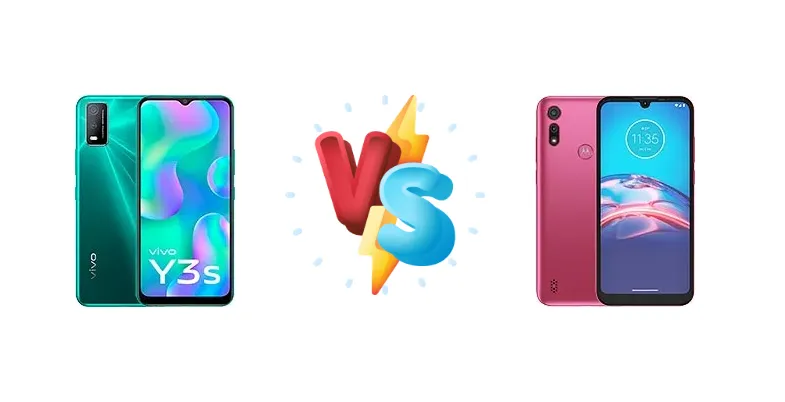
The sub-$150 smartphone market is fiercely competitive. Both the vivo Y3s (2021) and Motorola Moto E6i aim to deliver essential smartphone functionality at an incredibly affordable price. However, significant differences in their underlying hardware – specifically the chipsets – dictate which phone is better suited for different users. This comparison dives deep into those differences, analyzing performance, battery life, and overall value.
🏆 Quick Verdict
For most users, the vivo Y3s (2021) offers a more responsive experience thanks to its Mediatek Helio P35 chipset. While both phones share a 10W charging rate, the P35’s more modern Cortex-A53 cores provide a noticeable advantage in app loading and multitasking, making it the better choice for daily use.
| Network |
|---|
| 2G bands | GSM 850 / 900 / 1800 / 1900 | GSM 850 / 900 / 1800 / 1900 |
| 3G bands | HSDPA 850 / 900 / 2100 | HSDPA 850 / 900 / 1700(AWS) / 1900 / 2100 |
| 4G bands | 1, 3, 5, 8, 40 | 1, 2, 3, 4, 5, 7, 8, 19, 28, 66 |
| Speed | HSPA, LTE | HSPA, LTE |
| Technology | GSM / HSPA / LTE | GSM / HSPA / LTE |
| Launch |
|---|
| Announced | 2021, October 18 | 2021, February 11 |
| Status | Available. Released 2021, October 18 | Available. Released 2021, February 11 |
| Body |
|---|
| Build | Glass front, plastic back, plastic frame | Glass front, plastic back, plastic frame |
| Dimensions | 164.4 x 76.3 x 8.4 mm (6.47 x 3.00 x 0.33 in) | 155.6 x 73 x 8.5 mm (6.13 x 2.87 x 0.33 in) |
| SIM | Nano-SIM + Nano-SIM | Nano-SIM + Nano-SIM |
| Weight | 190 g (6.70 oz) | 160 g (5.64 oz) |
| Display |
|---|
| Resolution | 720 x 1600 pixels, 20:9 ratio (~270 ppi density) | 720 x 1560 pixels, 19.5:9 ratio (~282 ppi density) |
| Size | 6.51 inches, 102.3 cm2 (~81.6% screen-to-body ratio) | 6.1 inches, 91.3 cm2 (~80.4% screen-to-body ratio) |
| Type | IPS LCD | IPS LCD |
| Platform |
|---|
| CPU | Octa-core (4x2.3 GHz Cortex-A53 & 4x1.8 GHz Cortex-A53) | Octa-core (4x1.6 GHz Cortex-A55 & 4x1.2 GHz Cortex-A55) |
| Chipset | Mediatek MT6765 Helio P35 (12 nm) | Unisoc SC9863A (28 nm) |
| GPU | PowerVR GE8320 | IMG8322 |
| OS | Android 11 (Go edition), Funtouch 11 | Android 10 (Go edition) |
| Memory |
|---|
| Card slot | microSDXC (dedicated slot) | microSDXC (uses shared SIM slot) |
| Internal | 32GB 2GB RAM | 32GB 2GB RAM |
| | eMMC 5.1 | eMMC 5.1 |
| Main Camera |
|---|
| Dual | - | 13 MP, f/2.2, 26mm (wide), 1/3.1", 1.12µm, PDAF
Auxiliary lens |
| Features | LED flash, HDR, panorama | LED flash, HDR, panorama |
| Single | 13 MP, f/2.2, 27mm (wide), AF | - |
| Video | 1080p@30fps | 1080p@30fps |
| Selfie camera |
|---|
| Single | 5 MP, f/1.8 | 5 MP, f/2.2, 27mm (wide), 1.12µm |
| Video | Unspecified | 1080p@30fps |
| Sound |
|---|
| 3.5mm jack | Yes | Yes |
| 35mm jack | Yes | Yes |
| Loudspeaker | Yes | Yes |
| Comms |
|---|
| Bluetooth | 5.0, A2DP, LE | 4.2, A2DP, LE |
| NFC | No | No |
| Positioning | GPS, GLONASS, GALILEO, BDS | GPS, GLONASS |
| Radio | FM radio | Unspecified |
| USB | microUSB 2.0, OTG | microUSB 2.0, OTG |
| WLAN | Wi-Fi 802.11 b/g/n, Wi-Fi Direct | Wi-Fi 802.11 b/g/n |
| Features |
|---|
| Sensors | Accelerometer, proximity, compass | Fingerprint (rear-mounted), accelerometer, proximity |
| Battery |
|---|
| Charging | 10W wired
5W reverse wired | 10W wired |
| Type | 5000 mAh | Li-Ion 3000 mAh |
| Misc |
|---|
| Colors | Starry Blue, Pearl White, Mint Green | Titanium Gray, Pink |
| Models | V2044 | XT2053-5 |
| Price | About 110 EUR | About 170 EUR |
vivo Y3s (2021)
- More powerful Mediatek Helio P35 chipset
- Potentially better camera image processing
- Slightly better battery efficiency
- 10W charging is slow
- Likely limited software updates
Motorola Moto E6i
- Lower price point
- Potentially more readily available in some markets
- Simple and straightforward Android experience
- Significantly weaker Unisoc SC9863A chipset
- Lower performance and responsiveness
- Less efficient battery usage
Display Comparison
Neither vivo nor Motorola provide detailed display specifications for these models. Given their price point, it’s safe to assume both utilize LCD panels with 720p+ resolutions. However, the lack of detailed specs makes a direct comparison impossible. The focus here is on internal performance, as display quality is likely similar and adequate for basic use.
Camera Comparison
Both phones likely feature basic camera setups, with the specifics being less important than the overall processing power. While megapixel counts may vary, the Unisoc SC9863A’s weaker image signal processor (ISP) in the Moto E6i will likely result in lower-quality photos, especially in low-light conditions. The Helio P35 in the Y3s provides a more capable ISP, allowing for better image processing and potentially sharper, more vibrant photos. It's unlikely either phone will excel in photography, but the Y3s has a clear edge.
Performance
The core difference lies in the chipsets. The vivo Y3s (2021) features the Mediatek Helio P35, a 12nm processor with an octa-core configuration split between 2.3 GHz and 1.8 GHz Cortex-A53 cores. The Motorola Moto E6i, conversely, uses the Unisoc SC9863A, a significantly older 28nm chip with a similar octa-core layout but clocked lower at 1.6 GHz and 1.2 GHz Cortex-A55 cores. The Helio P35’s newer architecture and higher clock speeds translate to demonstrably faster performance in real-world usage. The Cortex-A55 cores in the Moto E6i are more efficient, but the lower clock speeds and older manufacturing process can’t overcome the P35’s advantages. This difference is particularly noticeable when launching apps or switching between them.
Battery Life
Both devices are equipped with 10W wired charging, indicating similar charging speeds. While battery capacity isn’t specified, the Unisoc SC9863A’s 28nm process is less power-efficient than the Helio P35’s 12nm process. This means the Moto E6i will likely drain its battery faster under similar usage conditions. The Y3s, despite potentially having a similar battery capacity, should offer slightly longer battery life due to the more efficient chipset.
Buying Guide
Buy the vivo Y3s (2021) if you prioritize a smoother user experience and slightly better performance for everyday tasks like social media, browsing, and light gaming. Buy the Motorola Moto E6i if you are looking for the absolute lowest price point and are willing to accept slower performance and potentially more lag during multitasking. The E6i is best suited for users with very basic smartphone needs.
Frequently Asked Questions
❓ Will the Motorola Moto E6i struggle with popular apps like WhatsApp and Facebook?
The Unisoc SC9863A chipset in the Moto E6i is relatively weak. While it can run these apps, you may experience noticeable lag when opening them, switching between them, or loading media. The vivo Y3s (2021) with its Helio P35 will provide a smoother experience with these commonly used applications.
❓ Is the 10W charging on either phone fast enough for daily use?
No, 10W charging is quite slow by today’s standards. Expect it to take several hours to fully charge either device from 0%. Both phones prioritize affordability over fast charging technology. Consider this a trade-off for the low price point.
❓ Which phone is better for playing casual games like Candy Crush or Subway Surfers?
The vivo Y3s (2021) will offer a more playable experience for casual games. The Helio P35’s GPU is more capable than the one in the Moto E6i, resulting in fewer frame drops and smoother gameplay. While neither phone is designed for demanding games, the Y3s will handle simpler titles more effectively.