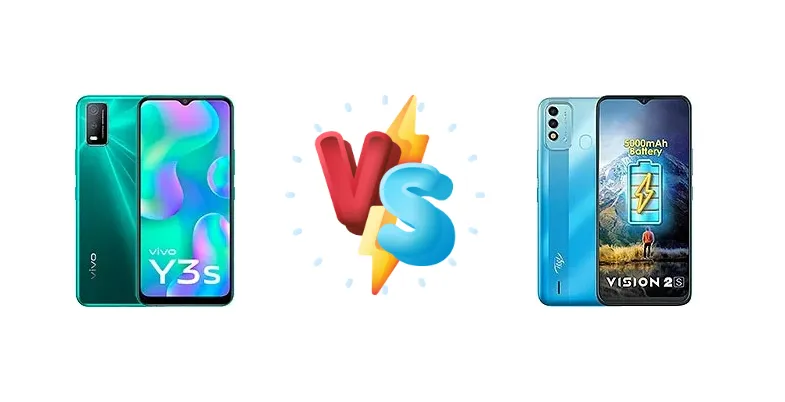
The sub-$150 smartphone market is fiercely competitive. Both the vivo Y3s (2021) and the itel Vision 2S aim to deliver essential smartphone functionality at an incredibly affordable price. However, they take different approaches to achieving this, with the vivo leveraging a Mediatek Helio P35 while the itel opts for a Unisoc SC9863A. This comparison dissects these choices to determine which device offers the best experience for the price-conscious consumer.
🏆 Quick Verdict
For most users, the vivo Y3s (2021) is the better choice. While the itel Vision 2S boasts faster 18W charging, the Helio P35 chipset in the vivo offers a noticeable performance advantage in everyday tasks and app responsiveness, making it a more fluid daily driver.
| Network |
|---|
| 2G bands | GSM 850 / 900 / 1800 / 1900 | GSM 850 / 900 / 1800 / 1900 |
| 3G bands | HSDPA 850 / 900 / 2100 | HSDPA 850 / 900 / 2100 |
| 4G bands | 1, 3, 5, 8, 40 | LTE |
| Speed | HSPA, LTE | HSPA, LTE |
| Technology | GSM / HSPA / LTE | GSM / HSPA / LTE |
| Launch |
|---|
| Announced | 2021, October 18 | 2021 |
| Status | Available. Released 2021, October 18 | Available. Released 2021 |
| Body |
|---|
| Build | Glass front, plastic back, plastic frame | - |
| Dimensions | 164.4 x 76.3 x 8.4 mm (6.47 x 3.00 x 0.33 in) | 166 x 76.3 x 8.9 mm (6.54 x 3.00 x 0.35 in) |
| SIM | Nano-SIM + Nano-SIM | Dual SIM |
| Weight | 190 g (6.70 oz) | - |
| Display |
|---|
| Resolution | 720 x 1600 pixels, 20:9 ratio (~270 ppi density) | 720 x 1600 pixels, 20:9 ratio (~269 ppi density) |
| Size | 6.51 inches, 102.3 cm2 (~81.6% screen-to-body ratio) | 6.52 inches, 102.6 cm2 (~81.0% screen-to-body ratio) |
| Type | IPS LCD | IPS LCD |
| Platform |
|---|
| CPU | Octa-core (4x2.3 GHz Cortex-A53 & 4x1.8 GHz Cortex-A53) | Octa-core (4x1.6 GHz Cortex-A55 & 4x1.2 GHz Cortex-A55) |
| Chipset | Mediatek MT6765 Helio P35 (12 nm) | Unisoc SC9863A (28 nm) |
| GPU | PowerVR GE8320 | IMG8322 |
| OS | Android 11 (Go edition), Funtouch 11 | Android 11 (Go edition) |
| Memory |
|---|
| Card slot | microSDXC (dedicated slot) | microSDXC |
| Internal | 32GB 2GB RAM | 32GB 2GB RAM |
| | eMMC 5.1 | - |
| Main Camera |
|---|
| Dual | - | 8 MP
0.3 MP |
| Features | LED flash, HDR, panorama | LED flash |
| Single | 13 MP, f/2.2, 27mm (wide), AF | - |
| Video | 1080p@30fps | 1080p@30fps |
| Selfie camera |
|---|
| Single | 5 MP, f/1.8 | 5 MP |
| Video | Unspecified | Yes |
| Sound |
|---|
| 3.5mm jack | Yes | - |
| 35mm jack | Yes | Yes |
| Loudspeaker | Yes | Yes |
| Comms |
|---|
| Bluetooth | 5.0, A2DP, LE | Yes |
| NFC | No | No |
| Positioning | GPS, GLONASS, GALILEO, BDS | GPS |
| Radio | FM radio | Unspecified |
| USB | microUSB 2.0, OTG | microUSB |
| WLAN | Wi-Fi 802.11 b/g/n, Wi-Fi Direct | Yes |
| Features |
|---|
| Sensors | Accelerometer, proximity, compass | Fingerprint (rear-mounted), accelerometer |
| Battery |
|---|
| Charging | 10W wired
5W reverse wired | 18W wired |
| Type | 5000 mAh | 5000 mAh |
| Misc |
|---|
| Colors | Starry Blue, Pearl White, Mint Green | Gradation Purple, Gradation Blue, Deep Blue |
| Models | V2044 | - |
| Price | About 110 EUR | - |
vivo Y3s (2021)
- Better overall performance with the Helio P35 chipset.
- More efficient processor leading to potentially better battery life.
- 5W reverse wired charging for topping up other devices.
- Slower 10W charging.
- Likely similar camera performance to the itel.
itel Vision 2S
- Faster 18W wired charging.
- Potentially lower price point (depending on region).
- Acceptable for very basic smartphone tasks.
- Significantly slower processor performance.
- Less efficient chipset leading to potentially shorter battery life.
- Limited multitasking capabilities.
Display Comparison
Neither device boasts a standout display. Both likely utilize LCD panels, typical for this price bracket. However, detailed display specs (resolution, brightness, color gamut) are unavailable. The focus here is on processing power, not visual fidelity. Bezels are expected to be substantial on both, impacting the overall screen-to-body ratio. Without specific data, it's safe to assume display quality is comparable and won't be a deciding factor.
Camera Comparison
Camera performance is likely to be similar, and largely unimpressive. Both phones likely feature a primary camera alongside auxiliary lenses of questionable utility. Without specific sensor details, it's difficult to make a definitive statement. However, the image processing capabilities of Mediatek chipsets are generally more refined than those of Unisoc, potentially giving the vivo Y3s (2021) a slight edge in image quality, particularly in challenging lighting conditions. Expect both to struggle with low-light photography.
Performance
The core difference lies in the chipsets. The vivo Y3s (2021) utilizes the Mediatek Helio P35, a 12nm process chipset with an octa-core CPU configuration split into 4x2.3 GHz Cortex-A53 and 4x1.8 GHz Cortex-A53 cores. This contrasts with the itel Vision 2S’s Unisoc SC9863A, built on a less efficient 28nm process, and featuring 4x1.6 GHz Cortex-A55 and 4x1.2 GHz Cortex-A55 cores. The Helio P35’s higher clock speeds and more modern architecture (though still Cortex-A53) translate to demonstrably better performance in app loading times and multitasking. The Unisoc’s 28nm process will likely result in higher power consumption for similar tasks. The Cortex-A55 cores in the itel are more efficient *per clock cycle*, but the lower clock speeds and overall architecture can't match the Helio P35.
Battery Life
The itel Vision 2S has a clear advantage in charging speed with its 18W wired charging support, compared to the vivo Y3s (2021)’s 10W charging. While battery capacity isn't specified, the less efficient Unisoc SC9863A will likely require more frequent charging despite potentially similar battery sizes. The vivo’s more efficient Helio P35, coupled with its 5W reverse wired charging capability (allowing it to charge other devices), offers a more versatile battery experience, even if it takes longer to fully charge.
Buying Guide
Buy the vivo Y3s (2021) if you prioritize a smoother user experience and slightly better performance for tasks like social media, browsing, and light gaming. Buy the itel Vision 2S if fast charging is your absolute top priority and you primarily use your phone for calls, texts, and very basic app usage, accepting a trade-off in processing speed.
Frequently Asked Questions
❓ Will the Unisoc SC9863A in the itel Vision 2S struggle with popular apps like WhatsApp and Facebook?
While the itel Vision 2S can run these apps, the Unisoc SC9863A's lower processing power may result in slower loading times, occasional lag, and a less responsive experience, especially when multitasking. The vivo Y3s (2021) with its Helio P35 will handle these apps more smoothly.
❓ How long will it take to fully charge the vivo Y3s (2021) with the 10W charger?
Expect a full charge from 0% to 100% to take approximately 2.5 to 3.5 hours with the included 10W charger. While slower than the itel Vision 2S, the more efficient Helio P35 chipset may offset this with longer battery life between charges.
❓ Is the 18W charging on the itel Vision 2S compatible with any USB-PD chargers?
It's unlikely. The itel Vision 2S likely uses a proprietary 18W charging protocol. While it *may* work with some USB-PD chargers, it won't necessarily achieve the full 18W charging speed. Using the included charger is recommended.
❓ Can the vivo Y3s (2021) be used as a power bank to charge other devices?
Yes, the vivo Y3s (2021) supports 5W reverse wired charging. This allows you to use it to slowly charge other devices like wireless earbuds or a smartwatch, though it's not a fast charging solution.