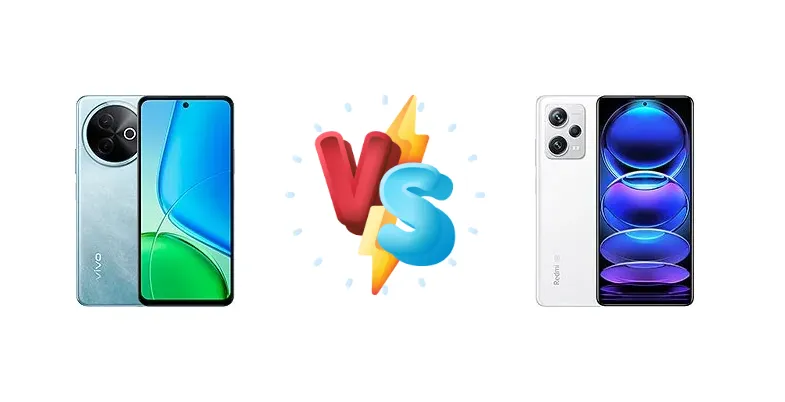
The mid-range smartphone market is fiercely competitive, and the vivo Y39 and Xiaomi Redmi Note 12 Pro+ represent compelling options for budget-conscious buyers. While both aim to deliver a solid experience, they take distinctly different approaches to performance and features. The Y39 focuses on efficiency with a newer Snapdragon chipset, while the Redmi Note 12 Pro+ prioritizes raw speed and incredibly fast charging.
🏆 Quick Verdict
For the average user prioritizing speed and convenience, the Xiaomi Redmi Note 12 Pro+ is the clear winner. Its 120W charging dramatically reduces downtime, and the Dimensity 1080 offers a performance edge. However, the vivo Y39’s Snapdragon 4 Gen 2 provides excellent efficiency for everyday tasks.
| Network |
|---|
| 2G bands | GSM 850 / 900 / 1800 / 1900 | GSM 850 / 900 / 1800 / 1900 - SIM 1 & SIM 2 |
| 3G bands | HSDPA 850 / 900 / 2100 | HSDPA 800 / 850 / 900 / 1900 / 2100 |
| 4G bands | 1, 3, 5, 8, 28, 38, 40, 41 | 1, 3, 5, 8, 19, 34, 38, 39, 40, 41 - International, China |
| 5G bands | 1, 3, 5, 8, 28, 40, 77, 78 SA/NSA | 1, 3, 5, 8, 28, 38, 40, 41, 77, 78 SA/NSA - International |
| Speed | HSPA, LTE, 5G | HSPA, LTE-A (CA), 5G |
| Technology | GSM / HSPA / LTE / 5G | GSM / CDMA / HSPA / EVDO / LTE / 5G |
| | - | 1, 3, 5, 8, 28, 38, 41, 77, 78 SA/NSA - China |
| Launch |
|---|
| Announced | 2025, March 27 | 2022, October 27 |
| Status | Available. Released 2025, March 27 | Available. Released 2022, November 01 |
| Body |
|---|
| Build | Glass front, plastic frame, plastic back | Glass front (Gorilla Glass 5), glass back |
| Dimensions | 165.7 x 76.3 x 8.3 mm (6.52 x 3.00 x 0.33 in) | 162.9 x 76 x 8.9 mm (6.41 x 2.99 x 0.35 in) |
| SIM | Nano-SIM + Nano-SIM | Dual SIM (Nano-SIM, dual stand-by) |
| Weight | 205 g (7.23 oz) | 208.4 g (7.34 oz) |
| | - | IP53, dust and splash resistant |
| Display |
|---|
| Protection | Schott Glass | Corning Gorilla Glass 5 |
| Resolution | 720 x 1608 pixels, 20:9 ratio (~264 ppi density) | 1080 x 2400 pixels, 20:9 ratio (~395 ppi density) |
| Size | 6.68 inches, 107.4 cm2 (~84.9% screen-to-body ratio) | 6.67 inches, 107.4 cm2 (~86.8% screen-to-body ratio) |
| Type | IPS LCD, 120Hz, 1000 nits (HBM) | OLED, 1B colors, 120Hz, Dolby Vision, HDR10+, 500 nits (typ), 900 nits (HBM) |
| Platform |
|---|
| CPU | Octa-core (2x2.2 GHz Cortex-A78 & 6x1.95 GHz Cortex-A55) | Octa-core (2x2.6 GHz Cortex-A78 & 6x2.0 GHz Cortex-A55) |
| Chipset | Qualcomm SM4450 Snapdragon 4 Gen 2 (4 nm) | Mediatek MT6877V Dimensity 1080 (6 nm) |
| GPU | Adreno 613 | Mali-G68 MC4 |
| OS | Android 15, Funtouch 15 | Android 12, MIUI 13 |
| Memory |
|---|
| Card slot | No | No |
| Internal | 128GB 8GB RAM, 256GB 8GB RAM | 256GB 8GB RAM, 256GB 12GB RAM |
| | - | UFS 2.2 |
| Main Camera |
|---|
| Dual | 50 MP, f/1.8, (wide), PDAF
Auxiliary lens | - |
| Features | LED flash, HDR, panorama | Dual-LED dual-tone flash, HDR, panorama |
| Triple | - | 200 MP, f/1.7, 24mm (wide), 1/1.4", 0.56µm, PDAF, OIS
8 MP, f/2.2, 120˚ (ultrawide), 1/4", 1.12µm
2 MP, f/2.4, (macro) |
| Video | 1080p@30fps | 4K@30fps, 1080p@30/60/120fps, 720p@960fps |
| Selfie camera |
|---|
| Features | - | HDR |
| Single | 8 MP, f/2.0, (wide) | 16 MP, f/2.5, (wide), 1/3.06", 1.0µm |
| Video | 1080p@30fps | 1080p@30/60fps |
| Sound |
|---|
| 3.5mm jack | - | Yes |
| 35mm jack | No | - |
| Loudspeaker | Yes, with stereo speakers | Yes, with stereo speakers |
| | - | 24-bit/192kHz audio |
| Comms |
|---|
| Bluetooth | 5.0, A2DP, LE | 5.2, A2DP, LE |
| Infrared port | - | Yes |
| NFC | No | Yes (market/region dependent) |
| Positioning | GPS, GALILEO, GLONASS, BDS, QZSS | GPS (L1), GLONASS (G1), BDS (B1I+B1c), GALILEO (E1), QZSS (L1) |
| Radio | No | No |
| USB | USB Type-C 2.0, OTG | USB Type-C 2.0, OTG |
| WLAN | Wi-Fi 802.11 a/b/g/n/ac, dual-band | Wi-Fi 802.11 a/b/g/n/ac/6, dual-band, Wi-Fi Direct |
| Features |
|---|
| Sensors | Fingerprint (side-mounted), accelerometer, gyro, proximity, compass | Fingerprint (side-mounted), accelerometer, proximity, gyro, compass |
| Battery |
|---|
| Charging | 44W wired, 74% in 60 min
Reverse wired | 120W wired, PD3.0, 100% in 19 min (advertised) |
| Type | Si/C Li-Ion 6500 mAh | Li-Po 5000 mAh, non-removable |
| Misc |
|---|
| Colors | Lotus Purple, Ocean Blue | Arctic White, Iceberg Blue, Obsidian Black, Trend edition |
| Models | V2443, V2436 | 22101316UCP, 22101316UG |
| Price | About 180 EUR | $ 348.00 / £ 439.00 / € 399.00 / ₹ 29,949 |
| SAR | 0.99 W/kg (head) 0.98 W/kg (body) | - |
| Tests |
|---|
| Battery life | - |
Endurance rating 88h
|
| Camera | - |
Photo / Video |
| Display | - |
Contrast ratio: Infinite (nominal) |
| Loudspeaker | - |
-26.7 LUFS (Good)
|
| Performance | - |
AnTuTu: 498710 (v9)
GeekBench: 2208 (v5.1), 2372 (v6)
GFXBench: 22fps (ES 3.1 onscreen) |
vivo Y39
- More efficient 4nm Snapdragon 4 Gen 2 chipset
- Potentially better battery life due to efficient chipset
- Reverse wired charging capability
- Slower charging speed (44W)
- Likely less powerful processor than the Redmi Note 12 Pro+
- Display specs are unknown and likely inferior
Xiaomi Redmi Note 12 Pro+
- Ultra-fast 120W charging (19 minutes to full)
- More powerful Mediatek Dimensity 1080 processor
- Likely superior AMOLED display with high contrast
- Less efficient 6nm Dimensity 1080 chipset
- Potentially shorter battery life under heavy use
- Higher price point (likely)
Display Comparison
The context data lacks display specifics for the vivo Y39, but given its market positioning, we can expect a standard LCD panel. The Redmi Note 12 Pro+ boasts an 'Infinite' contrast ratio, suggesting a high-quality AMOLED display. This difference is significant; AMOLED offers superior color vibrancy, deeper blacks, and potentially better outdoor visibility. While the Redmi Note 12 Pro+ likely has a higher peak brightness, the Y39 may benefit from better power efficiency due to its likely LCD panel. The absence of refresh rate data for the Y39 is a drawback, while the Redmi Note 12 Pro+ is expected to have a 120Hz panel.
Camera Comparison
The provided data doesn’t offer detailed camera specifications. However, the Redmi Note 12 Pro+ is known for its 200MP main sensor (not in provided data, but a key feature), which allows for detailed images and significant cropping flexibility. The Y39 likely features a more modest sensor. The Redmi Note 12 Pro+’s image processing capabilities are also expected to be more advanced, offering features like improved dynamic range and low-light performance. Without specific aperture and OIS details for either device, it’s difficult to make a definitive judgment, but the Redmi Note 12 Pro+’s higher-resolution sensor gives it a significant edge.
Performance
The Xiaomi Redmi Note 12 Pro+’s Mediatek Dimensity 1080 (6nm) holds a clear advantage over the vivo Y39’s Qualcomm Snapdragon 4 Gen 2 (4nm) in raw processing power. The Dimensity 1080 features higher clocked Cortex-A78 cores (2.6 GHz vs 2.2 GHz), translating to snappier app launches and smoother multitasking. While the Snapdragon 4 Gen 2 benefits from a more efficient 4nm process, the Dimensity 1080’s architectural advantage and higher clock speeds will be noticeable in demanding applications. Both utilize Cortex-A55 cores for efficiency, but the Redmi Note 12 Pro+ is likely to exhibit less throttling under sustained load.
Battery Life
The Redmi Note 12 Pro+’s 120W charging is a game-changer, promising a full charge in just 19 minutes (advertised). This is a massive advantage over the vivo Y39’s 44W charging, which takes approximately 60 minutes to reach 74%. While the Y39’s battery capacity isn’t specified, the Redmi Note 12 Pro+ has an endurance rating of 88 hours, suggesting a substantial battery size. The faster charging of the Redmi Note 12 Pro+ mitigates any potential disadvantage from a slightly smaller battery capacity, offering significantly less downtime.
Buying Guide
Buy the vivo Y39 if you need a reliable, efficient smartphone for daily tasks and prioritize battery life over peak performance. It’s ideal for users who don’t heavily game or require extremely fast charging. Buy the Xiaomi Redmi Note 12 Pro+ if you prefer a faster, more responsive experience, especially if you frequently use power-intensive apps or games, and value the convenience of incredibly rapid 120W charging.
Frequently Asked Questions
❓ Will the Dimensity 1080 in the Redmi Note 12 Pro+ overheat during prolonged gaming sessions?
While the Dimensity 1080 is a powerful chip, Mediatek has made strides in thermal management. The Redmi Note 12 Pro+ likely incorporates cooling solutions to mitigate heat buildup. However, sustained gaming at maximum settings will inevitably generate heat, potentially leading to some throttling. The Snapdragon 4 Gen 2 in the Y39, being less powerful, will likely run cooler.
❓ Is the 44W charging on the vivo Y39 slow compared to the competition?
44W charging is considered relatively standard in the mid-range segment, but it pales in comparison to the Redmi Note 12 Pro+'s 120W charging. While 44W will still top up the battery overnight, users accustomed to the speed of 120W charging will find it significantly slower. The Y39’s efficiency may offset this somewhat, requiring less frequent charging.
❓ Does the Snapdragon 4 Gen 2 in the vivo Y39 support 5G connectivity?
The Qualcomm Snapdragon 4 Gen 2 does support 5G connectivity, allowing for faster download and streaming speeds where available. This is a key advantage over older 4G-only chipsets and ensures the Y39 remains future-proof for the next generation of mobile networks.
❓ How does the Dimensity 1080 handle graphically intensive games like Genshin Impact or PUBG?
The Dimensity 1080 is capable of running graphically demanding games like Genshin Impact and PUBG, but you may need to adjust graphics settings to achieve a smooth frame rate. Expect playable performance at medium to high settings. The Redmi Note 12 Pro+’s GPU will provide a noticeable advantage over the Y39 in these scenarios.