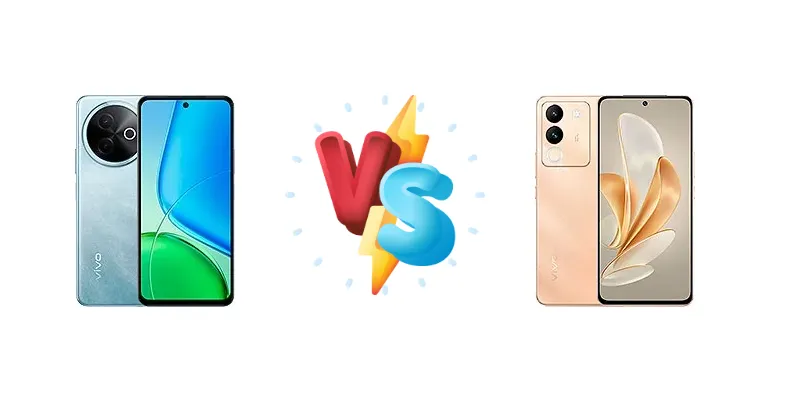
vivo's Y and V series represent distinct approaches to the budget smartphone market. The Y39 focuses on delivering a modern experience at the lowest possible price, while the V29e aims for a slightly more premium feel with added features like 5G connectivity. This comparison dissects the core differences between these two devices, focusing on performance, charging, and overall value.
🏆 Quick Verdict
For the average user prioritizing future-proofing and occasional 5G access, the vivo V29e is the better choice. Its Snapdragon 695 offers a more versatile experience, despite the Y39's newer 4nm process. However, the Y39 remains a compelling option for those on a strict budget who don't need 5G.
| Network |
|---|
| 2G bands | GSM 850 / 900 / 1800 / 1900 | GSM 850 / 900 / 1800 / 1900 |
| 3G bands | HSDPA 850 / 900 / 2100 | HSDPA 850 / 900 / 1700(AWS) / 1900 / 2100 |
| 4G bands | 1, 3, 5, 8, 28, 38, 40, 41 | 1, 2, 3, 4, 5, 7, 8, 18, 19, 20, 26, 28, 38, 39, 40, 41 |
| 5G bands | 1, 3, 5, 8, 28, 40, 77, 78 SA/NSA | 1, 3, 5, 7, 8, 28, 38, 40, 41, 77, 78 SA/NSA |
| Speed | HSPA, LTE, 5G | HSPA, LTE, 5G |
| Technology | GSM / HSPA / LTE / 5G | GSM / HSPA / LTE / 5G |
| Launch |
|---|
| Announced | 2025, March 27 | 2023, October 23 |
| Status | Available. Released 2025, March 27 | Available. Released 2023, October 23 |
| Body |
|---|
| Build | Glass front, plastic frame, plastic back | Glass front, plastic frame, glass back |
| Dimensions | 165.7 x 76.3 x 8.3 mm (6.52 x 3.00 x 0.33 in) | 162.4 x 74.9 x 7.7 mm (6.39 x 2.95 x 0.30 in) |
| SIM | Nano-SIM + Nano-SIM | Nano-SIM + Nano-SIM |
| Weight | 205 g (7.23 oz) | 190 g (6.70 oz) |
| Display |
|---|
| Protection | Schott Glass | - |
| Resolution | 720 x 1608 pixels, 20:9 ratio (~264 ppi density) | 1080 x 2400 pixels, 20:9 ratio (~395 ppi density) |
| Size | 6.68 inches, 107.4 cm2 (~84.9% screen-to-body ratio) | 6.67 inches, 107.4 cm2 (~88.3% screen-to-body ratio) |
| Type | IPS LCD, 120Hz, 1000 nits (HBM) | AMOLED, 120Hz, 1150 nits (peak) |
| Platform |
|---|
| CPU | Octa-core (2x2.2 GHz Cortex-A78 & 6x1.95 GHz Cortex-A55) | Octa-core (2x2.2 GHz Kryo 660 Gold & 6x1.8 GHz Kryo 660 Silver) |
| Chipset | Qualcomm SM4450 Snapdragon 4 Gen 2 (4 nm) | Qualcomm SM6375 Snapdragon 695 5G (6 nm) |
| GPU | Adreno 613 | Adreno 619 |
| OS | Android 15, Funtouch 15 | Android 13, Funtouch 13 |
| Memory |
|---|
| Card slot | No | No |
| Internal | 128GB 8GB RAM, 256GB 8GB RAM | 256GB 8GB RAM, 256GB 12GB RAM |
| Main Camera |
|---|
| Dual | 50 MP, f/1.8, (wide), PDAF
Auxiliary lens | 64 MP, f/1.8, (wide), PDAF, OIS
8 MP, f/2.2, (ultrawide) |
| Features | LED flash, HDR, panorama | Ring-LED flash, panorama, HDR |
| Video | 1080p@30fps | 1080p@30fps |
| Selfie camera |
|---|
| Single | 8 MP, f/2.0, (wide) | 50 MP, f/2.0, 22mm (wide), AF |
| Video | 1080p@30fps | 1080p@30fps |
| Sound |
|---|
| 35mm jack | No | No |
| Loudspeaker | Yes, with stereo speakers | Yes |
| Comms |
|---|
| Bluetooth | 5.0, A2DP, LE | 5.1, A2DP, LE |
| NFC | No | No |
| Positioning | GPS, GALILEO, GLONASS, BDS, QZSS | GPS, GLONASS, GALILEO, BDS, QZSS |
| Radio | No | No |
| USB | USB Type-C 2.0, OTG | USB Type-C 2.0, OTG |
| WLAN | Wi-Fi 802.11 a/b/g/n/ac, dual-band | Wi-Fi 802.11 a/b/g/n/ac, dual-band |
| Features |
|---|
| Sensors | Fingerprint (side-mounted), accelerometer, gyro, proximity, compass | Fingerprint (under display, optical), accelerometer, gyro, proximity, compass |
| Battery |
|---|
| Charging | 44W wired, 74% in 60 min
Reverse wired | 44W wired |
| Type | Si/C Li-Ion 6500 mAh | Li-Ion 4800 mAh |
| Misc |
|---|
| Colors | Lotus Purple, Ocean Blue | Forest Black, Rose Gold, Ice Creek Blue |
| Models | V2443, V2436 | V2317 |
| Price | About 180 EUR | About 320 EUR |
| SAR | 0.99 W/kg (head) 0.98 W/kg (body) | - |
vivo Y39
- More efficient 4nm Snapdragon 4 Gen 2 chipset
- Potentially longer battery life due to efficiency
- Fast 44W charging
- Lacks 5G connectivity
- Potentially lower overall performance compared to the V29e
- Limited information on display quality
vivo V29e
- 5G connectivity for faster data speeds
- Snapdragon 695 offers a performance advantage
- Fast 44W charging
- 6nm process is less efficient than the Y39's 4nm
- Potentially shorter battery life under heavy load
- Limited information on display quality
Display Comparison
Both devices lack detailed display specifications in the provided data. However, given their price points, we can expect both to utilize LCD panels. The absence of information regarding refresh rates or peak brightness suggests neither will be a standout performer in this category. Bezels are likely comparable, typical of this segment. Color accuracy will likely be standard for budget devices, prioritizing power efficiency over color calibration.
Camera Comparison
Without detailed camera specs beyond the chipsets, a direct comparison is limited. Both phones likely feature a multi-camera setup, but the quality will heavily depend on the sensors used. The absence of information suggests neither phone will excel in low-light photography. The 2MP macro cameras commonly found in this price range are unlikely to deliver significant detail. Image processing will likely be tuned for vibrant colors, a common characteristic of vivo’s camera software.
Performance
The core difference lies in the chipsets. The vivo V29e’s Snapdragon 695 5G (6nm) offers 5G connectivity, a significant advantage for users in areas with 5G coverage. While the Y39’s Snapdragon 4 Gen 2 (4nm) boasts a more modern fabrication process, potentially leading to better efficiency, the 695’s Kryo 660 Gold cores provide a performance edge in CPU-intensive tasks. The Y39’s Cortex-A78 cores are powerful, but the 695’s architecture is generally more refined. Both utilize an octa-core configuration, but the 6nm process of the 695, combined with its core design, likely translates to smoother multitasking and gaming. The Y39's 4nm process *should* result in lower heat generation under sustained load, but the 695's overall performance advantage is likely to outweigh this.
Battery Life
Both the vivo Y39 and V29e support 44W wired charging, with the Y39 claiming 74% charge in 60 minutes. This suggests comparable charging speeds in real-world usage. The actual battery capacity isn't specified, but given the target market, we can assume capacities around 5000mAh for both. The Y39’s more efficient Snapdragon 4 Gen 2 *could* translate to slightly longer battery life in typical usage scenarios, but the difference is unlikely to be substantial.
Buying Guide
Buy the vivo Y39 if you need a reliable daily driver for basic tasks like calling, texting, social media, and light web browsing, and 5G connectivity isn't a priority. You'll benefit from a very efficient processor for its class. Buy the vivo V29e if you want a phone capable of handling more demanding apps, enjoy faster download speeds with 5G, and appreciate a slightly more refined user experience.
Frequently Asked Questions
❓ Will the Snapdragon 695 in the V29e handle demanding games like PUBG Mobile smoothly?
The Snapdragon 695 is capable of running PUBG Mobile, but you'll likely need to lower the graphics settings to achieve consistently smooth frame rates. It's not a gaming powerhouse, but it's a step up from the Snapdragon 4 Gen 2 in terms of GPU performance.
❓ Does the 44W charging on either phone support Power Delivery (PD) or Quick Charge?
While both phones support 44W charging, vivo typically uses its own proprietary charging standard. Compatibility with Power Delivery or Quick Charge is unlikely without an adapter specifically designed for vivo devices. Check the included charger specifications for confirmation.
❓ How significant is the difference in efficiency between the 4nm and 6nm chipsets in real-world usage?
The difference in efficiency between the 4nm and 6nm processes will be most noticeable during prolonged, demanding tasks like gaming or video recording. The Y39 should exhibit slightly less heat and potentially longer battery life in these scenarios, but for typical daily use, the difference will be minimal.
❓ Is the lack of 5G on the Y39 a major drawback in 2024?
Whether the lack of 5G is a major drawback depends entirely on your location and carrier. If 5G coverage is limited or unavailable in your area, it won't make a difference. However, if you live in a city with widespread 5G access, the V29e's connectivity will provide a noticeable improvement in download and streaming speeds.