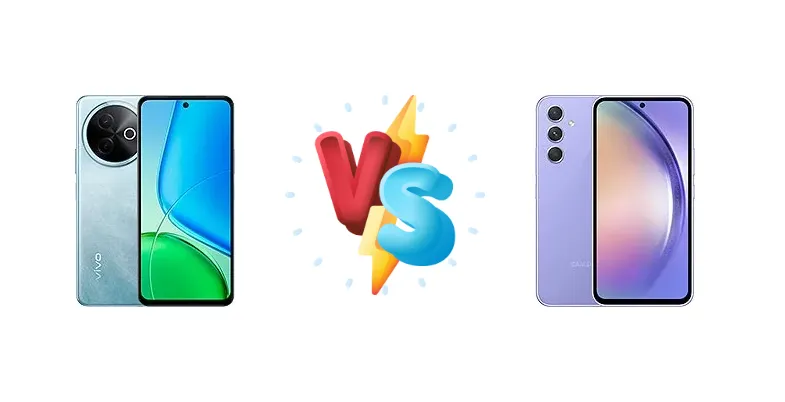
The mid-range smartphone market is fiercely competitive, and the vivo Y39 and Samsung Galaxy A54 represent compelling options for budget-conscious buyers. The Y39, powered by Qualcomm's Snapdragon 4 Gen 2, aims for efficiency and fast charging, while the A54 leverages Samsung's Exynos 1380 and a reputation for a strong all-around experience. This comparison dives deep into the specifics to determine which device delivers the best value.
🏆 Quick Verdict
For the average user prioritizing a vibrant display and established brand ecosystem, the Samsung Galaxy A54 is the better choice. However, the vivo Y39 offers significantly faster 44W charging and a more efficient processor, making it ideal for users who prioritize battery top-ups and sustained performance over peak power.
| Network |
|---|
| 2G bands | GSM 850 / 900 / 1800 / 1900 | GSM 850 / 900 / 1800 / 1900 |
| 3G bands | HSDPA 850 / 900 / 2100 | HSDPA 850 / 900 / 1700(AWS) / 1900 / 2100 |
| 4G bands | 1, 3, 5, 8, 28, 38, 40, 41 | 1, 2, 3, 4, 5, 7, 8, 12, 17, 20, 26, 28, 32, 38, 40, 41, 66 - International |
| 5G bands | 1, 3, 5, 8, 28, 40, 77, 78 SA/NSA | 1, 3, 7, 8, 20, 28, 38, 40, 41, 77, 78 SA/NSA/Sub6 - International |
| Speed | HSPA, LTE, 5G | HSPA, LTE, 5G |
| Technology | GSM / HSPA / LTE / 5G | GSM / HSPA / LTE / 5G |
| | - | 25, 41, 66, 71 SA/NSA/Sub6/mmWave - USA |
| Launch |
|---|
| Announced | 2025, March 27 | 2023, March 15 |
| Status | Available. Released 2025, March 27 | Available. Released 2023, March 24 |
| Body |
|---|
| Build | Glass front, plastic frame, plastic back | Glass front (Gorilla Glass 5), glass back (Gorilla Glass 5), plastic frame |
| Dimensions | 165.7 x 76.3 x 8.3 mm (6.52 x 3.00 x 0.33 in) | 158.2 x 76.7 x 8.2 mm (6.23 x 3.02 x 0.32 in) |
| SIM | Nano-SIM + Nano-SIM | · Nano-SIM + eSIM· Nano-SIM + Nano-SIM |
| Weight | 205 g (7.23 oz) | 202 g (7.13 oz) |
| | - | IP67 dust/water resistant (up to 1m for 30 min) |
| Display |
|---|
| Protection | Schott Glass | Corning Gorilla Glass 5 |
| Resolution | 720 x 1608 pixels, 20:9 ratio (~264 ppi density) | 1080 x 2340 pixels, 19.5:9 ratio (~403 ppi density) |
| Size | 6.68 inches, 107.4 cm2 (~84.9% screen-to-body ratio) | 6.4 inches, 100.5 cm2 (~82.9% screen-to-body ratio) |
| Type | IPS LCD, 120Hz, 1000 nits (HBM) | Super AMOLED, 120Hz, HDR10+, 1000 nits (HBM) |
| Platform |
|---|
| CPU | Octa-core (2x2.2 GHz Cortex-A78 & 6x1.95 GHz Cortex-A55) | Octa-core (4x2.4 GHz Cortex-A78 & 4x2.0 GHz Cortex-A55) |
| Chipset | Qualcomm SM4450 Snapdragon 4 Gen 2 (4 nm) | Exynos 1380 (5 nm) |
| GPU | Adreno 613 | Mali-G68 MP5 |
| OS | Android 15, Funtouch 15 | Android 13, up to 4 major Android upgrades, One UI 7 |
| Memory |
|---|
| Card slot | No | microSDXC (uses shared SIM slot) |
| Internal | 128GB 8GB RAM, 256GB 8GB RAM | 128GB 4GB RAM, 128GB 6GB RAM, 128GB 8GB RAM, 256GB 6GB RAM, 256GB 8GB RAM |
| Main Camera |
|---|
| Dual | 50 MP, f/1.8, (wide), PDAF
Auxiliary lens | - |
| Features | LED flash, HDR, panorama | LED flash, panorama, HDR |
| Single | - | 32 MP, f/2.2, 26mm (wide), 1/2.8", 0.8µm |
| Triple | - | 50 MP, f/1.8, 23mm (wide), 1/1.56", 1.0µm, PDAF, OIS
12 MP, f/2.2, 13mm, 123˚ (ultrawide), 1/3.X", 1.12µm
5 MP (macro) |
| Video | 1080p@30fps | 4K@30fps, 1080p@30/60fps, 720p@480fps, gyro-EIS |
| Selfie camera |
|---|
| Single | 8 MP, f/2.0, (wide) | 32 MP, f/2.2, 26mm (wide), 1/2.8", 0.8µm |
| Video | 1080p@30fps | 4K@30fps, 1080p@30/60fps |
| Sound |
|---|
| 3.5mm jack | - | No |
| 35mm jack | No | No |
| Loudspeaker | Yes, with stereo speakers | Yes, with stereo speakers |
| Comms |
|---|
| Bluetooth | 5.0, A2DP, LE | 5.3, A2DP, LE |
| NFC | No | Yes (market/region dependent) |
| Positioning | GPS, GALILEO, GLONASS, BDS, QZSS | GPS, GLONASS, GALILEO, BDS |
| Radio | No | No |
| USB | USB Type-C 2.0, OTG | USB Type-C 2.0, OTG |
| WLAN | Wi-Fi 802.11 a/b/g/n/ac, dual-band | Wi-Fi 802.11 a/b/g/n/ac/6, dual-band, Wi-Fi Direct |
| Features |
|---|
| Sensors | Fingerprint (side-mounted), accelerometer, gyro, proximity, compass | Fingerprint (under display, optical), accelerometer, gyro, compass, barometer (USA only) |
| | - | Virtual proximity sensing |
| Battery |
|---|
| Charging | 44W wired, 74% in 60 min
Reverse wired | 25W wired |
| Type | Si/C Li-Ion 6500 mAh | 5000 mAh |
| Misc |
|---|
| Colors | Lotus Purple, Ocean Blue | Lime, Graphite, Violet, White |
| Models | V2443, V2436 | SM-A546V, SM-A546U, SM-A546U1, SM-A546B, SM-A546B/DS, SM-A546E, SM-A546E/DS, SM-A5460, SM-A546M, SM-A546M/DS, SM-A546W |
| Price | About 180 EUR | € 210.00 / $ 119.11 / £ 169.95 / ₹ 28,999 |
| SAR | 0.99 W/kg (head) 0.98 W/kg (body) | 0.81 W/kg (head) 0.67 W/kg (body) |
| SAR EU | - | 0.69 W/kg (head) 1.34 W/kg (body) |
| Tests |
|---|
| Battery life | - |
Endurance rating 119h
|
| Camera | - |
Photo / Video |
| Display | - |
Contrast ratio: Infinite (nominal) |
| Loudspeaker | - |
-26.6 LUFS (Good)
|
| Performance | - |
AnTuTu: 506678 (v9)
GeekBench: 2703 (v5.1), 2797 (v6)
GFXBench: 25fps (ES 3.1 onscreen) |
vivo Y39
- 44W Fast Charging: Significantly faster top-ups.
- Efficient Snapdragon 4 Gen 2: Better thermal management potential.
- Reverse Wired Charging: Can charge other devices.
- Display Specs Unknown: Likely inferior to the A54.
- Camera Details Limited: Image quality is uncertain.
Samsung Galaxy A54
- Bright and Vibrant Display: 980 nits peak brightness.
- Established Brand Reputation: Samsung’s strong ecosystem.
- Excellent Battery Life: 119-hour endurance rating.
- Slower 25W Charging: Takes longer to fully charge.
- Exynos 1380 Throttling: Potential for performance drops under sustained load.
Display Comparison
The Samsung Galaxy A54 boasts a significantly brighter display, reaching a measured 980 nits, compared to an unstated value for the vivo Y39. While the Y39’s display specs are unknown, the A54’s high peak brightness ensures excellent visibility outdoors. The A54 also benefits from Samsung’s ‘Infinite’ contrast ratio, suggesting a superior viewing experience with deeper blacks. The lack of LTPO technology on either device means refresh rate scaling isn’t as efficient as on flagship models, but the A54’s panel quality is a clear advantage.
Camera Comparison
Both devices offer photo and video capabilities, but detailed sensor information is lacking for the vivo Y39. The Samsung Galaxy A54 likely benefits from Samsung’s image processing expertise and potentially a larger main sensor (though specifics are unavailable). The inclusion of Optical Image Stabilization (OIS) on the A54 is a significant advantage for sharper photos and smoother videos, especially in low light. The Y39’s camera system is likely geared towards general use, while the A54 aims for a more refined and versatile photography experience.
Performance
The Samsung Galaxy A54’s Exynos 1380 (5nm) has a slight edge in raw CPU power with its 4x2.4 GHz Cortex-A78 cores versus the vivo Y39’s 2x2.2 GHz Cortex-A78 cores. However, the Snapdragon 4 Gen 2 (4nm) in the Y39 is built on a more efficient node, potentially leading to better thermal management and sustained performance during extended use. Both utilize Cortex-A55 cores for efficiency, but the Y39’s 4nm process could mitigate throttling better in demanding scenarios. The A54’s performance will be noticeable in heavier tasks, but the Y39’s efficiency is a key differentiator.
Battery Life
The Samsung Galaxy A54 achieves an impressive endurance rating of 119 hours and a real-world active use score of 11:15h, indicating excellent battery life. However, the vivo Y39 counters with significantly faster 44W wired charging, capable of reaching 74% charge in just 60 minutes, compared to the A54’s slower 25W charging. While the A54’s battery capacity isn’t specified, the Y39’s faster charging is a major convenience factor for users who dislike long charging times. The Y39 also offers reverse wired charging, a feature absent on the A54.
Buying Guide
Buy the vivo Y39 if you need a phone that charges incredibly quickly and offers solid, efficient performance for everyday tasks and light gaming. It’s the pick for users who frequently find themselves needing a fast power boost. Buy the Samsung Galaxy A54 if you prefer a brighter, more visually appealing display, a more refined software experience, and the peace of mind that comes with Samsung’s established brand and support network. It’s best for multimedia consumption and users invested in the Samsung ecosystem.
Frequently Asked Questions
❓ Does the Exynos 1380 in the Galaxy A54 tend to overheat during prolonged gaming sessions?
The Exynos 1380 is known to exhibit some throttling under sustained load, particularly in graphically demanding games. While it won't shut down, users may experience frame rate drops after extended play. The vivo Y39’s Snapdragon 4 Gen 2, built on a more efficient 4nm process, is less prone to overheating and may offer more consistent performance over longer periods.
❓ Is the 44W charging on the vivo Y39 compatible with Power Delivery (PD) chargers?
While vivo doesn't explicitly state PD compatibility, the Y39 supports standard Quick Charge protocols. Using a PD charger *may* work, but it's not guaranteed to deliver the full 44W. It's recommended to use the charger included in the box or a charger specifically designed for vivo devices to ensure optimal charging speeds.
❓ How does the camera performance of the vivo Y39 compare to the Samsung Galaxy A54 in low-light conditions?
Given the limited information about the vivo Y39’s camera sensors and features, it’s difficult to make a direct comparison. However, the Samsung Galaxy A54 likely performs better in low light due to its potential for OIS and Samsung’s advanced image processing algorithms, which are designed to reduce noise and improve detail in challenging lighting conditions.
❓ What kind of storage and RAM options are available for each device?
Specific storage and RAM configurations vary by region. However, the Samsung Galaxy A54 typically comes in configurations of 6GB or 8GB of RAM and 128GB or 256GB of storage. The vivo Y39 is generally available with 6GB of RAM and 128GB of storage, with microSD card support for expansion on both devices.