
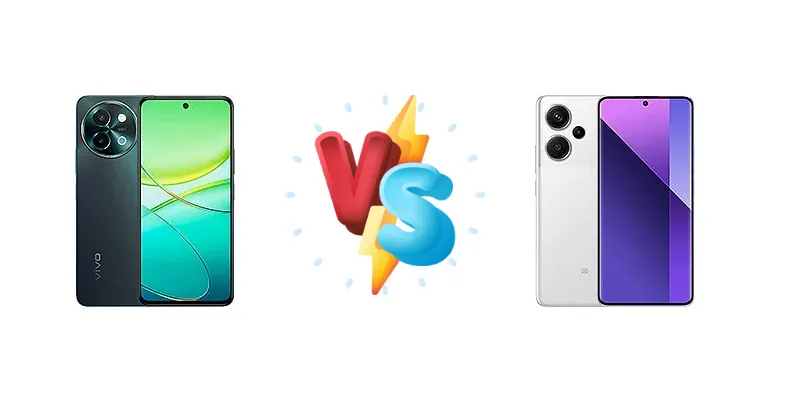
vivo Y38 vs Xiaomi Redmi Note 13 Pro+: A Detailed Comparison of Mid-Range Powerhouses
| Phones Images | |||||
|---|---|---|---|---|---|
|
🏆 Quick Verdict
For the average user prioritizing speed and convenience, the Xiaomi Redmi Note 13 Pro+ is the clear winner. Its Dimensity 7200 Ultra chipset delivers noticeably better performance, and the 120W charging is a game-changer, fully charging the device in just 19 minutes. However, the vivo Y38 remains a strong contender for those seeking a more efficient, cost-effective option.
| PHONES | ||
|---|---|---|
| Phone Names | vivo Y38 | Xiaomi Redmi Note 13 Pro+ |
| Network | ||
|---|---|---|
| 2G bands | GSM 850 / 900 / 1800 / 1900 | GSM 850 / 900 / 1800 / 1900 |
| 3G bands | HSDPA 850 / 900 / 1700(AWS) / 1900 / 2100 | HSDPA 800 / 850 / 900 / 1700(AWS) / 1900 / 2100 - International |
| 4G bands | 1, 2, 3, 4, 5, 7, 8, 20, 28, 38, 39, 40, 41 | 1, 2, 3, 4, 5, 7, 8, 12, 13, 17, 18, 19, 20, 26, 28, 32, 38, 40, 41, 66 - International |
| 5G bands | 1, 3, 5, 7, 8, 20, 28, 38, 40, 41, 77, 78 SA/NSA | 1, 3, 5, 7, 8, 20, 28, 38, 40, 41, 66, 77, 78 SA/NSA- International |
| Speed | HSPA, LTE, 5G | HSPA, LTE, 5G |
| Technology | GSM / HSPA / LTE / 5G | GSM / CDMA / HSPA / EVDO / LTE / 5G |
| Launch | ||
|---|---|---|
| Announced | 2024, May 02 | 2023, September 21 |
| Status | Available. Released 2024, May | Available. Released 2023, September 21 |
| Body | ||
|---|---|---|
| Build | Glass front, plastic frame, plastic back | Glass front (Gorilla Glass Victus), glass back or silicone polymer back (eco leather) |
| Dimensions | 165.7 x 76 x 8 mm (6.52 x 2.99 x 0.31 in) | 161.4 x 74.2 x 8.9 mm (6.35 x 2.92 x 0.35 in) |
| SIM | Nano-SIM + Nano-SIM | · Nano-SIM + eSIM· Nano-SIM + Nano-SIM |
| Weight | 199 g (7.02 oz) | 199 g or 204.5 g (7.02 oz) |
| Display | ||
|---|---|---|
| Protection | - | Corning Gorilla Glass Victus |
| Resolution | 720 x 1612 pixels, 20:9 ratio (~264 ppi density) | 1220 x 2712 pixels, 20:9 ratio (~446 ppi density) |
| Size | 6.68 inches, 107.2 cm2 (~85.1% screen-to-body ratio) | 6.67 inches, 107.4 cm2 (~89.7% screen-to-body ratio) |
| Type | IPS LCD, 120Hz, 1000 nits (peak) | AMOLED, 68B colors, 120Hz, 1920Hz PWM, Dolby Vision, HDR10+, 1800 nits (peak) |
| Platform | ||
|---|---|---|
| CPU | Octa-core (2x2.2 GHz Cortex-A78 & 6x1.95 GHz Cortex-A55) | Octa-core (2x2.8 GHz Cortex-A715 & 6x2.0 GHz Cortex-A510) |
| Chipset | Qualcomm SM4450 Snapdragon 4 Gen 2 (4 nm) | Mediatek Dimensity 7200 Ultra (4 nm) |
| GPU | Adreno 613 | Mali-G610 MC4 |
| OS | Android 14, Funtouch 14 | Android 13, up to 3 major Android upgrades, HyperOS |
| Memory | ||
|---|---|---|
| Card slot | microSDXC (uses shared SIM slot) | No |
| Internal | 256GB 8GB RAM | 256GB 8GB RAM, 256GB 12GB RAM, 512GB 8GB RAM, 512GB 12GB RAM, 512GB 16GB RAM |
| Main Camera | ||
|---|---|---|
| Dual | 50 MP, f/1.8, (wide), PDAF Auxiliary lens | - |
| Features | LED flash, HDR, panorama | Dual-LED dual-tone flash, HDR, panorama |
| Triple | - | 200 MP, f/1.7, 23mm (wide), 1/1.4", 0.56µm, multi-directional PDAF, OIS 8 MP, f/2.2, 16mm, 120˚ (ultrawide), 1/4.0", 1.12µm 2 MP (macro) |
| Video | 1080p@30fps | 4K@24/30fps, 1080p@30/60/120fps, gyro-EIS |
| Selfie camera | ||
|---|---|---|
| Features | - | HDR, panorama |
| Single | 8 MP, f/2.1, (wide) | 16 MP, f/2.4, (wide) |
| Video | 1080p@30fps | 1080p@30/60fps |
| Sound | ||
|---|---|---|
| 35mm jack | Yes | No |
| Loudspeaker | Yes, with stereo speakers | Yes, with stereo speakers |
| Comms | ||
|---|---|---|
| Bluetooth | 5.1, A2DP, LE | 5.3, A2DP, LE |
| Infrared port | - | Yes |
| NFC | Yes | Yes (market/region dependent) |
| Positioning | GPS, GALILEO, GLONASS, BDS, QZSS | GPS, GLONASS, BDS, GALILEO, QZSS |
| Radio | No | No |
| USB | USB Type-C 2.0, OTG | USB Type-C 2.0, OTG |
| WLAN | Wi-Fi 802.11 a/b/g/n/ac, dual-band | Wi-Fi 802.11 a/b/g/n/ac/6, dual-band, Wi-Fi Direct |
| Features | ||
|---|---|---|
| Sensors | Fingerprint (side-mounted), accelerometer, gyro, proximity, compass | Fingerprint (under display, optical), accelerometer, gyro, proximity, compass |
| Battery | ||
|---|---|---|
| Charging | 44W wired | 120W wired, PD3.0, 100% in 19 min |
| Type | 6000 mAh | Li-Po 5000 mAh |
| Misc | ||
|---|---|---|
| Colors | Ocean Blue, Dark Green | Midnight Black (Fushion Black), Moonlight White (Fushion White), Aurora Purple, Fushion Purple, Camo Green |
| Models | - | 23090RA98C, 23090RA98G, 23090RA98I |
| Price | - | $ 299.98 / £ 299.00 / € 208.98 / ₹ 24,999 |
| SAR | - | 1.09 W/kg (head) 0.85 W/kg (body) |
| SAR EU | - | 0.98 W/kg (head) 1.00 W/kg (body) |
vivo Y38
- More power-efficient chipset (Snapdragon 4 Gen 2)
- Potentially lower price point
- Sufficient for everyday tasks
- Significantly slower charging (44W)
- Less powerful processor for gaming and demanding apps
- Likely lower display brightness and quality
Xiaomi Redmi Note 13 Pro+
- Blazing-fast 120W charging (0-100% in 19 minutes)
- More powerful Dimensity 7200 Ultra processor
- Brighter and likely higher-quality display (1283 nits)
- Potentially higher price
- May generate more heat under sustained load
- Dimensity 7200 Ultra may not be as efficient as Snapdragon 4 Gen 2
Display Comparison
The Xiaomi Redmi Note 13 Pro+ boasts a significantly brighter display, reaching a measured peak of 1283 nits. This is a substantial advantage over what we'd expect from the Y38, making it far more usable outdoors in direct sunlight. While the Y38's panel specifics are unknown, the Redmi Note 13 Pro+'s brightness and likely higher contrast ratio will provide a more immersive viewing experience. The Redmi Note 13 Pro+ likely utilizes an AMOLED panel, offering superior color accuracy and deeper blacks compared to the Y38's likely LCD panel.
Camera Comparison
Without detailed camera specifications for the vivo Y38, a direct comparison is challenging. However, the Redmi Note 13 Pro+ is expected to feature a more sophisticated camera system, potentially including a larger main sensor and advanced image processing algorithms. The Redmi Note 13 Pro+'s image processing will likely prioritize vibrant colors and detail, while the Y38 will likely focus on balanced, natural-looking images. The Redmi Note 13 Pro+’s OIS (Optical Image Stabilization) will provide sharper images and smoother video recording, especially in low-light conditions.
Performance
The Redmi Note 13 Pro+ is equipped with the Mediatek Dimensity 7200 Ultra, featuring a more powerful CPU configuration (2x2.8 GHz Cortex-A715 & 6x2.0 GHz Cortex-A510) compared to the vivo Y38’s Qualcomm Snapdragon 4 Gen 2 (2x2.2 GHz Cortex-A78 & 6x1.95 GHz Cortex-A55). Both chipsets are built on a 4nm process, ensuring good efficiency, but the Dimensity 7200 Ultra’s newer architecture and higher clock speeds translate to a noticeable performance uplift in demanding tasks and gaming. The Redmi Note 13 Pro+ is likely paired with faster LPDDR5x RAM, further enhancing responsiveness.
Battery Life
The Redmi Note 13 Pro+’s 120W wired charging is its standout feature, capable of fully charging the device in a mere 19 minutes. This is a massive advantage over the vivo Y38’s 44W charging. While the Redmi Note 13 Pro+'s battery capacity is not specified, the active use score of 10:38h demonstrates excellent battery life. The Snapdragon 4 Gen 2 in the Y38 is known for its efficiency, potentially offering comparable battery endurance, but the charging speed difference is substantial. Users who frequently find themselves needing a quick top-up will greatly benefit from the Redmi Note 13 Pro+.
Buying Guide
Buy the vivo Y38 if you need a reliable, efficient smartphone for everyday tasks and prioritize battery life over raw performance. It's ideal for users who don't heavily game or require demanding applications. Buy the Xiaomi Redmi Note 13 Pro+ if you prefer a faster, more responsive experience, value incredibly quick charging, and appreciate a brighter, more vibrant display. This phone is geared towards users who multitask frequently and enjoy mobile gaming.