
vivo Y38 vs Samsung Galaxy A55: A Detailed Mid-Range Showdown
| Phones Images | |||||
|---|---|---|---|---|---|
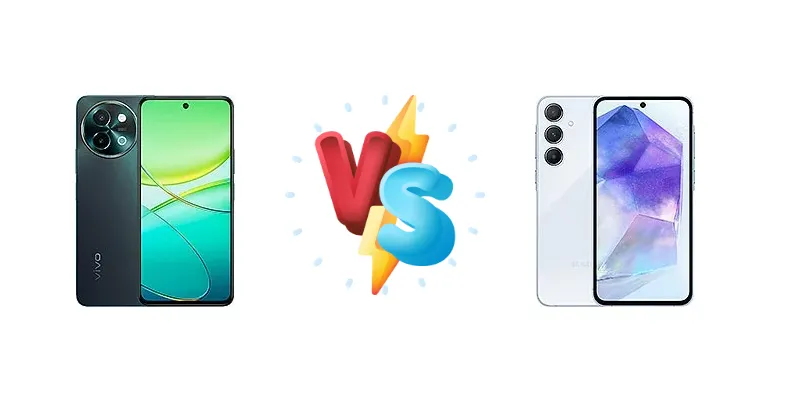
|
🏆 Quick Verdict
For the average user prioritizing display quality and long-term software support, the Samsung Galaxy A55 is the better choice. Its brighter 1010 nit display and proven Exynos 1480 chipset offer a smoother, more visually appealing experience. However, the vivo Y38 provides excellent value with its 44W charging and efficient Snapdragon 4 Gen 2, making it ideal for users on a tighter budget.
| PHONES | ||
|---|---|---|
| Phone Names | vivo Y38 | Samsung Galaxy A55 |
| Network | ||
|---|---|---|
| 2G bands | GSM 850 / 900 / 1800 / 1900 | GSM 850 / 900 / 1800 / 1900 |
| 3G bands | HSDPA 850 / 900 / 1700(AWS) / 1900 / 2100 | HSDPA 850 / 900 / 1700(AWS) / 1900 / 2100 |
| 4G bands | 1, 2, 3, 4, 5, 7, 8, 20, 28, 38, 39, 40, 41 | 1, 2, 3, 4, 5, 7, 8, 12, 17, 20, 25, 26, 28, 32, 38, 40, 41, 66 |
| 5G bands | 1, 3, 5, 7, 8, 20, 28, 38, 40, 41, 77, 78 SA/NSA | 1, 3, 5, 7, 8, 20, 28, 38, 40, 41, 66, 77, 78 SA/NSA/Sub6 |
| Speed | HSPA, LTE, 5G | HSPA, LTE, 5G |
| Technology | GSM / HSPA / LTE / 5G | GSM / HSPA / LTE / 5G |
| Launch | ||
|---|---|---|
| Announced | 2024, May 02 | 2024, March 11 |
| Status | Available. Released 2024, May | Available. Released 2024, March 15 |
| Body | ||
|---|---|---|
| Build | Glass front, plastic frame, plastic back | Glass front (Gorilla Glass Victus+), glass back (Gorilla Glass), aluminum frame |
| Dimensions | 165.7 x 76 x 8 mm (6.52 x 2.99 x 0.31 in) | 161.1 x 77.4 x 8.2 mm (6.34 x 3.05 x 0.32 in) |
| SIM | Nano-SIM + Nano-SIM | · Nano-SIM· Nano-SIM + eSIM· Nano-SIM + Nano-SIM· Nano-SIM + Nano-SIM + eSIM (max 2 at a time) |
| Weight | 199 g (7.02 oz) | 213 g (7.51 oz) |
| Display | ||
|---|---|---|
| Protection | - | Corning Gorilla Glass Victus+ |
| Resolution | 720 x 1612 pixels, 20:9 ratio (~264 ppi density) | 1080 x 2340 pixels, 19.5:9 ratio (~390 ppi density) |
| Size | 6.68 inches, 107.2 cm2 (~85.1% screen-to-body ratio) | 6.6 inches, 106.9 cm2 (~85.8% screen-to-body ratio) |
| Type | IPS LCD, 120Hz, 1000 nits (peak) | Super AMOLED, 120Hz, HDR10+, 1000 nits (HBM) |
| Platform | ||
|---|---|---|
| CPU | Octa-core (2x2.2 GHz Cortex-A78 & 6x1.95 GHz Cortex-A55) | Octa-core (4x2.75 GHz Cortex-A78 & 4x2.0 GHz Cortex-A55) |
| Chipset | Qualcomm SM4450 Snapdragon 4 Gen 2 (4 nm) | Exynos 1480 (4 nm) |
| GPU | Adreno 613 | Xclipse 530 |
| OS | Android 14, Funtouch 14 | Android 14, up to 4 major Android upgrades, One UI 6.1 |
| Memory | ||
|---|---|---|
| Card slot | microSDXC (uses shared SIM slot) | microSDXC (uses shared SIM slot) |
| Internal | 256GB 8GB RAM | 128GB 6GB RAM, 128GB 8GB RAM, 256GB 6GB RAM, 256GB 8GB RAM, 256GB 12GB RAM |
| Main Camera | ||
|---|---|---|
| Dual | 50 MP, f/1.8, (wide), PDAF Auxiliary lens | - |
| Features | LED flash, HDR, panorama | LED flash, panorama, HDR |
| Triple | - | 50 MP, f/1.8, (wide), 1/1.56", 1.0µm, PDAF, OIS 12 MP, f/2.2, 123˚ (ultrawide), 1/3.06", 1.12µm 5 MP (macro) |
| Video | 1080p@30fps | 4K@30fps, 1080p@30/60fps, gyro-EIS |
| Selfie camera | ||
|---|---|---|
| Single | 8 MP, f/2.1, (wide) | 32 MP, f/2.2, 26mm (wide), 1/2.74", 0.8µm |
| Video | 1080p@30fps | 4K@30fps, 1080p@30/60fps |
| Sound | ||
|---|---|---|
| 35mm jack | Yes | No |
| Loudspeaker | Yes, with stereo speakers | Yes, with stereo speakers |
| Comms | ||
|---|---|---|
| Bluetooth | 5.1, A2DP, LE | 5.3, A2DP, LE |
| NFC | Yes | Yes (market/region dependent) |
| Positioning | GPS, GALILEO, GLONASS, BDS, QZSS | GPS, GALILEO, GLONASS, BDS, QZSS |
| Radio | No | No |
| USB | USB Type-C 2.0, OTG | USB Type-C 2.0, OTG |
| WLAN | Wi-Fi 802.11 a/b/g/n/ac, dual-band | Wi-Fi 802.11 a/b/g/n/ac/6, dual-band, Wi-Fi Direct |
| Features | ||
|---|---|---|
| Sensors | Fingerprint (side-mounted), accelerometer, gyro, proximity, compass | Fingerprint (under display, optical), accelerometer, gyro, compass |
| Battery | ||
|---|---|---|
| Charging | 44W wired | 25W wired |
| Type | 6000 mAh | Li-Ion 5000 mAh |
| Misc | ||
|---|---|---|
| Colors | Ocean Blue, Dark Green | Iceblue, Lilac, Navy, Lemon |
| Models | - | SM-A556V, SM-A556B, SM-A556B/DS, SM-A556E, SM-A556E/DS, SM-A5560 |
| Price | - | $ 324.99 / £ 251.50 / € 319.99 / ₹ 23,998 |
| SAR EU | - | 0.68 W/kg (head) 1.04 W/kg (body) |
vivo Y38
- Faster 44W wired charging
- More affordable price point
- Efficient Snapdragon 4 Gen 2 chipset
- Likely lower display brightness
- Potentially less powerful CPU performance
Samsung Galaxy A55
- Brighter 1010 nit display
- More powerful Exynos 1480 processor
- Longer battery life (13:27h active use)
- Slower 25W wired charging
- Higher price tag
Display Comparison
The Samsung Galaxy A55 immediately pulls ahead in the display department with a measured peak brightness of 1010 nits. This significantly surpasses what we’d expect from the Y38, offering superior visibility outdoors. While the Y38’s panel specifics are unknown, the A55’s brightness advantage translates to a more enjoyable viewing experience in all lighting conditions. The A55 likely utilizes a Super AMOLED panel, known for its vibrant colors and deep blacks, while the Y38 likely uses an IPS LCD. The A55’s display is also likely to have a higher contrast ratio, further enhancing image quality.
Camera Comparison
Without detailed camera specs for the vivo Y38, a direct comparison is challenging. However, Samsung typically invests heavily in image processing, and the A55 likely benefits from this. The A55’s image processing algorithms are likely more refined, resulting in better dynamic range and noise reduction. While the Y38 may offer a decent camera experience for casual users, the A55 is expected to deliver more consistent and higher-quality photos and videos, especially in challenging lighting conditions. We can assume the A55 will have better video stabilization and potentially more advanced features like Pro mode.
Performance
Both phones utilize 4nm chipsets, but the Samsung Galaxy A55’s Exynos 1480 boasts a more powerful CPU configuration: 4x2.75 GHz Cortex-A78 cores versus the vivo Y38’s 2x2.2 GHz Cortex-A78 cores. This translates to faster application loading times and smoother multitasking on the A55. While both use Cortex-A55 efficiency cores (6x1.95 GHz on the Y38, 4x2.0 GHz on the A55), the A55’s higher clock speeds and core count give it a clear performance edge. The Snapdragon 4 Gen 2 in the Y38 is optimized for efficiency, making it suitable for everyday tasks, but will struggle with demanding games compared to the A55.
Battery Life
The Samsung Galaxy A55 demonstrates impressive battery life, achieving 13 hours and 27 minutes of active use. While the Y38’s battery capacity is unknown, the A55’s longevity is a significant advantage. The Y38 compensates with faster 44W wired charging, potentially offering quicker top-ups compared to the A55’s 25W charging. However, the A55’s superior efficiency and larger battery (likely around 5000mAh) mean it will likely last a full day even with heavy usage, while the Y38 may require a mid-day charge for power users.
Buying Guide
Buy the vivo Y38 if you need a reliable daily driver with fast charging and prioritize value for money. It’s perfect for users who frequently consume media on the go and need a phone that can keep up without breaking the bank. Buy the Samsung Galaxy A55 if you prefer a brighter, more vibrant display, a more polished software experience, and are willing to pay a premium for Samsung’s ecosystem and longer software update commitment.