
vivo Y38 vs Motorola Edge 50 Pro: A Detailed Comparison of Mid-Range Powerhouses
| Phones Images | |||||
|---|---|---|---|---|---|
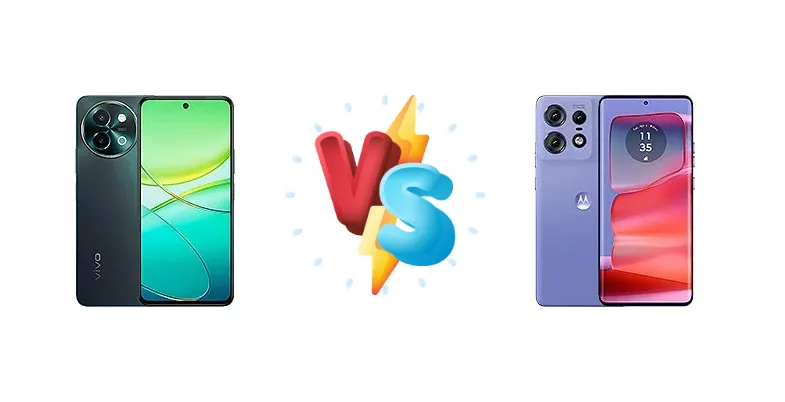
|
🏆 Quick Verdict
For the average user prioritizing all-around performance and rapid charging, the Motorola Edge 50 Pro is the clear winner. Its Snapdragon 7 Gen 3 chipset, coupled with 125W charging and a brighter display, offers a more premium experience. However, the vivo Y38 remains a viable option for budget-conscious users who value efficiency and a more streamlined experience.
| PHONES | ||
|---|---|---|
| Phone Names | vivo Y38 | Motorola Edge 50 Pro |
| Network | ||
|---|---|---|
| 2G bands | GSM 850 / 900 / 1800 / 1900 | GSM 850 / 900 / 1800 / 1900 |
| 3G bands | HSDPA 850 / 900 / 1700(AWS) / 1900 / 2100 | HSDPA 850 / 900 / 1700(AWS) / 1900 / 2100 |
| 4G bands | 1, 2, 3, 4, 5, 7, 8, 20, 28, 38, 39, 40, 41 | 1, 2, 3, 4, 5, 7, 8, 12, 13, 17, 18, 19, 20, 26, 28, 32, 38, 39, 40, 41, 43, 48, 66 |
| 5G bands | 1, 3, 5, 7, 8, 20, 28, 38, 40, 41, 77, 78 SA/NSA | 1, 2, 3, 5, 7, 8, 20, 26, 28, 38, 40, 41, 66, 77, 78 SA/NSA/Sub6 |
| Speed | HSPA, LTE, 5G | HSPA, LTE, 5G |
| Technology | GSM / HSPA / LTE / 5G | GSM / HSPA / LTE / 5G |
| Launch | ||
|---|---|---|
| Announced | 2024, May 02 | 2024, April 03 |
| Status | Available. Released 2024, May | Available. Released 2024, April 08 |
| Body | ||
|---|---|---|
| Build | Glass front, plastic frame, plastic back | Glass front, plastic back or silicone polymer back (eco leather), aluminum frame |
| Dimensions | 165.7 x 76 x 8 mm (6.52 x 2.99 x 0.31 in) | 161.2 x 72.4 x 8.2 mm (6.35 x 2.85 x 0.32 in) |
| SIM | Nano-SIM + Nano-SIM | · Nano-SIM + eSIM· Nano-SIM + Nano-SIM |
| Weight | 199 g (7.02 oz) | 186 g (6.56 oz) |
| Display | ||
|---|---|---|
| Protection | - | Corning Gorilla Glass (unspecified version) |
| Resolution | 720 x 1612 pixels, 20:9 ratio (~264 ppi density) | 1220 x 2712 pixels, 20:9 ratio (~446 ppi density) |
| Size | 6.68 inches, 107.2 cm2 (~85.1% screen-to-body ratio) | 6.7 inches, 107.4 cm2 (~92.0% screen-to-body ratio) |
| Type | IPS LCD, 120Hz, 1000 nits (peak) | P-OLED, 1B colors, 144Hz, HDR10+, 2000 nits (peak) |
| Platform | ||
|---|---|---|
| CPU | Octa-core (2x2.2 GHz Cortex-A78 & 6x1.95 GHz Cortex-A55) | Octa-core (1x2.63 GHz Cortex-A715 & 4x2.4 GHz Cortex-A715 & 3x1.8 GHz Cortex-A510) |
| Chipset | Qualcomm SM4450 Snapdragon 4 Gen 2 (4 nm) | Qualcomm SM7550-AB Snapdragon 7 Gen 3 (4 nm) |
| GPU | Adreno 613 | Adreno 720 |
| OS | Android 14, Funtouch 14 | Android 14, up to 3 major Android upgrades |
| Memory | ||
|---|---|---|
| Card slot | microSDXC (uses shared SIM slot) | No |
| Internal | 256GB 8GB RAM | 128GB 8GB RAM, 256GB 8GB RAM, 256GB 12GB RAM, 512GB 12GB RAM |
| Main Camera | ||
|---|---|---|
| Dual | 50 MP, f/1.8, (wide), PDAF Auxiliary lens | - |
| Features | LED flash, HDR, panorama | Laser AF, LED flash, panorama, HDR |
| Triple | - | 50 MP, f/1.4, 25mm (wide), 1/1.55", 1.0µm, multi-directional PDAF, OIS 10 MP, f/2.0, 67mm (telephoto), 1/3.94", 1.0µm, PDAF, OIS, 3x optical zoom 13 MP, f/2.2, 16mm, 120˚ (ultrawide), 1/3.0", 1.12µm, PDAF |
| Video | 1080p@30fps | 4K@30fps, 1080p@30/60/120/240fps, 10-bit HDR10+, gyro-EIS |
| Selfie camera | ||
|---|---|---|
| Features | - | HDR |
| Single | 8 MP, f/2.1, (wide) | 50 MP, f/1.9, 21mm (wide), 0.64µm, AF |
| Video | 1080p@30fps | 4K@30fps, 1080p@30/60fps |
| Sound | ||
|---|---|---|
| 35mm jack | Yes | No |
| Loudspeaker | Yes, with stereo speakers | Yes, with stereo speakers |
| Comms | ||
|---|---|---|
| Bluetooth | 5.1, A2DP, LE | 5.4, A2DP, LE |
| NFC | Yes | Yes |
| Positioning | GPS, GALILEO, GLONASS, BDS, QZSS | GPS, GLONASS, GALILEO, BDS, QZSS, NavIC |
| Radio | No | No |
| USB | USB Type-C 2.0, OTG | USB Type-C 3.1, OTG, DisplayPort 1.4 |
| WLAN | Wi-Fi 802.11 a/b/g/n/ac, dual-band | Wi-Fi 802.11 a/b/g/n/ac/6e, tri-band, Wi-Fi Direct |
| Features | ||
|---|---|---|
| Sensors | Fingerprint (side-mounted), accelerometer, gyro, proximity, compass | Fingerprint (under display, optical), accelerometer, gyro, proximity, compass |
| Battery | ||
|---|---|---|
| Charging | 44W wired | 125W wired, 100% in 18 min 50W wireless 10W reverse wireless |
| Type | 6000 mAh | Li-Po 4500 mAh |
| Misc | ||
|---|---|---|
| Colors | Ocean Blue, Dark Green | Luxe Lavender, Black Beauty, Moonlight Pearl, Vanilla Cream |
| Models | - | XT2403-2 |
| Price | - | € 410.57 / $ 399.00 / £ 369.99 / ₹ 22,995 |
| SAR | - | 1.08 W/kg (head) 1.08 W/kg (body) |
vivo Y38
- More affordable price point
- Efficient Snapdragon 4 Gen 2 chipset
- Potentially longer battery life with conservative use
- Significantly slower charging speed
- Less powerful processor for demanding tasks
- Likely lower display quality
Motorola Edge 50 Pro
- Ultra-fast 125W wired charging
- Powerful Snapdragon 7 Gen 3 chipset
- Brighter and higher-quality display
- Wireless and reverse wireless charging
- Higher price tag
- Potentially shorter battery life under heavy load
Display Comparison
The Motorola Edge 50 Pro boasts a significantly brighter display, reaching a measured peak of 1295 nits. This is a substantial advantage over what we’d expect from the Y38, making the Edge 50 Pro far more usable in direct sunlight. While the Y38’s panel specifications are not provided, it’s likely to be a standard LCD or lower-tier AMOLED. The Edge 50 Pro’s brightness also suggests a higher-quality panel with better contrast and color accuracy. The absence of LTPO technology in either device means refresh rate scaling will likely be less efficient than flagship models, but the Edge 50 Pro’s superior brightness is a key differentiator.
Camera Comparison
Without detailed camera specifications for the vivo Y38, a direct comparison is challenging. However, the Motorola Edge 50 Pro is likely to offer a more sophisticated camera system due to its higher-tier chipset and potential for advanced image processing. The Edge 50 Pro’s image signal processor (ISP) within the Snapdragon 7 Gen 3 will enable features like improved low-light performance and faster image capture. We can assume the Edge 50 Pro will have a larger main sensor and more advanced features like optical image stabilization (OIS), which are crucial for capturing sharp, detailed photos and videos. The Y38 likely relies on software optimization to compensate for a less capable sensor.
Performance
The core difference lies in the chipsets: the vivo Y38 utilizes the Qualcomm SM4450 Snapdragon 4 Gen 2, while the Motorola Edge 50 Pro features the SM7550-AB Snapdragon 7 Gen 3. The Snapdragon 7 Gen 3 represents a significant step up in performance, employing a more advanced CPU architecture (Cortex-A715 vs A78) and a more powerful GPU. The Edge 50 Pro’s CPU configuration (1x2.63 GHz Cortex-A715 & 4x2.4 GHz Cortex-A715 & 3x1.8 GHz Cortex-A510) provides a more balanced and capable processing experience. While both are built on a 4nm process, the Snapdragon 7 Gen 3’s architecture delivers superior performance per watt, translating to smoother multitasking and gaming. The Y38’s Snapdragon 4 Gen 2 is sufficient for basic tasks, but will struggle with graphically intensive games.
Battery Life
The Motorola Edge 50 Pro truly shines in the battery and charging department. Its 125W wired charging can fully charge the device in just 18 minutes – a game-changer for users who need a quick power boost. The addition of 50W wireless charging and 10W reverse wireless charging further enhances its versatility. While the vivo Y38 offers 44W wired charging, it’s significantly slower. The Edge 50 Pro’s active use score of 11:59h demonstrates excellent battery life, likely due to the efficient Snapdragon 7 Gen 3 chipset and optimized software. While the Y38 may offer comparable battery capacity, the slower charging speed and potentially less efficient chipset could result in a less convenient user experience.
Buying Guide
Buy the vivo Y38 if you need a reliable, efficient smartphone for everyday tasks and prioritize battery life over raw power. It’s ideal for users who don’t heavily game or require demanding applications. Buy the Motorola Edge 50 Pro if you prefer a faster, more responsive experience, especially for gaming and multitasking, and value the convenience of incredibly fast wired and wireless charging. This phone is geared towards power users and those who demand a more feature-rich device.