
vivo Y37 Pro vs Xiaomi 13 Lite: A Detailed Comparison of Mid-Range Contenders
| Phones Images | |||||
|---|---|---|---|---|---|
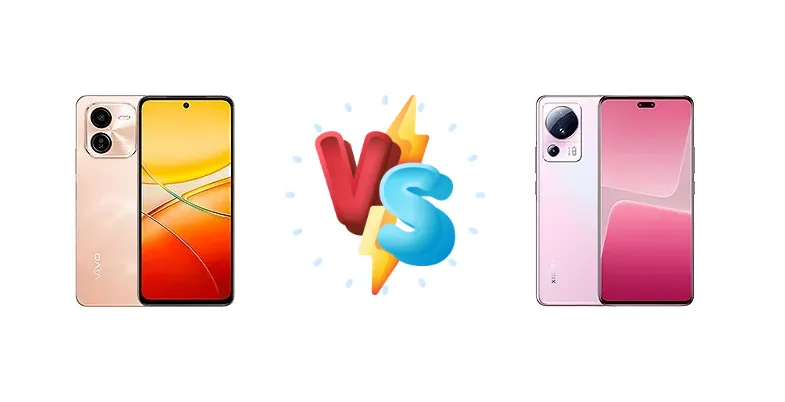
|
🏆 Quick Verdict
For the average user prioritizing a vibrant display and slightly more processing power, the Xiaomi 13 Lite is the better choice. However, the vivo Y37 Pro’s 44W charging and efficient Snapdragon 4 Gen 2 make it a strong contender for those who value battery longevity and quick top-ups, especially given potential price differences.
| PHONES | ||
|---|---|---|
| Phone Names | vivo Y37 Pro | Xiaomi 13 Lite |
| Network | ||
|---|---|---|
| 2G bands | GSM 850 / 900 / 1800 / 1900 | GSM 850 / 900 / 1800 / 1900 |
| 3G bands | HSDPA 850 / 900 / 2100 | HSDPA 800 / 850 / 900 / 1700(AWS) / 1900 / 2100 |
| 4G bands | 1, 3, 5, 8, 28, 34, 38, 39, 40, 41 | 1, 2, 3, 4, 5, 7, 8, 12, 13, 17, 18, 19, 20, 26, 28, 32, 38, 40, 41, 42, 66 |
| 5G bands | 1, 3, 5, 8, 28, 41, 77, 78 SA/NSA | 1, 3, 5, 7, 8, 20, 28, 38, 40, 41, 66, 77, 78 SA/NSA |
| Speed | HSPA, LTE, 5G | HSPA, LTE, 5G |
| Technology | GSM / CDMA / HSPA / CDMA2000 / LTE / 5G | GSM / HSPA / LTE / 5G |
| Launch | ||
|---|---|---|
| Announced | 2024, August 29 | 2023, February 26 |
| Status | Available. Released 2024, September | Available. Released 2023, March 08 |
| Body | ||
|---|---|---|
| Build | Glass front, plastic frame, plastic back | Glass front (Gorilla Glass 5), glass back, plastic frame |
| Dimensions | 165.7 x 76 x 8 mm (6.52 x 2.99 x 0.31 in) | 159.2 x 72.7 x 7.2 mm (6.27 x 2.86 x 0.28 in) |
| SIM | Nano-SIM + Nano-SIM | · Nano-SIM + eSIM· Nano-SIM + Nano-SIM |
| Weight | 199 g (7.02 oz) | 171 g (6.03 oz) |
| - | IP53, dust and splash resistant | |
| Display | ||
|---|---|---|
| Protection | - | Corning Gorilla Glass 5 |
| Resolution | 720 x 1608 pixels, 20:9 ratio (~264 ppi density) | 1080 x 2400 pixels, 20:9 ratio (~402 ppi density) |
| Size | 6.68 inches, 107.4 cm2 (~85.3% screen-to-body ratio) | 6.55 inches, 103.6 cm2 (~89.5% screen-to-body ratio) |
| Type | IPS LCD, 120Hz, 1000 nits (HBM) | AMOLED, 68B colors, Dolby Vision, HDR10+, 120Hz, 500 nits (typ), 1000 nits (peak) |
| Platform | ||
|---|---|---|
| CPU | Octa-core (2x2.2 GHz Cortex-A78 & 6x2.0 GHz Cortex-A55) | Octa-core (1x2.4 GHz Cortex-A710 & 3x2.36 GHz Cortex-A710 & 4x1.8 GHz Cortex-A510) |
| Chipset | Qualcomm SM4450 Snapdragon 4 Gen 2 (4 nm) | Qualcomm SM7450-AB Snapdragon 7 Gen 1 (4 nm) |
| GPU | Adreno 613 | Adreno 644 |
| OS | Android 14, OriginOS 4 | Android 12, MIUI 14 |
| Memory | ||
|---|---|---|
| Card slot | No | No |
| Internal | 256GB 8GB RAM | 64GB 8GB RAM, 128GB 8GB RAM, 256GB 8GB RAM |
| - | UFS 2.2 | |
| Main Camera | ||
|---|---|---|
| Dual | 50 MP, f/1.8, (wide), PDAF Auxiliary lens | - |
| Features | LED flash, panorama | Dual-LED dual-tone flash, HDR, panorama |
| Triple | - | 50 MP, f/1.8, 23mm (wide), 1/1.56", 1.0µm, PDAF 8 MP, f/2.2, 119˚ (ultrawide), 1/4.0", 1.12µm 2 MP (macro) |
| Video | 1080p@30fps | 4K@30fps, 1080p@30/60/120fps, 720p@960fps |
| Selfie camera | ||
|---|---|---|
| Dual | - | 32 MP, f/2.4, 100˚ (ultrawide), 1/2.74", 0.8µm 8 MP, f/2.3, (depth) |
| Features | - | Dual-LED flash, HDR |
| Single | 5 MP, f/2.2, (wide) | - |
| Video | 1080p@30fps | 1080p@30/60fps |
| Sound | ||
|---|---|---|
| 3.5mm jack | - | No |
| 35mm jack | Yes | No |
| Loudspeaker | Yes, with stereo speakers | Yes |
| - | 24-bit/192kHz audio | |
| Comms | ||
|---|---|---|
| Bluetooth | 4.2, A2DP, LE, aptX Adaptive | 5.2, A2DP, LE |
| Infrared port | - | Yes |
| NFC | No | Yes (market/region dependent) |
| Positioning | GPS, GALILEO, GLONASS, BDS, QZSS | GPS (L1), GLONASS (G1), BDS (B1I+B1c), GALILEO (E1), QZSS (L1) |
| Radio | No | No |
| USB | USB Type-C 2.0, OTG | USB Type-C 2.0, OTG |
| WLAN | Wi-Fi 802.11 a/b/g/n/ac, dual-band | Wi-Fi 802.11 a/b/g/n/ac/6, dual-band |
| Features | ||
|---|---|---|
| Sensors | Fingerprint (side-mounted), accelerometer, proximity, compass | Fingerprint (under display, optical), accelerometer, gyro, proximity, compass |
| Battery | ||
|---|---|---|
| Charging | 44W wired, 50% in 36 min Reverse wired | 67W wired, 100% in 40 min |
| Type | 6000 mAh | Li-Po 4500 mAh |
| Misc | ||
|---|---|---|
| Colors | Dark Gray, Green, Apricot | Black, Lite Blue, Lite Pink |
| Models | V2354A | - |
| Price | About 230 EUR | About 180 EUR |
| Tests | ||
|---|---|---|
| Battery life | - | Endurance rating 93h |
| Camera | - | Photo / Video |
| Display | - | Contrast ratio: Infinite (nominal) |
| Loudspeaker | - | -28.5 LUFS (Average) |
| Performance | - | AnTuTu: 534143 (v9) GeekBench: 2936 (v5.1), 2434 (v6) GFXBench: 33fps (ES 3.1 onscreen) |
vivo Y37 Pro
- Faster initial charging speed (50% in 36 mins)
- More power-efficient Snapdragon 4 Gen 2 chipset
- Potentially lower price point
- Less powerful processor for demanding tasks
- Display brightness likely lower than Xiaomi 13 Lite
- Limited camera details available
Xiaomi 13 Lite
- Brighter display (938 nits)
- More powerful Snapdragon 7 Gen 1 processor
- Faster full charge time (100% in 40 mins)
- Potentially lower battery efficiency
- May be more expensive than vivo Y37 Pro
- Similar battery endurance rating despite faster charging
Display Comparison
The Xiaomi 13 Lite boasts a significantly brighter display, reaching a measured 938 nits, compared to an unspecified brightness for the Y37 Pro. This higher peak brightness translates to better visibility outdoors under direct sunlight. While both displays have an 'infinite' (nominal) contrast ratio, the Xiaomi 13 Lite’s superior brightness is a clear advantage for multimedia viewing. The Y37 Pro’s display specifications are currently limited, making a detailed comparison of color accuracy and panel technology difficult, but given its price point, it likely utilizes a standard LCD panel.
Camera Comparison
Both phones are advertised with 'Photo / Video' capabilities, but detailed camera specifications are lacking. Without sensor size or aperture information, a direct comparison is challenging. However, the Xiaomi 13 Lite, positioned as a more premium device, likely incorporates a more sophisticated camera system with potentially larger sensors and optical image stabilization (OIS). The Y37 Pro’s camera is likely geared towards casual photography, while the 13 Lite aims to deliver more detailed and vibrant images, particularly in low-light conditions. The prevalence of 2MP macro lenses on both devices suggests limited utility for serious macro photography.
Performance
The Xiaomi 13 Lite’s Snapdragon 7 Gen 1 chipset represents a substantial performance leap over the vivo Y37 Pro’s Snapdragon 4 Gen 2. The 7 Gen 1 features a more powerful CPU configuration – a 1x2.4 GHz Cortex-A710 prime core alongside 3x2.36 GHz Cortex-A710 cores and 4x1.8 GHz Cortex-A510 efficiency cores – versus the Y37 Pro’s 2x2.2 GHz Cortex-A78 and 6x2.0 GHz Cortex-A55 setup. Both chips are fabricated on a 4nm process, offering good efficiency, but the 7 Gen 1’s architectural advantages will result in noticeably faster app loading times, smoother multitasking, and improved gaming performance. The Y37 Pro’s Snapdragon 4 Gen 2 prioritizes efficiency, making it suitable for everyday tasks, but will struggle with demanding applications.
Battery Life
Both devices achieve an endurance rating of 93 hours, suggesting comparable overall battery life. However, the charging speeds differ significantly. The Xiaomi 13 Lite supports 67W wired charging, achieving a full charge in 40 minutes, while the vivo Y37 Pro offers 44W charging, reaching 50% in 36 minutes. While the Xiaomi 13 Lite charges faster overall, the Y37 Pro’s initial charging speed is competitive. The Snapdragon 4 Gen 2’s efficiency in the Y37 Pro may offset the slightly slower charging speed, providing comparable real-world usage time despite a potentially smaller battery capacity.
Buying Guide
Buy the vivo Y37 Pro if you need a phone that can withstand a full day of moderate use and charges incredibly quickly, making it ideal for users who frequently forget to charge overnight. Buy the Xiaomi 13 Lite if you prioritize a brighter, more visually appealing display for media consumption and demand a bit more processing muscle for multitasking and light gaming.