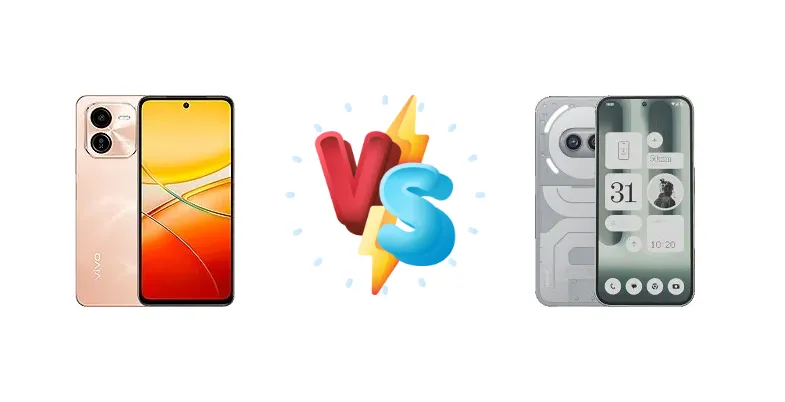
The mid-range smartphone market is fiercely competitive, and the vivo Y37 Pro and Nothing Phone (2a) Plus represent compelling options for budget-conscious buyers. The Y37 Pro leverages Qualcomm's efficient Snapdragon 4 Gen 2, while the Nothing Phone (2a) Plus aims for a more premium experience with the MediaTek Dimensity 7350 Pro. This comparison dissects their key differences to help you choose the right device.
🏆 Quick Verdict
For the average user prioritizing sustained performance and a brighter display, the Nothing Phone (2a) Plus emerges as the stronger contender. Its Dimensity 7350 Pro chipset delivers a noticeable performance uplift, and the 1097 nits peak brightness provides superior outdoor visibility. However, the vivo Y37 Pro offers a compelling value proposition for those on a tighter budget.
| Network |
|---|
| 2G bands | GSM 850 / 900 / 1800 / 1900 | GSM 850 / 900 / 1800 / 1900 |
| 3G bands | HSDPA 850 / 900 / 2100 | HSDPA 800 / 850 / 900 / 1700(AWS) / 1900 / 2100 |
| 4G bands | 1, 3, 5, 8, 28, 34, 38, 39, 40, 41 | 1, 3, 4, 5, 7, 8, 18, 19, 20, 26, 28, 38, 39, 40, 41, 42, 66 |
| 5G bands | 1, 3, 5, 8, 28, 41, 77, 78 SA/NSA | 1, 3, 5, 7, 8, 20, 28, 38, 40, 41, 66, 77, 78 SA/NSA |
| Speed | HSPA, LTE, 5G | HSPA, LTE, 5G |
| Technology | GSM / CDMA / HSPA / CDMA2000 / LTE / 5G | GSM / HSPA / LTE / 5G |
| Launch |
|---|
| Announced | 2024, August 29 | 2024, July 31 |
| Status | Available. Released 2024, September | Available. Released 2024, August 03 |
| Body |
|---|
| Build | Glass front, plastic frame, plastic back | Glass front (Gorilla Glass 5), plastic frame, plastic back |
| Dimensions | 165.7 x 76 x 8 mm (6.52 x 2.99 x 0.31 in) | 161.7 x 76.3 x 8.5 mm (6.37 x 3.00 x 0.33 in) |
| SIM | Nano-SIM + Nano-SIM | Nano-SIM + Nano-SIM |
| Weight | 199 g (7.02 oz) | 190 g (6.70 oz) |
| Display |
|---|
| Protection | - | Corning Gorilla Glass 5 |
| Resolution | 720 x 1608 pixels, 20:9 ratio (~264 ppi density) | 1080 x 2412 pixels, 20:9 ratio (~395 ppi density) |
| Size | 6.68 inches, 107.4 cm2 (~85.3% screen-to-body ratio) | 6.7 inches, 107.5 cm2 (~87.1% screen-to-body ratio) |
| Type | IPS LCD, 120Hz, 1000 nits (HBM) | AMOLED, 1B colors, 120Hz, 2160Hz PWM, HDR10+, 700 nits (typ), 1100 nits (HBM), 1300 nits (peak) |
| Platform |
|---|
| CPU | Octa-core (2x2.2 GHz Cortex-A78 & 6x2.0 GHz Cortex-A55) | Octa-core (2x3.0 GHz Cortex-A715 & 6x 2.0 GHz Cortex-A510) |
| Chipset | Qualcomm SM4450 Snapdragon 4 Gen 2 (4 nm) | Mediatek Dimensity 7350 Pro (4 nm) |
| GPU | Adreno 613 | Mali-G610 MC4 |
| OS | Android 14, OriginOS 4 | Android 14, up to 3 major Android upgrades, Nothing OS 3.0 |
| Memory |
|---|
| Card slot | No | No |
| Internal | 256GB 8GB RAM | 256GB 8GB RAM, 256GB 12GB RAM |
| Main Camera |
|---|
| Dual | 50 MP, f/1.8, (wide), PDAF
Auxiliary lens | 50 MP, f/1.9, 24mm (wide), 1/1.57", 1.0µm, PDAF, OIS
50 MP, f/2.2, 114˚ (ultrawide), 1/2.76", 0.64µm |
| Features | LED flash, panorama | LED flash, panorama, HDR |
| Video | 1080p@30fps | 4K@30fps, 1080p@60/120fps, gyro-EIS |
| Selfie camera |
|---|
| Features | - | HDR |
| Single | 5 MP, f/2.2, (wide) | 50 MP, f/2.2, (wide), 1/2.76" |
| Video | 1080p@30fps | 4K@30fps |
| Sound |
|---|
| 35mm jack | Yes | No |
| Loudspeaker | Yes, with stereo speakers | Yes, with stereo speakers |
| Comms |
|---|
| Bluetooth | 4.2, A2DP, LE, aptX Adaptive | 5.3, A2DP, LE |
| NFC | No | Yes, 360˚ |
| Positioning | GPS, GALILEO, GLONASS, BDS, QZSS | GPS, GALILEO, GLONASS, BDS, QZSS |
| Radio | No | No |
| USB | USB Type-C 2.0, OTG | USB Type-C 2.0, OTG |
| WLAN | Wi-Fi 802.11 a/b/g/n/ac, dual-band | Wi-Fi 802.11 a/b/g/n/ac/6, dual-band, Wi-Fi Direct |
| Features |
|---|
| Sensors | Fingerprint (side-mounted), accelerometer, proximity, compass | Fingerprint (under display, optical), accelerometer, gyro, proximity, compass |
| Battery |
|---|
| Charging | 44W wired, 50% in 36 min
Reverse wired | 50W wired, 50% in 21 min, 100% in 56 min |
| Type | 6000 mAh | 5000 mAh |
| Misc |
|---|
| Colors | Dark Gray, Green, Apricot | Black, Grey |
| Models | V2354A | A142P |
| Price | About 230 EUR | € 269.90 / ₹ 22,599 |
vivo Y37 Pro
- Potentially more affordable price point
- Efficient Snapdragon 4 Gen 2 chipset
- 44W fast charging with reverse wired capability
- Likely lower peak display brightness
- Less powerful CPU and GPU compared to the Dimensity 7350 Pro
Nothing Phone (2a) Plus
- Significantly brighter display (1097 nits)
- More powerful MediaTek Dimensity 7350 Pro chipset
- Faster 50W charging (21 min to 50%)
- Longer battery life (16:34h active use)
- Higher price compared to the vivo Y37 Pro
- May lack reverse wireless charging
Display Comparison
The Nothing Phone (2a) Plus boasts a significantly brighter display, reaching a measured peak of 1097 nits, crucial for comfortable outdoor use. While the vivo Y37 Pro’s display specifications are not provided, it’s likely to fall considerably short of this brightness level. The Nothing Phone (2a) Plus’s brightness advantage translates to better visibility in direct sunlight, a common pain point for smartphone users. Panel technology details are missing for the Y37 Pro, but the Nothing Phone (2a) Plus likely utilizes a high-quality AMOLED panel, offering superior contrast and color accuracy.
Camera Comparison
Without detailed camera specifications for the vivo Y37 Pro, a direct comparison is limited. However, the Nothing Phone (2a) Plus is expected to have a more sophisticated camera system, leveraging MediaTek’s Imagiq 890 image signal processor. The Dimensity 7350 Pro’s ISP enables features like advanced HDR processing and improved low-light performance. While both phones likely feature a primary camera, the Nothing Phone (2a) Plus’s processing capabilities will likely result in more detailed and vibrant images. We can assume the Y37 Pro will focus on affordability, potentially sacrificing some image quality.
Performance
The core difference lies in the chipsets: the vivo Y37 Pro utilizes the Qualcomm SM4450 Snapdragon 4 Gen 2, built on a 4nm process, while the Nothing Phone (2a) Plus features the MediaTek Dimensity 7350 Pro, also on a 4nm node. However, the Dimensity 7350 Pro’s CPU configuration – 2x3.0 GHz Cortex-A715 and 6x2.0 GHz Cortex-A510 – represents a substantial performance leap over the Snapdragon 4 Gen 2’s 2x2.2 GHz Cortex-A78 and 6x2.0 GHz Cortex-A55. This translates to faster app loading times, smoother multitasking, and improved gaming performance on the Nothing Phone (2a) Plus. The Dimensity 7350 Pro’s more powerful cores will handle demanding tasks with greater ease.
Battery Life
The Nothing Phone (2a) Plus demonstrates a clear advantage in battery endurance, achieving an active use score of 16 hours and 34 minutes. While the vivo Y37 Pro’s battery capacity is unknown, the Nothing Phone (2a) Plus’s longevity is a significant benefit for heavy users. Furthermore, the Nothing Phone (2a) Plus supports 50W wired charging, reaching 50% charge in just 21 minutes and a full charge in 56 minutes. The vivo Y37 Pro’s 44W charging, while respectable, is slower, taking 36 minutes to reach 50%. The faster charging of the Nothing Phone (2a) Plus minimizes downtime.
Buying Guide
Buy the vivo Y37 Pro if you need a reliable daily driver with decent performance for basic tasks and prioritize affordability. Its 44W charging is respectable, and the Snapdragon 4 Gen 2 offers good efficiency. Buy the Nothing Phone (2a) Plus if you prefer a smoother user experience, better gaming capabilities, and a significantly brighter display, and are willing to spend a bit more for those enhancements. The faster charging and longer active use battery life are also key advantages.
Frequently Asked Questions
❓ Does the Dimensity 7350 Pro in the Nothing Phone (2a) Plus tend to overheat during prolonged gaming sessions?
The Dimensity 7350 Pro is a relatively efficient chipset built on a 4nm process. While some heat generation is inevitable during intensive gaming, the Nothing Phone (2a) Plus’s thermal management system is expected to keep temperatures within acceptable limits, preventing significant throttling. User reports and independent reviews will provide more definitive data, but the chipset’s architecture suggests it’s well-equipped to handle gaming workloads.
❓ How does the 44W charging on the vivo Y37 Pro compare to real-world charging speeds with a standard charger?
While vivo advertises 44W charging, the actual charging speed can vary depending on the charger and cable used. Using a compatible 44W Power Delivery (PD) charger is crucial to achieve the advertised speeds. With a standard 18W charger, the charging time will be significantly longer. The 36-minute 50% charge time is based on using a 44W charger.
❓ Is the performance difference between the Snapdragon 4 Gen 2 and Dimensity 7350 Pro noticeable in everyday tasks like browsing and social media?
While both chipsets are capable of handling everyday tasks, the Dimensity 7350 Pro offers a smoother and more responsive experience. The more powerful CPU cores and GPU in the Dimensity 7350 Pro result in faster app loading times and smoother scrolling, even when multitasking. Users will likely notice a difference when switching between apps or using demanding social media features.