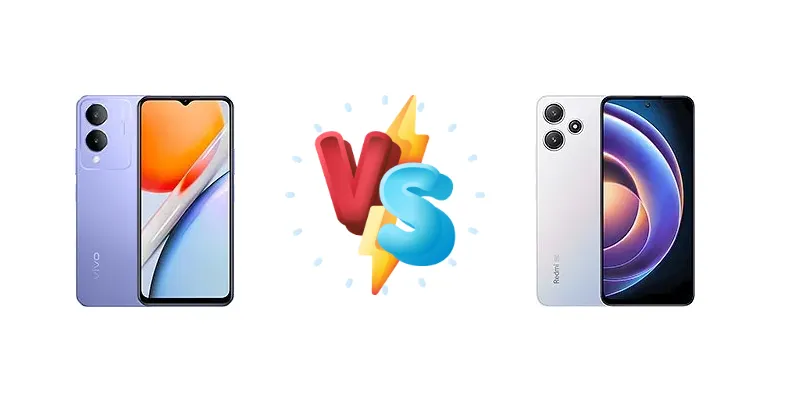
The sub-$200 smartphone market is fiercely competitive, and the Xiaomi Redmi Note 12R and vivo Y36i are two contenders vying for dominance. Both aim to deliver a solid experience without breaking the bank, but they take different approaches to achieving this. The Redmi Note 12R leverages Qualcomm's newer, 4nm Snapdragon 4 Gen 2, while the vivo Y36i opts for MediaTek's 7nm Dimensity 6020. This comparison will dissect their key differences to help you choose the right phone for your needs.
🏆 Quick Verdict
For the average user prioritizing all-around performance and future-proofing, the Xiaomi Redmi Note 12R emerges as the stronger choice. Its Snapdragon 4 Gen 2 chipset, built on a more efficient 4nm process, offers a slight edge in processing power and thermal management, coupled with faster 18W charging with PD support.
| Network |
|---|
| 2G bands | GSM 850 / 900 / 1800 / 1900 | GSM 850 / 900 / 1800 / 1900 |
| 3G bands | HSDPA 850 / 900 / 2100 | HSDPA 850 / 900 / 2100 |
| 4G bands | 1, 3, 5, 8, 28, 34, 38, 39, 40, 41 | 1, 3, 5, 8, 34, 38, 39, 40, 41 |
| 5G bands | 1, 5, 8, 28, 41, 77, 78 SA/NSA | 1, 5, 8, 28, 41, 78 SA/NSA |
| Speed | HSPA, LTE, 5G | HSPA, LTE, 5G |
| Technology | GSM / HSPA / LTE / 5G | GSM / CDMA / HSPA / EVDO / LTE / 5G |
| Launch |
|---|
| Announced | 2023, December 09 | 2023, June 28 |
| Status | Available. Released 2024, January | Available. Released 2023, June 28 |
| Body |
|---|
| Build | Glass front, plastic frame, plastic back | Glass front, plastic frame, glass back |
| Dimensions | 163.7 x 75.4 x 8.1 mm (6.44 x 2.97 x 0.32 in) | 168.6 x 76.3 x 8.2 mm (6.64 x 3.00 x 0.32 in) |
| SIM | Nano-SIM + Nano-SIM | Nano-SIM + Nano-SIM |
| Weight | 186 g (6.56 oz) | 199 g (7.02 oz) |
| Display |
|---|
| Resolution | 720 x 1612 pixels, 20:9 ratio (~269 ppi density) | 1080 x 2460 pixels (~396 ppi density) |
| Size | 6.56 inches, 103.4 cm2 (~83.8% screen-to-body ratio) | 6.79 inches, 109.5 cm2 (~85.1% screen-to-body ratio) |
| Type | IPS LCD, 90Hz, 840 nits (HBM) | IPS LCD, 90Hz, 550 nits |
| Platform |
|---|
| CPU | Octa-core (2x2.2 GHz Cortex-A76 & 6x2.0 GHz Cortex-A55) | Octa-core (2x2.2 GHz Cortex-A78 & 6x1.95 GHz Cortex-A55) |
| Chipset | Mediatek Dimensity 6020 (7 nm) | Qualcomm SM4450 Snapdragon 4 Gen 2 (4 nm) |
| GPU | Mali-G57 MC2 | Adreno 613 |
| OS | Android 13, OriginOS 3 | Android 13, MIUI 14 |
| Memory |
|---|
| Card slot | microSDXC | microSDXC (uses shared SIM slot) |
| Internal | 128GB 4GB RAM | 128GB 4GB RAM, 128GB 6GB RAM, 128GB 8GB RAM, 256GB 8GB RAM |
| Main Camera |
|---|
| Dual | - | 50 MP, f/1.8, (wide), PDAF
2 MP (macro) |
| Features | LED flash, panorama | LED flash, HDR |
| Single | 13 MP, f/2.2, (wide), PDAF
Anti-stroboscopic sensor | - |
| Video | 1080p@30fps | 1080p@30fps |
| Selfie camera |
|---|
| Features | - | HDR |
| Single | 5 MP, f/1.8, (wide) | 5 MP, f/2.2, (wide), 1/5.0", 1.12µm |
| Video | Yes | 1080p@30fps |
| Sound |
|---|
| 35mm jack | Yes | Yes |
| Loudspeaker | Yes | Yes |
| Comms |
|---|
| Bluetooth | 5.1, A2DP, LE, aptX HD | 5.3, A2DP, LE |
| Infrared port | - | Yes |
| NFC | No | Yes (market/region dependent) |
| Positioning | GPS, GLONASS, BDS | GPS, GLONASS, GALILEO, BDS |
| Radio | FM radio | No |
| USB | USB Type-C 2.0, OTG | USB Type-C |
| WLAN | Wi-Fi 802.11 a/b/g/n/ac, dual-band | Wi-Fi 802.11 a/b/g/n/ac, dual-band |
| Features |
|---|
| Sensors | Fingerprint (side-mounted), accelerometer, proximity, compass | Fingerprint (side-mounted), accelerometer, compass |
| Battery |
|---|
| Charging | 15W wired
Reverse wired | 18W wired, PD |
| Type | 5000 mAh | Li-Po 5000 mAh |
| Misc |
|---|
| Colors | Purple, Gold, Black | Black, Blue, Silver |
| Models | V2318A | 23076RA4BC |
| Price | About 160 EUR | About 150 EUR |
vivo Y36i
- More efficient Snapdragon 4 Gen 2 chipset
- Faster 18W charging with PD support
- Potentially better long-term performance
- Xiaomi’s MIUI software can be polarizing
- Camera image processing may be overly saturated for some
Xiaomi Redmi Note 12R
- Familiar vivo user experience
- Potentially optimized software for everyday tasks
- Competitive price point
- Less efficient 7nm Dimensity 6020 chipset
- Slower 15W charging without PD
Display Comparison
Neither device boasts a standout display. While specific panel details (like peak brightness or color gamut coverage) are absent, the focus here is on the underlying processors. Display quality will likely be similar, leaning towards adequate for the price point. Bezels are expected to be comparable, and both will likely utilize IPS LCD panels, prioritizing cost-effectiveness over advanced technologies like OLED.
Camera Comparison
Without detailed camera specs beyond the main sensors, a direct comparison is difficult. Both phones likely feature multi-camera setups with a primary sensor and supporting lenses (potentially including macro and depth sensors). Image processing will heavily influence the final results. Xiaomi’s image processing tends to be more vibrant and saturated, while vivo often aims for a more natural look. The absence of Optical Image Stabilization (OIS) on either device suggests reliance on software stabilization, which may struggle in low-light conditions. The 4nm process of the Redmi Note 12R could allow for slightly more sophisticated image signal processing (ISP) capabilities.
Performance
The core difference lies in the chipsets. The Redmi Note 12R’s Qualcomm Snapdragon 4 Gen 2 (4nm) utilizes Cortex-A78 cores, a step up in architecture from the Cortex-A76 cores found in the vivo Y36i’s MediaTek Dimensity 6020 (7nm). This architectural advantage, combined with the more efficient 4nm fabrication process, translates to potentially better sustained performance under load. While both CPUs peak at 2.2 GHz, the A78 cores in the Snapdragon are generally more efficient. The Redmi Note 12R’s 4nm process also implies better thermal efficiency, reducing the likelihood of throttling during extended gaming sessions. The Y36i's Dimensity 6020 is still a capable chip, but the Snapdragon 4 Gen 2 offers a more modern foundation.
Battery Life
The Redmi Note 12R’s 18W charging with Power Delivery (PD) is a clear advantage over the vivo Y36i’s 15W charging. PD support offers wider compatibility with chargers and potentially faster charging speeds, especially with compatible PD adapters. While battery capacity isn’t specified, the more efficient Snapdragon 4 Gen 2 in the Redmi Note 12R should contribute to longer battery life, even with a similar capacity to the Y36i. Expect both phones to comfortably last a full day with moderate usage, but the Redmi Note 12R will likely offer a more consistent experience under heavier loads.
Buying Guide
Buy the vivo Y36i if you prioritize a familiar vivo user experience and potentially slightly better software optimization for everyday tasks. Buy the Xiaomi Redmi Note 12R if you value a more modern chipset architecture, potentially better long-term performance, and the convenience of Power Delivery (PD) fast charging. The Redmi Note 12R is the better pick for users who anticipate heavier app usage or occasional gaming.
Frequently Asked Questions
❓ Will the Snapdragon 4 Gen 2 in the Redmi Note 12R handle demanding games like PUBG Mobile?
The Snapdragon 4 Gen 2 is capable of running PUBG Mobile, but you'll likely need to lower the graphics settings to achieve a smooth frame rate. While not a gaming powerhouse, it offers a noticeable improvement over the Dimensity 6020 for gaming due to its more efficient architecture and potentially better thermal management.
❓ Does the Redmi Note 12R support fast charging with any standard charger, or do I need a Power Delivery (PD) charger?
The Redmi Note 12R supports fast charging with a PD-compatible charger. While it will charge with a standard 5W charger, you'll only achieve the full 18W charging speed with a PD charger. Using a PD charger is highly recommended for a significantly faster charging experience.
❓ Is the difference between the 4nm and 7nm process significant in real-world usage?
Yes, the difference is noticeable. A smaller process node (4nm vs 7nm) generally translates to better power efficiency and reduced heat generation. This means the Redmi Note 12R will likely offer longer battery life and less performance throttling under sustained loads compared to the vivo Y36i.