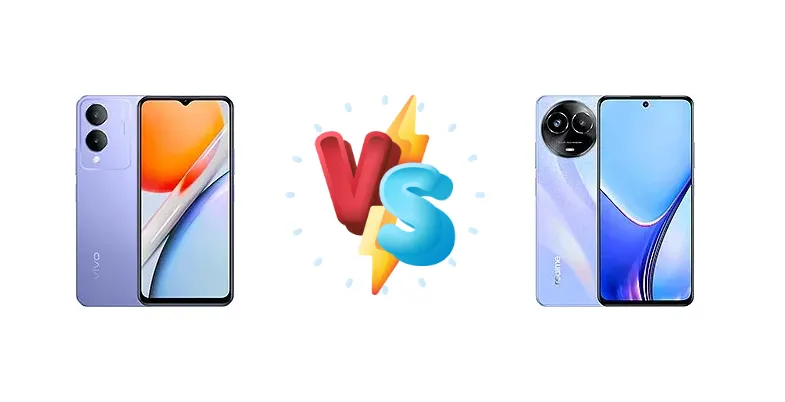
The sub-$200 smartphone market is fiercely competitive, and the Realme 11x and vivo Y36i are two recent entrants vying for attention. Both leverage Mediatek's Dimensity series, but subtle differences in chipset, charging, and potentially software experience separate them. This comparison dives deep to determine which phone delivers the best value for your money.
🏆 Quick Verdict
For most users, the Realme 11x emerges as the stronger choice. Its Dimensity 6100+ chipset, built on a more efficient 6nm process, offers a slight performance edge and better thermal management. Crucially, the 33W charging significantly reduces downtime compared to the Y36i’s 15W charging, making it ideal for users on the go.
| Network |
|---|
| 2G bands | GSM 850 / 900 / 1800 / 1900 | GSM 850 / 900 / 1800 / 1900 |
| 3G bands | HSDPA 850 / 900 / 2100 | HSDPA 850 / 900 / 2100 |
| 4G bands | 1, 3, 5, 8, 28, 34, 38, 39, 40, 41 | 1, 3, 5, 8, 28, 40, 41 |
| 5G bands | 1, 5, 8, 28, 41, 77, 78 SA/NSA | 1, 3, 5, 8, 28, 40, 41, 77, 78 SA/NSA |
| Speed | HSPA, LTE, 5G | HSPA, LTE, 5G |
| Technology | GSM / HSPA / LTE / 5G | GSM / HSPA / LTE / 5G |
| Launch |
|---|
| Announced | 2023, December 09 | 2023, August 23 |
| Status | Available. Released 2024, January | Available. Released 2023, August 30 |
| Body |
|---|
| Build | Glass front, plastic frame, plastic back | Glass front, aluminum frame, plastic back |
| Dimensions | 163.7 x 75.4 x 8.1 mm (6.44 x 2.97 x 0.32 in) | 165.7 x 76 x 7.9 mm (6.52 x 2.99 x 0.31 in) |
| SIM | Nano-SIM + Nano-SIM | Nano-SIM + Nano-SIM |
| Weight | 186 g (6.56 oz) | 190 g (6.70 oz) |
| Display |
|---|
| Resolution | 720 x 1612 pixels, 20:9 ratio (~269 ppi density) | 1080 x 2400 pixels, 20:9 ratio (~392 ppi density) |
| Size | 6.56 inches, 103.4 cm2 (~83.8% screen-to-body ratio) | 6.72 inches, 109.0 cm2 (~86.6% screen-to-body ratio) |
| Type | IPS LCD, 90Hz, 840 nits (HBM) | IPS LCD, 120Hz, 550 nits (typ), 680 nits (HBM) |
| Platform |
|---|
| CPU | Octa-core (2x2.2 GHz Cortex-A76 & 6x2.0 GHz Cortex-A55) | Octa-core (2x2.2 GHz Cortex-A76 & 6x2.0 GHz Cortex-A55) |
| Chipset | Mediatek Dimensity 6020 (7 nm) | Mediatek Dimensity 6100+ (6 nm) |
| GPU | Mali-G57 MC2 | Mali-G57 MC2 |
| OS | Android 13, OriginOS 3 | Android 13, Realme UI 4.0 |
| Memory |
|---|
| Card slot | microSDXC | microSDXC (dedicated slot) |
| Internal | 128GB 4GB RAM | 128GB 6GB RAM, 128GB 8GB RAM |
| Main Camera |
|---|
| Dual | - | 64 MP, f/1.8, 25mm (wide), 1/2.0", 0.7µm, PDAF
Auxiliary lens |
| Features | LED flash, panorama | LED flash, HDR, panorama |
| Single | 13 MP, f/2.2, (wide), PDAF
Anti-stroboscopic sensor | - |
| Video | 1080p@30fps | 1080p@30fps |
| Selfie camera |
|---|
| Features | - | Panorama |
| Single | 5 MP, f/1.8, (wide) | 8 MP, f/2.1, 26mm (wide) |
| Video | Yes | 1080p@30fps |
| Sound |
|---|
| 35mm jack | Yes | Yes |
| Loudspeaker | Yes | Yes |
| Comms |
|---|
| Bluetooth | 5.1, A2DP, LE, aptX HD | 5.2, A2DP, LE |
| NFC | No | No |
| Positioning | GPS, GLONASS, BDS | GPS, GALILEO, GLONASS, BDS |
| Radio | FM radio | Unspecified |
| USB | USB Type-C 2.0, OTG | USB Type-C 2.0 |
| WLAN | Wi-Fi 802.11 a/b/g/n/ac, dual-band | Wi-Fi 802.11 a/b/g/n/ac, dual-band, Wi-Fi Direct |
| Features |
|---|
| Sensors | Fingerprint (side-mounted), accelerometer, proximity, compass | Fingerprint (side-mounted), accelerometer, proximity, compass |
| Battery |
|---|
| Charging | 15W wired
Reverse wired | 33W wired, 50% in 29 min |
| Type | 5000 mAh | 5000 mAh |
| Misc |
|---|
| Colors | Purple, Gold, Black | Midnight Black, Purple Dawn |
| Models | V2318A | RMX3785 |
| Price | About 160 EUR | About 170 EUR |
vivo Y36i
- Faster 33W charging for quicker top-ups
- More efficient Dimensity 6100+ chipset
- Potentially better camera performance
- Likely slightly higher price
- May not have significantly better display quality
Realme 11x
- More affordable price point
- Decent performance for basic tasks
- Reverse wired charging capability
- Slower 15W charging
- Less efficient Dimensity 6020 chipset
Display Comparison
Both phones lack detailed display specifications in the provided data, but given their price bracket, we can expect 6.5-6.6 inch LCD panels with FHD+ resolution. The Realme 11x, benefiting from a slightly higher price, *may* feature a higher peak brightness or improved color calibration. However, without specific nit ratings or color gamut coverage, it’s difficult to definitively state a display advantage. Expect standard 60Hz refresh rates on both.
Camera Comparison
Without detailed camera sensor information beyond the presence of a main sensor, a direct comparison is limited. However, the Realme 11x’s slightly higher price suggests a potentially larger or more capable main sensor. Image processing algorithms will also play a significant role, and Realme typically focuses on vibrant, social media-ready images. The Y36i likely prioritizes cost savings, potentially resulting in less refined image quality, particularly in low-light conditions. We can assume both phones will include standard auxiliary lenses of limited utility.
Performance
The Realme 11x’s Mediatek Dimensity 6100+ (6nm) represents a clear advantage over the vivo Y36i’s Dimensity 6020 (7nm). The 6nm process inherently offers better power efficiency, translating to less heat generation under sustained load and potentially longer battery life. While both chipsets share the same CPU core configuration (2x2.2 GHz Cortex-A76 & 6x2.0 GHz Cortex-A55), the 6100+’s improved architecture and GPU will deliver a smoother experience in demanding applications and games. Users who frequently game or multitask will notice the difference.
Battery Life
The Realme 11x’s 33W wired charging is a game-changer compared to the vivo Y36i’s 15W charging. Realme claims a 50% charge in 29 minutes, a substantial time saving. While battery capacity isn’t specified, the faster charging speed mitigates any potential disadvantage if the Y36i has a slightly larger battery. Users who frequently top up their phones or need a quick boost before leaving the house will greatly appreciate the 11x’s charging capabilities.
Buying Guide
Buy the vivo Y36i if you prioritize absolute affordability and are willing to trade charging speed and a small performance margin for a lower price point. It’s a solid option for basic smartphone tasks. Buy the Realme 11x if you value faster charging, slightly improved performance for gaming or multitasking, and a more modern chipset architecture, even if it means spending a bit more.
Frequently Asked Questions
❓ Will the Realme 11x’s Dimensity 6100+ handle demanding games like PUBG Mobile at high settings?
The Dimensity 6100+ is capable of running PUBG Mobile at high settings, but expect some frame drops during intense firefights. The 6nm process helps with thermal throttling, but it’s not a flagship-level chipset. Optimizing in-game settings will be crucial for a consistently smooth experience.
❓ How significant is the difference in charging speed between 15W and 33W? Is it worth the extra cost?
The difference is substantial. 33W charging on the Realme 11x can add a significant percentage of battery life in the time it takes the Y36i to gain a small amount. For users who frequently need to quickly top up their phone, the 33W charging is a major convenience and worth the price premium.
❓ Does the vivo Y36i’s reverse wired charging feature work with all devices?
The vivo Y36i’s reverse wired charging is compatible with most devices that charge via USB-C, but the charging speed will be limited by the Y36i’s 15W output. It’s best suited for emergency charging of accessories like wireless earbuds or smartwatches.