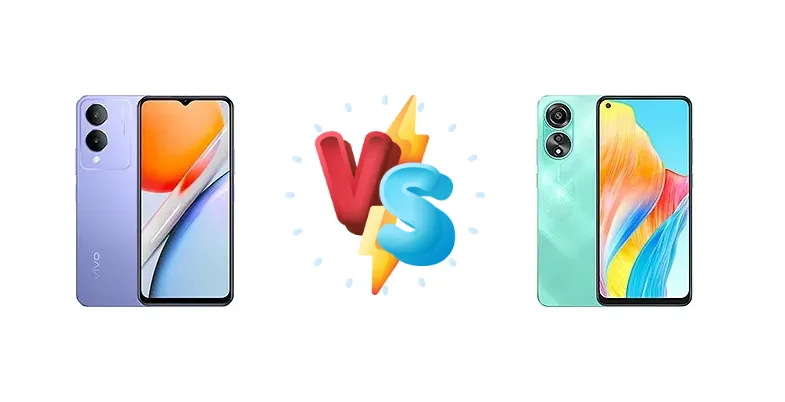
The sub-$200 smartphone market is fiercely competitive. The vivo Y36i and Oppo A78 4G both aim to deliver a solid experience without breaking the bank, but they take different approaches. The Y36i leverages MediaTek's Dimensity 6020, while the A78 4G opts for Qualcomm's Snapdragon 680. This comparison dives deep into the specifics to determine which device offers the best value.
🏆 Quick Verdict
For most users, the Oppo A78 4G emerges as the stronger choice. While the vivo Y36i offers a respectable processor, the A78 4G’s significantly faster 67W charging – capable of reaching 76% in just 30 minutes – and slightly higher CPU clock speeds provide a more compelling overall experience.
| Network |
|---|
| 2G bands | GSM 850 / 900 / 1800 / 1900 | GSM 850 / 900 / 1800 / 1900 |
| 3G bands | HSDPA 850 / 900 / 2100 | HSDPA 850 / 900 / 2100 |
| 4G bands | 1, 3, 5, 8, 28, 34, 38, 39, 40, 41 | LTE |
| 5G bands | 1, 5, 8, 28, 41, 77, 78 SA/NSA | - |
| Speed | HSPA, LTE, 5G | HSPA, LTE |
| Technology | GSM / HSPA / LTE / 5G | GSM / HSPA / LTE |
| Launch |
|---|
| Announced | 2023, December 09 | 2023, July 10 |
| Status | Available. Released 2024, January | Available. Released 2023, July 10 |
| Body |
|---|
| Build | Glass front, plastic frame, plastic back | - |
| Dimensions | 163.7 x 75.4 x 8.1 mm (6.44 x 2.97 x 0.32 in) | 160 x 73.2 x 7.9 mm (6.30 x 2.88 x 0.31 in) |
| SIM | Nano-SIM + Nano-SIM | Nano-SIM + Nano-SIM |
| Weight | 186 g (6.56 oz) | 180 g (6.35 oz) |
| Display |
|---|
| Protection | - | Corning Gorilla Glass 5 |
| Resolution | 720 x 1612 pixels, 20:9 ratio (~269 ppi density) | 1080 x 2400 pixels, 20:9 ratio (~409 ppi density) |
| Size | 6.56 inches, 103.4 cm2 (~83.8% screen-to-body ratio) | 6.43 inches, 99.8 cm2 (~85.2% screen-to-body ratio) |
| Type | IPS LCD, 90Hz, 840 nits (HBM) | AMOLED, 90Hz, 430 nits |
| Platform |
|---|
| CPU | Octa-core (2x2.2 GHz Cortex-A76 & 6x2.0 GHz Cortex-A55) | Octa-core (4x2.4 GHz Kryo 265 Gold & 4x1.9 GHz Kryo 265 Silver) |
| Chipset | Mediatek Dimensity 6020 (7 nm) | Qualcomm SM6225 Snapdragon 680 4G (6 nm) |
| GPU | Mali-G57 MC2 | Adreno 610 |
| OS | Android 13, OriginOS 3 | Android 13, ColorOS 13.1 |
| Memory |
|---|
| Card slot | microSDXC | microSDXC |
| Internal | 128GB 4GB RAM | 128GB 8GB RAM, 256GB 8GB RAM |
| Main Camera |
|---|
| Dual | - | 50 MP, f/1.8, (wide), PDAF
Auxiliary lens |
| Features | LED flash, panorama | LED flash, HDR, panorama |
| Single | 13 MP, f/2.2, (wide), PDAF
Anti-stroboscopic sensor | - |
| Video | 1080p@30fps | 1080p@30fps |
| Selfie camera |
|---|
| Single | 5 MP, f/1.8, (wide) | 8 MP, f/2.0, (wide) |
| Video | Yes | 1080p@30fps |
| Sound |
|---|
| 35mm jack | Yes | Yes |
| Loudspeaker | Yes | Yes, with stereo speakers |
| Comms |
|---|
| Bluetooth | 5.1, A2DP, LE, aptX HD | 5.0, A2DP, LE |
| NFC | No | Yes (market/region dependent) |
| Positioning | GPS, GLONASS, BDS | GPS, GALILEO, GLONASS, BDS |
| Radio | FM radio | No |
| USB | USB Type-C 2.0, OTG | USB Type-C 2.0, OTG |
| WLAN | Wi-Fi 802.11 a/b/g/n/ac, dual-band | Wi-Fi 802.11 a/b/g/n/ac, dual-band |
| Features |
|---|
| Sensors | Fingerprint (side-mounted), accelerometer, proximity, compass | Fingerprint (under display, optical), accelerometer, gyro, proximity, compass |
| Battery |
|---|
| Charging | 15W wired
Reverse wired | 67W wired, PD, 76% in 30 min |
| Type | 5000 mAh | Li-Po 5000 mAh |
| Misc |
|---|
| Colors | Purple, Gold, Black | Mist Black, Aqua Green |
| Models | V2318A | CPH2565 |
| Price | About 160 EUR | About 200 EUR |
vivo Y36i
- More modern chipset architecture (Dimensity 6020)
- Potential for longer software support (vivo's track record)
- Reverse wired charging capability
- Significantly slower 15W charging
- Likely less efficient CPU compared to Snapdragon 680
Oppo A78 4G
- Ultra-fast 67W charging (76% in 30 minutes)
- Potentially better thermal management (Snapdragon 680 6nm)
- Higher CPU clock speeds
- Older chipset architecture (Snapdragon 680)
- Image processing may be overly saturated for some users
Display Comparison
Neither device boasts a standout display. Both are likely to feature LCD panels, typical for this price bracket. The focus here isn't on cutting-edge tech, but on usability. While specific display specs (resolution, brightness) are missing, the A78 4G's slightly larger screen size (based on typical Oppo A-series designs) may offer a more immersive viewing experience. Color accuracy and viewing angles will likely be similar on both.
Camera Comparison
Camera performance is likely to be similar, with both phones relying on budget-friendly sensors. Without specific sensor details, it’s difficult to make a definitive judgment. However, the Oppo A78 4G’s image processing algorithms, historically, tend to favor more vibrant and saturated colors, appealing to a wider audience. The inclusion of features like Night Mode will be crucial for low-light photography on both devices. The presence of a 2MP macro lens on both is largely a marketing tactic and unlikely to deliver significant improvements in image quality.
Performance
The core difference lies in the chipsets. The vivo Y36i’s MediaTek Dimensity 6020 (7nm) utilizes a more modern architecture with its Cortex-A76 cores, potentially offering a slight edge in single-core performance. However, the Oppo A78 4G’s Qualcomm Snapdragon 680 (6nm) counters with higher peak CPU clock speeds (2.4 GHz vs 2.2 GHz) and a potentially more efficient manufacturing process. The 6nm process of the Snapdragon 680 should translate to better thermal efficiency under sustained load, reducing the likelihood of throttling during extended gaming sessions. Both devices will likely pair their chipsets with 8GB of RAM, ensuring smooth multitasking for typical usage.
Battery Life
This is where the Oppo A78 4G truly shines. Its 67W wired charging capability is a massive advantage over the vivo Y36i’s 15W charging. The A78 4G can reach 76% charge in just 30 minutes, a significant time saver. While battery capacity isn’t specified, the faster charging speed effectively mitigates any potential disadvantage from a slightly smaller battery. The Y36i’s 15W charging will require considerably longer to fully replenish the battery, making it less convenient for users on the go. The A78 4G also supports PD (Power Delivery), adding to its charging versatility.
Buying Guide
Buy the vivo Y36i if you prioritize a slightly newer chipset architecture and potentially better long-term software support from vivo. It’s a good option for users who don’t heavily rely on fast charging and prefer a balanced feature set. Buy the Oppo A78 4G if you value rapid charging above all else. The 67W charging is a game-changer for those who frequently find themselves needing a quick power boost, and the Snapdragon 680 provides sufficient performance for everyday tasks.
Frequently Asked Questions
❓ Will the Snapdragon 680 in the Oppo A78 4G struggle with demanding games like PUBG Mobile?
The Snapdragon 680 is capable of running PUBG Mobile, but you'll likely need to stick to medium graphics settings for a smooth experience. The 6nm process helps with thermal management, preventing excessive throttling during extended gaming sessions. The Dimensity 6020 in the Y36i might offer slightly better peak performance, but the A78 4G's thermal efficiency is a key advantage.
❓ How much faster is the 67W charging on the Oppo A78 4G compared to the 15W charging on the vivo Y36i in real-world use?
The difference is substantial. The Oppo A78 4G can reach 76% charge in 30 minutes, while the vivo Y36i will likely take over two hours to fully charge from 0%. This means you can quickly top up the A78 4G during a short break, whereas the Y36i requires a much longer charging period.
❓ Does the Oppo A78 4G support video recording at 1080p 60fps?
While not explicitly stated, the Snapdragon 680 is capable of 1080p 60fps video recording. It's highly probable that the Oppo A78 4G supports this feature, but image stabilization quality may vary. The vivo Y36i's video recording capabilities are likely similar.